Cabin Crew vs Ground Staff Interview Difference :Introduction
Cabin Crew vs Ground Staff Interview Difference is one of the most important topics aviation students should understand before attending airline interviews. Many freshers think both interviews are almost the same because both jobs are connected to airlines and airports. But in reality, cabin crew interviews and ground staff interviews are very different in terms of personality checks, communication style, grooming standards, job responsibilities, and interview rounds.
If you are planning to build a career in aviation after 12th, you must first understand which role matches your personality and career goals. Cabin crew jobs mainly focus on passenger safety and in-flight service inside the aircraft, while ground staff jobs focus on airport operations, customer support, baggage handling, and passenger management at airports.
The aviation industry in India is growing very fast. According to the Ministry of Civil Aviation, India is expected to become one of the largest aviation markets in the world within the next few years. This growth is creating thousands of new jobs for freshers in airlines and airports.
📖 Source: Ministry of Civil Aviation India
Because competition is increasing, airlines now conduct detailed interviews to select the best candidates. In this blog, you will clearly understand the Cabin Crew vs Ground Staff Interview Difference using examples, interview questions, salary comparisons, grooming standards, and real aviation industry insights.
1. Understanding Cabin Crew and Ground Staff Roles Before the Interview
To understand the Cabin Crew vs Ground Staff Interview Difference, you must first know what both jobs actually involve. Many students apply for aviation jobs without fully understanding their daily responsibilities.
Cabin crew members work inside the aircraft. Their main job is to ensure passenger safety and comfort during flights. They welcome passengers, demonstrate safety procedures, serve meals, manage emergencies, and help passengers during travel. Airlines expect cabin crew members to remain calm even during stressful situations like turbulence or medical emergencies.
Ground staff members work at airports instead of inside aircraft. Their responsibilities include passenger check-in, baggage handling, boarding assistance, customer service, ticket verification, and airport coordination. Ground staff employees help ensure airport operations run smoothly.
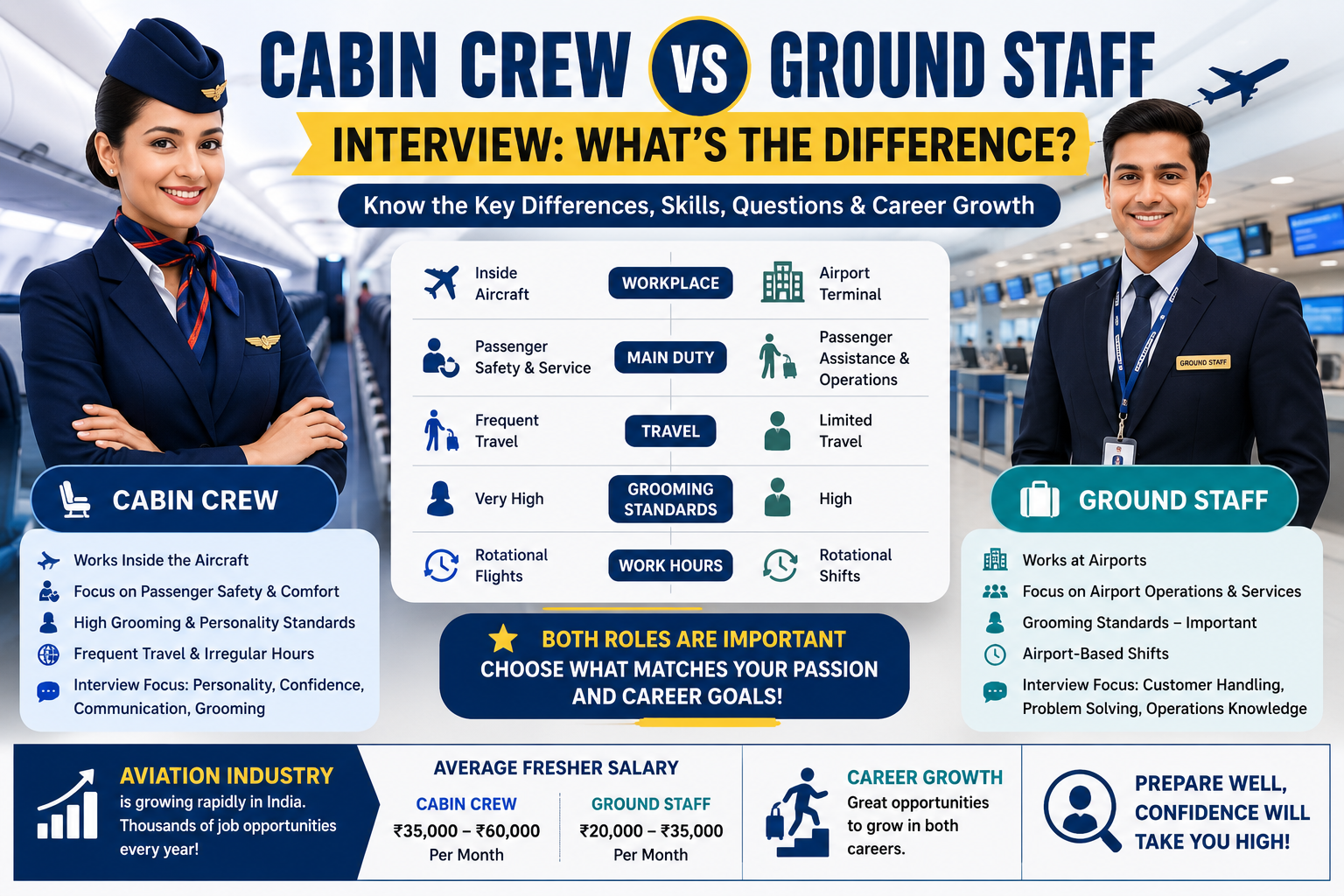
Here is a simple comparison table:
| Role | Cabin Crew | Ground Staff |
|---|---|---|
| Workplace | Inside Aircraft | Airport Terminal |
| Main Duty | Passenger Safety & Service | Airport Operations |
| Travel Requirement | Frequent Travel | Mostly Airport-Based |
| Grooming Standards | Very High | High |
| Shift Timing | Rotational Flights | Rotational Airport Shifts |
This difference directly affects interview patterns.
For example, cabin crew interviews focus heavily on:
- Personality
- Grooming
- Smile and confidence
- Communication skills
- Body language
Ground staff interviews focus more on:
- Customer handling
- Airport operations knowledge
- Problem-solving ability
- Communication skills
- Teamwork
According to the International Air Transport Association (IATA), customer experience is one of the top priorities for airlines globally.
📖 Source: IATA Official Website
This is why airlines carefully select candidates who can professionally represent the company.
Imagine this example:
A passenger becomes angry because of a delayed flight.
A cabin crew member may calm the passenger during the flight, while a ground staff employee may manage the issue at the boarding gate or check-in counter. Both roles require communication skills, but the work environment is different.
This is the first major Cabin Crew vs Ground Staff Interview Difference you should understand before applying.
2. Cabin Crew Interview Process vs Ground Staff Interview Process
Another major Cabin Crew vs Ground Staff Interview Difference is the actual interview process itself. Airlines use different selection methods depending on the role.
Cabin crew interviews are usually more personality-focused. Recruiters carefully observe your confidence, smile, posture, grooming, and communication from the moment you enter the room.
A typical cabin crew interview process may include:
- Introduction round
- Grooming assessment
- Group discussion
- Personal interview
- Communication test
- Medical assessment
Ground staff interviews are generally more operational and customer-service-focused. The interview process may include:
- Resume screening
- Communication round
- Customer handling questions
- Airport operations questions
- HR interview
Here is a helpful comparison chart:
| Interview Stage | Cabin Crew | Ground Staff |
|---|---|---|
| Grooming Check | Very Important | Important |
| Height Check | Often Required | Usually Not Required |
| Group Discussion | Common | Sometimes |
| Customer Handling Questions | Yes | Yes |
| Airport Operations Questions | Basic | Detailed |
One common cabin crew interview question is:
“How will you handle nervous passengers during turbulence?”
Example Answer:
“I would stay calm, reassure the passengers politely, and follow airline safety procedures.”
Ground staff interviewers may ask:
“What would you do if a passenger misses boarding?”
Example Answer:
“I would politely explain airline policies and help the passenger explore available options.”
Notice how cabin crew interviews focus more on in-flight passenger care, while ground staff interviews focus more on airport operations and customer assistance.
According to aviation recruitment reports, communication and professionalism are among the top skills airlines seek in aviation freshers.
📖 Source: LinkedIn Workplace Learning Report
This is why airlines pay close attention to how confidently you speak during interviews.
3. Grooming and Personality Standards: The Biggest Difference
One of the biggest areas in the Cabin Crew vs Ground Staff Interview Difference is grooming and personality evaluation.
Cabin crew interviews have stricter grooming standards because cabin crew members directly represent the airline inside flights. Airlines want crew members who look professional, confident, and approachable.
For cabin crew interviews:
- Hair must be neat
- Makeup should look professional
- Uniform-like formal clothing is preferred
- Skin grooming is important
- Body language is carefully observed
Ground staff interviews also require professional appearance, but the grooming standards are slightly less strict compared to cabin crew recruitment.
Here is a quick comparison:
| Grooming Factor | Cabin Crew | Ground Staff |
|---|---|---|
| Makeup Standards | High | Moderate |
| Smile & Facial Expression | Extremely Important | Important |
| Height Requirements | Common | Rare |
| Posture Evaluation | Strongly Checked | Moderately Checked |
For example, cabin crew recruiters often test how naturally you smile while speaking because airline passengers feel more comfortable with friendly staff members.
Imagine two candidates:
- One smiles confidently and maintains eye contact
- Another looks nervous and avoids interaction
Most airlines will choose the first candidate because personality plays a huge role in cabin crew selection.
Ground staff interviews focus more on calm communication and operational professionalism. Recruiters want candidates who can manage crowds, solve passenger issues, and remain polite under pressure.
According to airline customer service surveys, positive passenger interaction strongly affects airline reputation and customer loyalty.
This explains why communication, confidence, and grooming are heavily tested during aviation interviews.
4. Skills Airlines Check in Cabin Crew and Ground Staff Interviews
The next important Cabin Crew vs Ground Staff Interview Difference is the skill set airlines evaluate.
Cabin crew interviews mainly focus on:
- Passenger communication
- Emergency handling
- Confidence
- Hospitality
- Teamwork
- English fluency
Ground staff interviews focus on:
- Customer support
- Airport coordination
- Problem-solving
- Technical understanding
- Passenger management
- Time management
Here is a detailed comparison:
| Skill | Cabin Crew | Ground Staff |
|---|---|---|
| Hospitality Skills | Very High | Medium |
| Operational Knowledge | Medium | High |
| Passenger Safety | High | Medium |
| Crowd Management | Medium | High |
| Communication | Very High | Very High |
For example, cabin crew members may handle in-flight emergencies, while ground staff employees may manage long check-in queues during airport rush hours.
Recruiters may ask cabin crew candidates:
“Why do you want to become cabin crew?”
Strong Answer:
“I enjoy helping people, traveling, and working in professional environments where customer service is important.”
Ground staff candidates may hear:
“How would you handle multiple passengers during delays?”
Strong Answer:
“I would stay calm, provide accurate information, and assist passengers politely while following airport procedures.”
According to Airports Council International, passenger experience management is becoming one of the biggest priorities for airports worldwide.
📖 Source: Airports Council International
This means aviation companies need employees who can communicate professionally under pressure.
5. Salary, Career Growth, and Future Opportunities
The final major Cabin Crew vs Ground Staff Interview Difference relates to salaries, career growth, and long-term opportunities.
Cabin crew jobs often provide higher starting salaries because the role involves travel, passenger safety, and international operations. However, the work can also be physically demanding due to irregular schedules and frequent flying.
Ground staff jobs offer stable airport-based careers with opportunities to move into airport operations management, customer service leadership, and airline administration.
Here is a salary comparison table for India:
| Role | Fresher Salary |
|---|---|
| Cabin Crew | ₹35,000 – ₹60,000/month |
| Ground Staff | ₹20,000 – ₹35,000/month |
Career growth also differs.
Cabin crew professionals may grow into:
- Senior Cabin Crew
- Cabin Supervisor
- In-flight Manager
Ground staff professionals may become:
- Airport Operations Executive
- Customer Service Manager
- Airport Duty Manager
According to Airbus market forecasts, India’s aviation sector will require thousands of additional aviation professionals over the next two decades.
📖 Source: Airbus Global Market Forecast
This means both cabin crew and ground staff careers have strong future demand.
The best choice depends on your personality. If you enjoy travel, grooming, and passenger interaction inside flights, cabin crew may suit you better. If you prefer airport operations, customer support, and stable airport-based work, ground staff may be a smarter option.
Conclusion
Now you clearly understand the Cabin Crew vs Ground Staff Interview Difference and how airlines evaluate candidates differently for both roles. Cabin crew interviews focus more on personality, grooming, communication, and passenger service inside aircraft. Ground staff interviews focus more on airport operations, customer handling, teamwork, and problem-solving abilities.
Both careers offer exciting opportunities in the rapidly growing aviation industry. The key is choosing the role that matches your skills, personality, and long-term career goals.
If you prepare properly, practice interview questions regularly, improve communication skills, and maintain professional grooming, you can successfully crack aviation interviews as a fresher.
You can also continue learning through related topics like aviation management courses, airport ground staff careers, airline customer service training, and cabin crew interview preparation to improve your aviation career knowledge further.