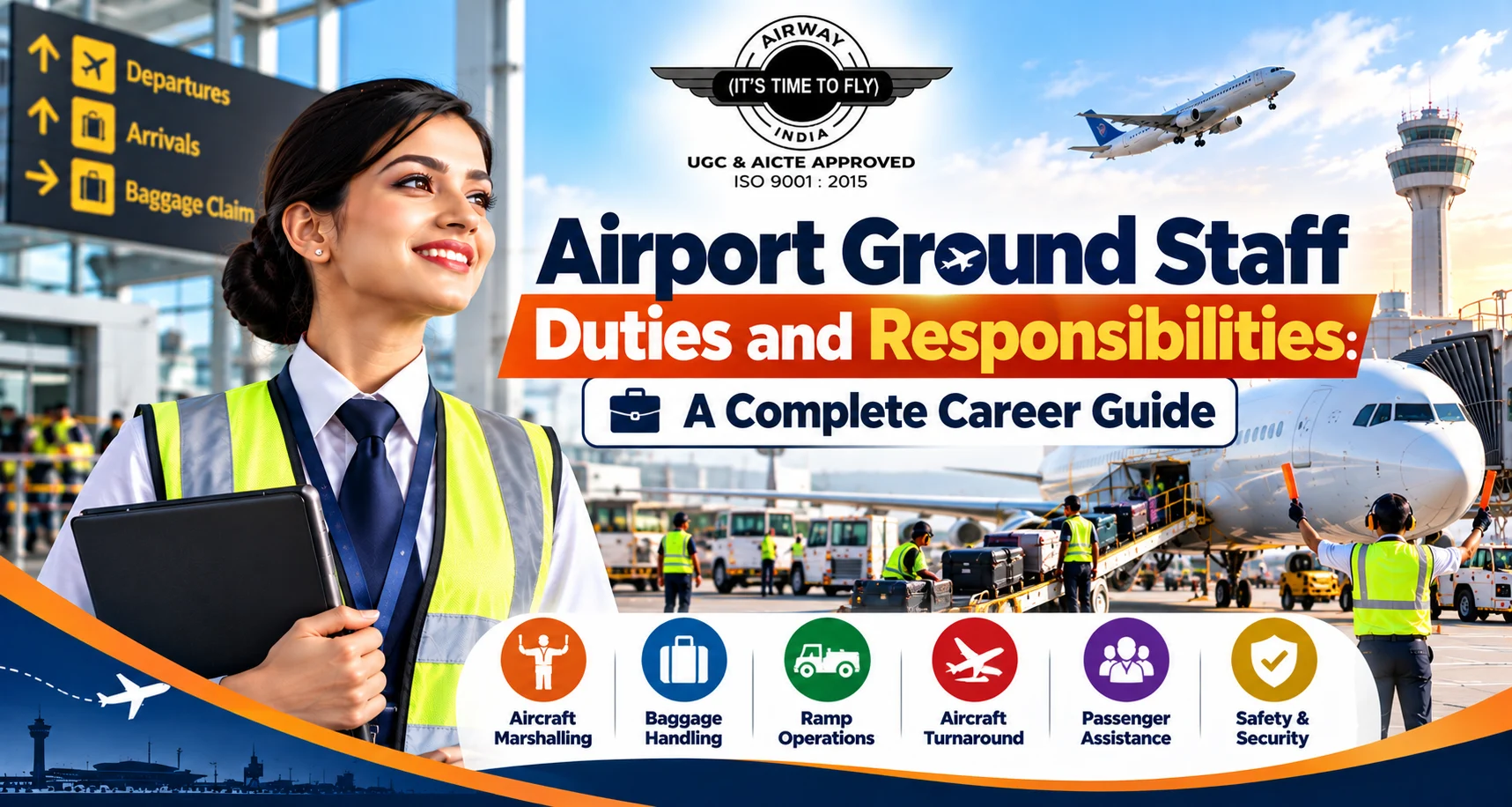
When passengers arrive at an airport, they interact with many professionals before they reach the aircraft. Check-in teams, boarding staff, baggage personnel, ramp agents, customer-service executives and operations coordinators all contribute to the journey. Together, these roles form an important part of airport ground staff operations.
The job is much broader than checking boarding passes or helping passengers find a gate. Ground staff may work with airline systems, baggage processes, aircraft turnaround activities, operational documentation and other airport stakeholders. Because aviation operates in a tightly coordinated environment, accuracy, communication and safety are essential.
For students considering an aviation career, understanding ground staff duties can help identify the role that fits their interests and prepare for interviews or professional training.
1. What Does Airport Ground Staff Mean?
Airport ground staff are employees or contracted personnel who support airline and airport operations while aircraft are on the ground. The exact job description differs by airline, airport and department. Some employees primarily interact with passengers in the terminal, while others work on the ramp, in baggage handling, at cargo facilities or in operational control functions.
The broader purpose of the role is to help ensure that an aircraft, its passengers, baggage and operational information are ready for safe and efficient movement. IATA identifies safe, secure and on-time ground handling turnarounds as critical deliverables for airlines and ground handling service providers.
Related keywords: airport ground staff duties, ground staff responsibilities, airport customer service, ramp agent responsibilities
- Passenger handling and customer service
- Check-in and boarding assistance
- Baggage and transfer coordination
- Ramp and turnaround support
- Documentation and operational communication
- Safety and security compliance
A ground staff professional may also need to coordinate with cabin crew, pilots, security teams, airport authorities, maintenance personnel, baggage teams and ground handling supervisors. This makes the position highly collaborative.
2. Key Airport Ground Staff Duties
One of the most visible responsibilities is passenger service. Depending on the assigned department, staff may assist passengers during check-in, document checks, seat or boarding processes, gate changes, transfers, arrivals and special-service requests. The objective is to provide accurate information while following airline and airport procedures.
Check-in staff may verify travel documents and passenger details, issue boarding passes where applicable, handle baggage acceptance and communicate important travel information. They must also be able to deal professionally with queues, delays and passenger questions.
At the gate, staff coordinate boarding. This can involve making announcements, checking boarding eligibility, organizing priority or special-assistance groups, monitoring passenger flow and communicating updates to the operations team. Efficient boarding matters because passenger movement is directly connected to the aircraft turnaround.
Baggage-related responsibilities can include accepting checked baggage, tagging bags, identifying exceptions, coordinating with baggage operations and helping trace or resolve mishandled baggage cases. The exact duties depend on whether the employee is part of passenger services, baggage services or another airport function.
Ground staff working near the aircraft may support ramp operations. Ramp-focused roles can include aircraft stand coordination, baggage and cargo loading support, equipment coordination, aircraft servicing activities and communication with the turnaround team. These jobs generally require strong awareness of airside hazards and strict adherence to procedures.
Typical responsibilities can include:
- Assisting with check-in and passenger processing
- Supporting boarding and gate activities
- Handling passenger queries and service issues
- Coordinating baggage acceptance, loading or tracing processes
- Supporting aircraft turnaround activities
- Communicating operational information to relevant teams
- Following airport, airline and safety procedures
3. Safety, Security and Communication Responsibilities
Safety is one of the most important elements of ground staff responsibilities. Airport operations involve aircraft, vehicles, equipment, passengers and employees operating in close proximity. A small communication failure or procedural deviation can create a significant operational problem.
IATA identifies three broad ground safety performance areas: injuries and occupational health and safety, aircraft ground damage, and load/loading errors. This helps explain why ground staff training includes more than customer service. Employees may need to understand safe movement around aircraft, equipment awareness, emergency processes, reporting procedures and the importance of accurate communication.
For ramp employees, awareness of engine intake, jet blast, propeller areas and moving Ground Support Equipment is particularly important. For terminal-facing staff, safety and security responsibilities may include following access controls, escalation procedures, passenger-handling policies and established airport rules.
Communication is another core competency. A ground employee may need to pass information between passengers and airline operations, between the gate and ramp team, or between baggage and customer-service teams. The information has to be timely and accurate.
Strong ground staff generally demonstrate:
- Clear verbal and written communication
- Situational awareness
- Ability to follow standard operating procedures
- Calm handling of operational disruptions
- Teamwork across multiple departments
- Attention to detail in documents and systems
4. Daily Workflow: From Check-In to Aircraft Departure
The daily routine of airport ground staff varies by department and shift, but many roles follow a predictable operational cycle. Staff may begin with a briefing covering flight schedules, expected passenger loads, operational alerts, special handling requirements and current airport conditions.
During passenger processing, the team handles check-in, baggage acceptance and customer queries. Before departure, gate staff monitor boarding readiness, coordinate passenger movement and communicate operational updates. At the same time, ramp and turnaround teams may be working on baggage unloading, cleaning, catering, loading and other aircraft services.
The aircraft turnaround is effectively a coordinated project with a tight deadline. IATA guidance on turnaround coordination emphasizes managing resources and processes together and maintaining safety and punctuality during loading and departure preparation.
A simplified workflow looks like this:
- Shift briefing and flight readiness review
- Passenger check-in and baggage acceptance
- Gate preparation and passenger assistance
- Aircraft arrival and ground safety procedures
- Passenger disembarkation and baggage unloading
- Aircraft servicing and preparation
- Baggage, cargo and passenger boarding processes
- Final reconciliation and departure coordination
- Pushback and completion of ground activities
During delays or irregular operations, the normal workflow can change quickly. Weather, technical issues, late inbound aircraft, baggage problems, airspace disruption or airport congestion can affect the schedule. Ground staff must follow escalation procedures and keep passengers and operational teams informed without providing inaccurate information.
5. Skills, Qualifications and Career Growth
There is no single educational route for every airport ground role. Employers may specify different combinations of education, communication ability, computer knowledge, language skills, customer-service experience, physical requirements and aviation training. Some entry-level roles are accessible to candidates with general qualifications and job-specific training, while specialized operational positions may require additional knowledge or certifications.
Students interested in airport ground staff jobs can strengthen their profile by studying aviation operations, airport management, airline processes, customer service and aviation safety. Familiarity with airport terminology and basic computer applications is also useful because modern ground operations rely heavily on digital systems.
IATA’s ground-operations standards emphasize training and competency, and its IGOM standardizes procedures for areas such as passenger handling, baggage handling, aircraft servicing, turnaround, load control and airside safety oversight. For this reason, professional training should not be treated as a formality; it can help candidates understand the operational environment before entering a busy airport workplace.
Career progression can vary, but a typical pathway may move from an entry-level service or handling role toward senior executive, team leader, supervisor, station operations or specialist functions. Experience can also support movement into areas such as load control, safety, quality, training, cargo operations or airport management.
People preparing for interviews should be ready to discuss customer-service situations, teamwork, shift work, handling pressure, safety awareness and examples that demonstrate accuracy and responsibility.
Conclusion
Airport ground staff are essential to the daily movement of passengers and aircraft. Their responsibilities can range from check-in and boarding to baggage, ramp coordination, documentation and operational communication. The exact duties depend on the department, but the common expectations remain strong: follow procedures, communicate clearly, protect safety and support an efficient turnaround.
For aviation students and freshers, ground operations can be a practical entry point into the wider airline and airport industry. Building customer-service ability alongside operational knowledge, digital skills and safety awareness can help candidates prepare for a variety of roles and create a foundation for future career growth.
Frequently Asked Questions
1. What are the main airport ground staff duties?
Main duties can include passenger handling, check-in support, boarding, baggage coordination, customer service, ramp support, documentation and communication with airline and airport teams.
2. Do airport ground staff work inside the terminal or outside?
Both are possible. Passenger-service employees commonly work in terminals and gates, while ramp, baggage, cargo and turnaround employees may work in airside operational areas.
3. What skills are important for ground staff?
Communication, teamwork, customer service, attention to detail, computer ability, situational awareness, punctuality and a strong understanding of safety procedures are important for many ground roles.
4. Can freshers apply for airport ground staff jobs?
Many employers recruit entry-level candidates for ground-service positions, but eligibility criteria vary by employer and role. Candidates should check the specific education, age, language, shift and training requirements in each job advertisement.
5. What can airport ground staff become after gaining experience?
Depending on experience and qualifications, professionals may progress into senior executive, team leader, supervisor, station operations, load control, cargo, safety, quality or training-related positions.
Data and standards note: The article draws on IATA ground-operations standards and guidance. Individual airport and airline procedures may differ because of aircraft type, local regulations, security requirements and employer-specific operating procedures.