
Aviation Course After 10th in Kolkata: The Honest Guide
- Can You Really Start Aviation After 10th? The Honest Answer
- What You CAN Genuinely Do After 10th
- What Still Needs 12th (No Way Around This)
- The Smart Move: Foundation Course + NIOS in Parallel
- Your Timeline: Age 15 to Your First Aviation Job
- Choosing Your 11th–12th Stream for Aviation
- Red Flags: What to Avoid at This Stage
- How Airway India Prepares You — Starting Now, Not Later
- Frequently Asked Questions
Can You Really Start Aviation After 10th? The Honest Answer
Short version: not into an airline job, yes into real preparation. Cabin crew, airline-employed ground staff, and most Airports Authority of India (AAI) roles all require a completed 10+2 — this is consistent across every airline and government aviation employer researched, not a policy that varies by institute or negotiation. IndiGo, Air India, Akasa, SpiceJet, and international carriers like Emirates and Qatar Airways all publish the same baseline requirement on their own official careers pages.
What varies is how honestly this gets communicated. Some aviation training content blurs "begin your aviation journey after 10th" with "get an aviation job after 10th" — they are not the same claim, and a 15 or 16-year-old reading this deserves the distinction stated plainly, not implied away through hopeful marketing language. If a course description or counsellor tells you differently for a cabin crew or ground staff role specifically, that claim doesn't match what the airlines themselves publish.
What You CAN Genuinely Do After 10th
Real, specific options exist — they're foundational, not job-ready credentials, and that's fine as a starting point.
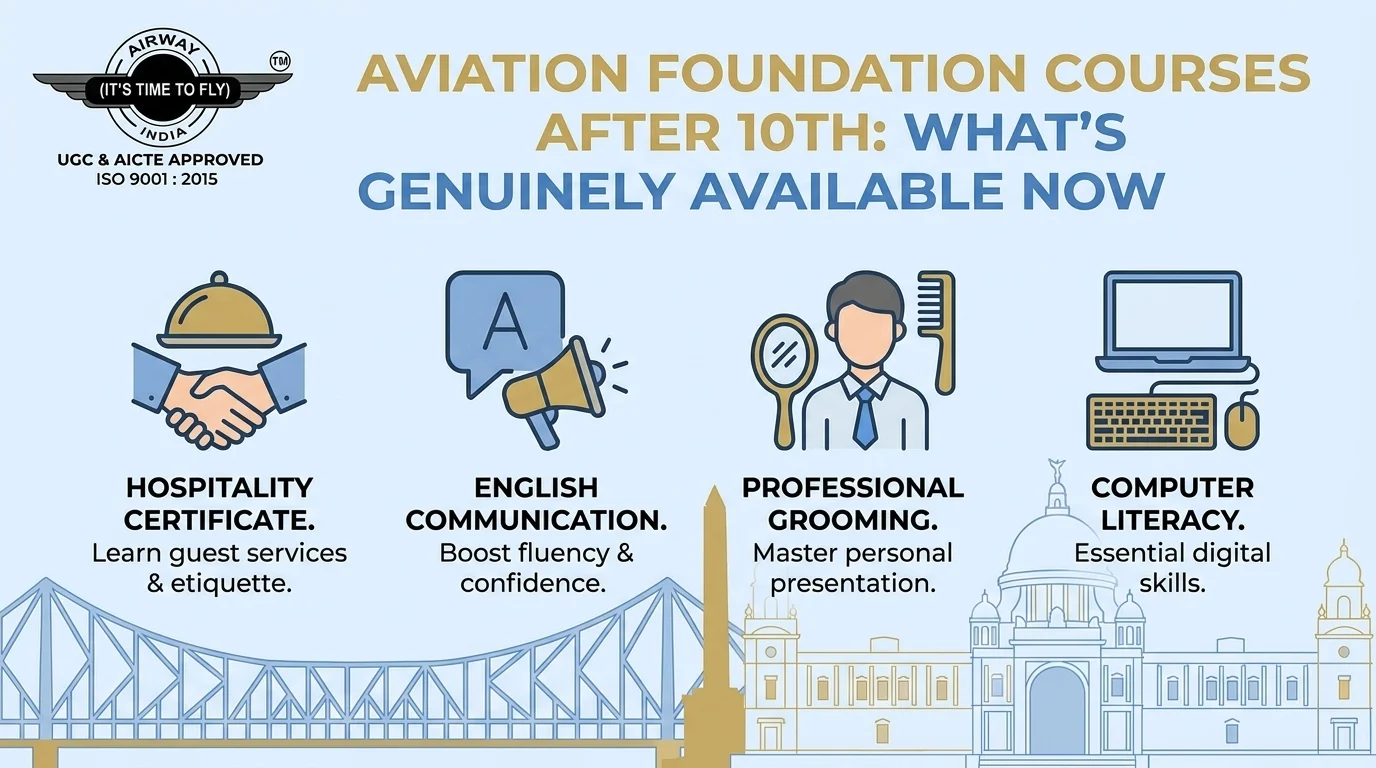
- Hospitality and travel-tourism foundation certificates (6 months to 2 years) — covering customer service basics, ticketing and reservations fundamentals, and airport-operations awareness, typically run by vocational institutes or aviation academies rather than the airlines themselves.
- English communication courses — spoken fluency is the single most-tested skill at every airline interview stage across this entire industry, and starting at 15–16 gives genuinely more runway to build real, unforced fluency than starting at 18 under interview pressure.
- Grooming and personality development modules — posture, presentation, and interview confidence, the same fundamentals every airline assessment day evaluates later, whether it's a walk-in interview or a scheduled Open Day.
- Basic computer literacy — MS Office, email etiquette, and general digital fluency, since airline systems for check-in, ticketing, and internal communication assume this baseline and rarely teach it from scratch.
None of these alone gets you hired. Together, completed early, they mean you walk into your first real cabin crew or ground staff interview at 18 already fluent, groomed, and confident — rather than starting that preparation from zero at the exact moment you're also nervous about the interview itself.
What Still Needs 12th (No Way Around This)
Stated flatly, because families researching this deserve a direct answer rather than a hedge:
- Cabin crew / air hostess roles at every airline researched (e.g., IndiGo, Air India) — 10+2 pass is the universal minimum.
- Airline-employed ground staff — same baseline requirement.
- AAI (government) roles, including most non-executive postings.
- Pilot training (CPL) — requires 12th with Physics and Mathematics; some flying schools allow 10th-pass students to begin ground school groundwork, but licensed commercial flying training itself needs completed 12th.
- Aircraft Maintenance Engineering (AME) — same PCM-at-12th requirement as pilot training (as per DGCA guidelines).
If any institute or advisor tells you otherwise for these specific roles, that claim doesn't match what every airline's own published air hostess eligibility criteria says. *(To learn more about the next steps, read our guide on how to become cabin crew after 12th).*
The Smart Move: Foundation Course + NIOS in Parallel
The genuinely useful strategy here — and the one most guides skip entirely — is running two tracks at once rather than treating 12th as a two-year pause before "real" aviation preparation starts.
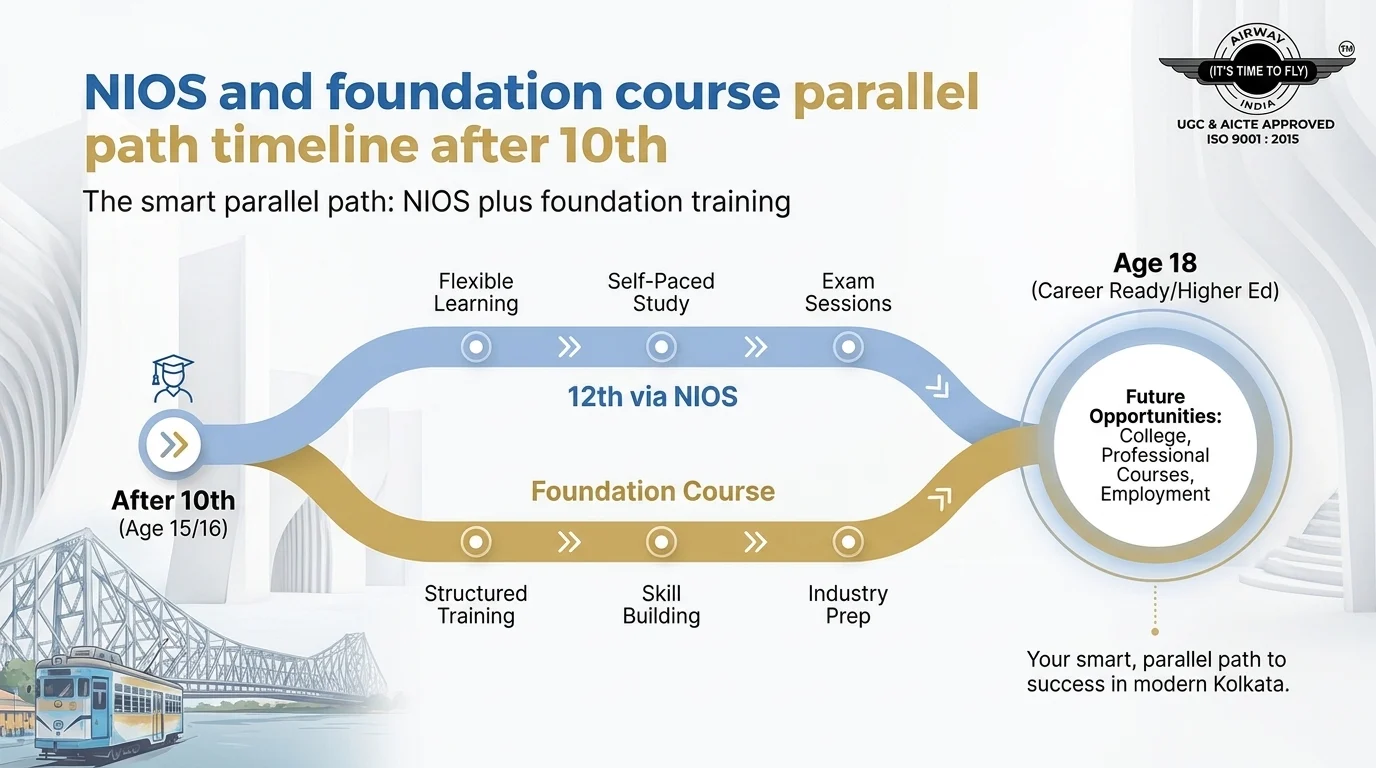
NIOS (National Institute of Open Schooling) lets you complete your 12th on a flexible schedule, accepted by every major airline exactly the same as a regular board 12th certificate — this isn't a lesser or informal qualification, it's a government-recognized open-schooling body with the same standing as any state or central board for employment eligibility purposes. That flexibility means you can complete a foundation aviation/hospitality certificate and your 12th in roughly the same window, rather than sequentially waiting for one to finish before starting the other.
Practically: enroll in a foundation course immediately after 10th, register for 12th through NIOS or continue with your regular board if that's working for you, and treat both as running in parallel rather than one blocking the other. By 18, you're not just 12th-pass — you're 12th-pass with two years of communication, grooming, and hospitality-fundamentals training already behind you, which is a genuinely different starting position than a candidate who only started thinking about aviation after finishing 12th.
Your Timeline: Age 15 to Your First Aviation Job
- Age 15–16 (just after 10th): Start a hospitality/travel foundation course. Begin English communication classes immediately — this is the highest-leverage early investment you can make, since fluency built over two unhurried years tends to hold up far better under interview pressure than fluency crammed in the months before you turn 18.
- Age 16–18 (during 11th–12th): Complete 12th through your board or NIOS. Continue grooming and personality-development training in parallel, not after — treat these two years as active preparation time, not a waiting period.
- Age 18 (12th complete): Now eligible for actual cabin crew and ground staff applications. Apply to the full range of airlines covered by age-18 minimums, or enroll in a dedicated Diploma in Cabin Crew or Ground Staff program for structured, interview-focused preparation building directly on your foundation-course years.
- Age 18–21: Typical window for first placement, given most airlines' 18–27/28/30 age ranges leave ample room — there's no penalty for taking a year or two to find the right fit rather than rushing the first offer.
Starting at 15–16 doesn't shorten the wait for eligibility — nothing does, and no course or institute can change an airline's published age minimum — but it means the 18-year-old version of you walks into that first real interview dramatically better prepared than one who starts from zero on their 18th birthday.
Choosing Your 11th–12th Stream for Aviation
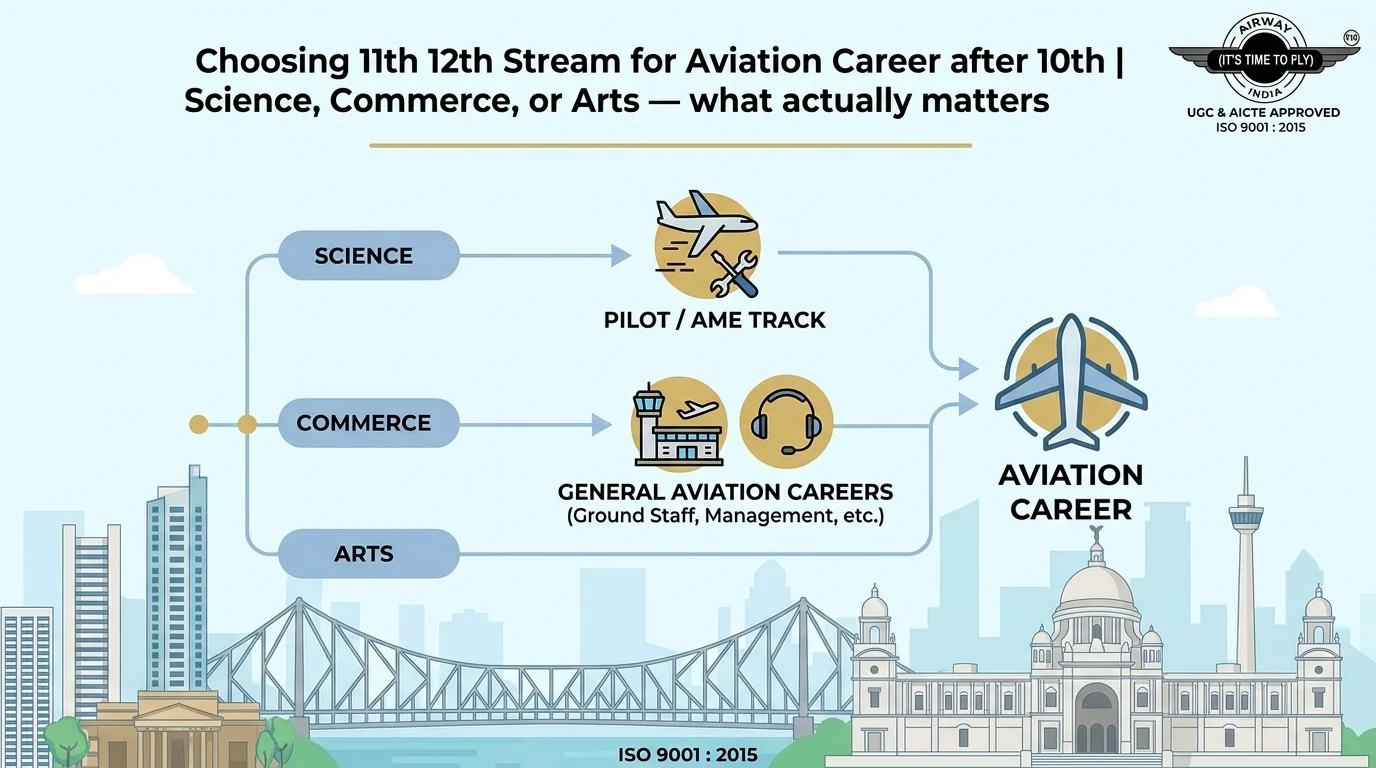
Honest answer: for cabin crew, ground staff, and airport management roles, stream genuinely doesn't matter. Every airline researched accepts 10+2 from any stream — Science, Commerce, or Arts — with no evidence any of them weight one stream above another in selection.
The one place stream matters is pilot training and Aircraft Maintenance Engineering, both of which require Physics and Mathematics at 12th. If there's any chance you'll want the technical/flying track later, keep that option open by choosing Science now — closing it off at 15 by picking Commerce or Arts is a harder mistake to undo later than staying flexible for two more years costs you now. If you're confident cabin crew, ground staff, or airport management is the goal specifically, any stream genuinely works and there's no reason to force Science for its own sake.
Red Flags: What to Avoid at This Stage
- "Guaranteed airline job after 10th" — no legitimate airline hires cabin crew or ground staff before 12th; treat this specific claim as a hard red flag regardless of which institute makes it, no matter how confidently it's presented.
- Paying premium fees for a "10th-pass cabin crew course" — a foundation/hospitality certificate is legitimate and useful; a course marketed as if it directly produces a cabin crew job at this stage is not accurately describing what it delivers, and the fee should reflect a foundation course, not a placement guarantee.
- Skipping English and grooming prep to "wait until 12th" — this is the one genuinely wasted opportunity in this whole timeline, since these specific skills benefit the most from an early, unhurried start rather than being crammed in later.
- Any request for money to "reserve" a future cabin crew interview slot — no airline or legitimate institute takes payment to guarantee a future interview years in advance; this pattern shows up in scams targeting exactly this age group and their parents.
How Airway India Prepares You — Starting Now, Not Later
Airway India's core Diploma in Cabin Crew Program and Ground Staff programs require completed 12th, matching every airline's actual eligibility criteria — this page won't tell you otherwise just to encourage an earlier enrollment. What starting early with Airway India genuinely means: building the English fluency, grooming, and interview-readiness foundation now, so enrollment in the full diploma program the moment you complete 12th (via any board or NIOS) starts from a stronger position, not from zero.
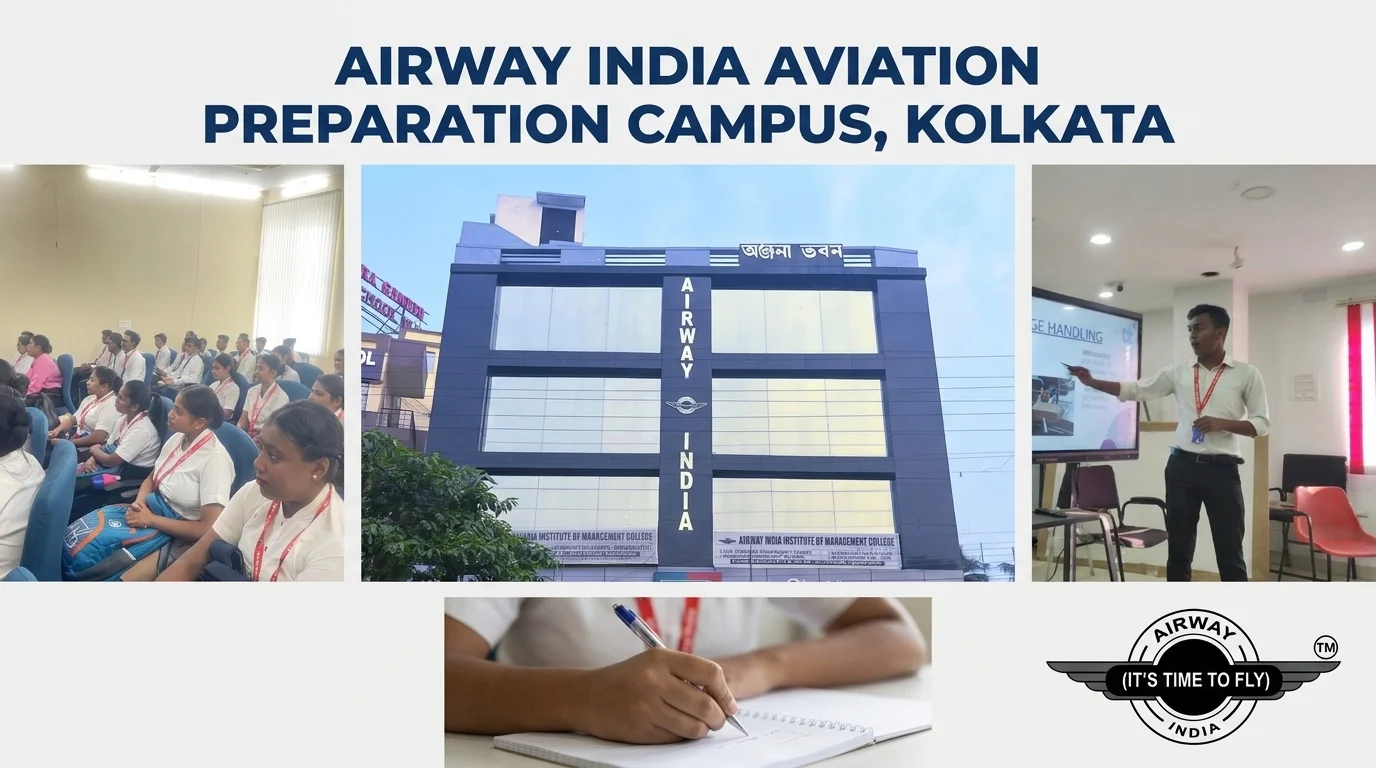
Based in Barasat, Kolkata and ISO 9001:2015 accredited, Airway India works with families planning this exact multi-year path — not just students who've already finished 12th and are ready to enroll immediately.
Frequently Asked Questions
No. Every major airline requires completed 10+2 for cabin crew roles — this is universal, not institute-specific.
Hospitality and travel-tourism foundation certificates, English communication courses, and grooming/personality-development modules — real preparation, not a job-ready credential on their own.
Yes. Airlines treat NIOS 12th certification the same as any recognized board for eligibility purposes.
Not for cabin crew, ground staff, or airport management — any stream is accepted. It matters only for pilot training and Aircraft Maintenance Engineering, which require Physics and Mathematics.
Not directly — commercial pilot licensing requires completed 12th with Physics and Mathematics. Some flying schools allow 10th-pass students to begin ground school groundwork only.
Most training institutes accept students from around 16; actual airline hiring for cabin crew starts at 18.
Yes — English fluency and grooming are the two skills that benefit most from an early start, and completing them alongside 12th means you're genuinely ahead, not just older, by the time you're eligible to apply.
This varies by institute and isn't something this page can confirm generally — ask directly when enquiring about a specific foundation course.
No — waiting means starting English and grooming training from zero at 18, alongside candidates who began at 15–16. The eligibility wait is fixed either way; the preparation head start isn't.