
Introduction
Airports are among the most important components of India’s aviation infrastructure. They connect cities, support tourism and trade, create employment and help businesses reach domestic and international markets. As India’s aviation sector expands, the way airports are owned, managed and developed has become an increasingly important topic for passengers, students and aviation professionals.
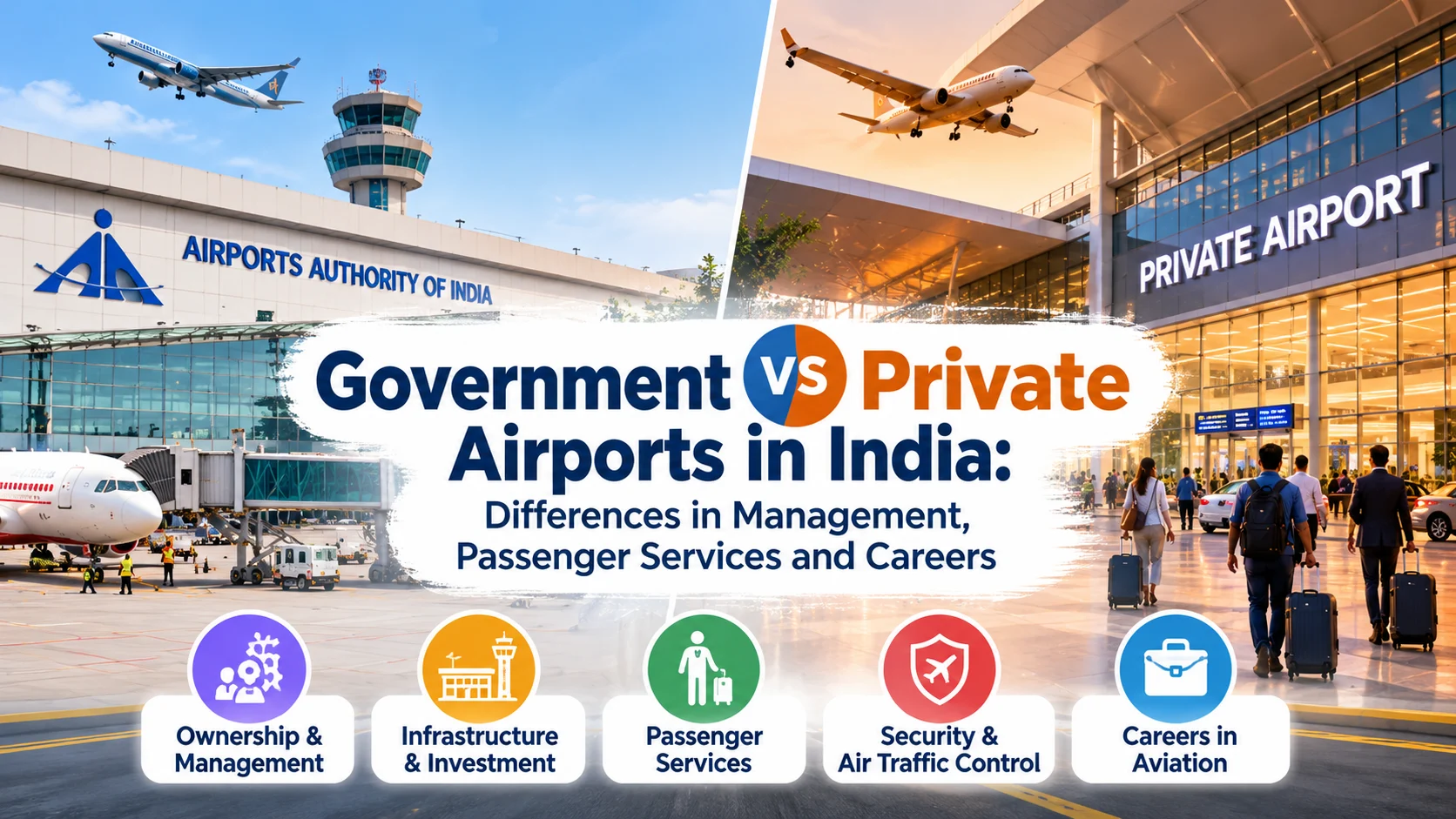
One common question is: what is the difference between government and private airports in India? The answer is more complex than simply comparing public and private ownership. Some airports are owned and operated by the Airports Authority of India (AAI), while others are privately owned or developed through joint ventures. Several airports originally operated by AAI have also been leased to private concessionaires under a public-private partnership (PPP) model.
These arrangements can influence infrastructure investment, commercial services, management practices and career opportunities. However, airport security and air traffic control are governed by separate regulatory and operational responsibilities, so private management does not mean that every airport function is controlled by a private company.
The distinction has become particularly relevant amid discussions about airport privatisation in India, including reports that Kolkata Airport could be considered for a future PPP arrangement. Understanding the differences between government and private airports helps passengers make sense of the debate and helps aspiring professionals understand the wider airport management careers landscape.
1. Who Owns and Operates Government and Private Airports in India?
The first step in understanding government vs private airports in India is to distinguish between ownership, development and day-to-day operations. These are related but separate functions, and one airport can involve both public and private organisations.
Government-operated airports are commonly managed by the Airports Authority of India, a statutory organisation under the Ministry of Civil Aviation. The AAI manages airports and associated facilities, provides air navigation services and undertakes airport infrastructure development. It also supports the operation and development of regional airports across the country.
Privately managed airports may be owned or developed by private companies, or operated through joint ventures and concession agreements. For example, Delhi and Mumbai have private-sector-led airport operating arrangements, while Bengaluru and Hyderabad airports were developed through private participation. These arrangements demonstrate that privately managed airports in India can operate within a framework that continues to involve government agencies and aviation regulators.
Public Private Partnership
It is important not to treat every airport as belonging to one of two simple categories. An airport may be publicly owned but privately operated under a lease or concession. Another may be developed by a private company under a government-approved arrangement. The applicable agreement determines the operator’s rights and responsibilities.
| Factor | Government-operated airport | Privately managed or PPP airport |
|---|---|---|
| Ownership | Often public-sector ownership | May be private, joint venture or public ownership with private operation |
| Day-to-day management | AAI or another public authority | Private concessionaire or joint-venture company |
| Infrastructure investment | Public funding and AAI resources, depending on the project | Private investment, public investment or a contractual combination |
| Commercial services | Managed under public-sector policies and contracts | Often commercially managed under the concession agreement |
| Regulation | Subject to aviation laws and regulators | Subject to the same applicable aviation laws and regulators |
| Employment | Public-sector and contractor roles, depending on the position | Private-company, contractor and service-provider roles |
The table describes broad tendencies, not universal rules. For instance, a government airport can have privately operated retail outlets, ground-handling services and maintenance contracts. Likewise, a private airport operator cannot independently set aside national aviation regulations.
For students researching airport management in India, this distinction is useful because the organisation operating an airport may not be the only employer at that location. Airlines, ground handlers, cargo companies, security providers, retailers and maintenance contractors can all recruit airport personnel.
2. How Does the PPP Model Work in Indian Aviation?
A public-private partnership, or PPP, is a contractual arrangement through which a public authority and a private-sector organisation share defined responsibilities for developing, operating or maintaining infrastructure. In the airport sector, PPP arrangements can help bring private investment and operational expertise into airport projects while retaining public oversight.
The Ministry of Civil Aviation’s Airport Development Section handles policy matters relating to PPPs, including proposals to lease AAI airports for operation, management and development. The process involves formal appraisal and approval rather than an automatic transfer from government to private ownership.