
MBA Aviation Management Specializations Explained: Which Track Fits Your Career Goal
If you only read one paragraph: Indian aviation-MBA programs generally cluster around four recurring specializations — Airport Operations/Management, Airline Operations/Management, Aviation Safety & Security, and increasingly Cargo/Logistics. But naming varies a lot by institute, and we checked five different sources this pass — no two of them list the exact same set. Airport Operations and Cargo/Logistics currently have the strongest job growth, tied to India's airport expansion and e-commerce-driven air freight. Aviation Safety is the smallest specialization by numbers but leads to the most senior compliance roles. Before you compare institutes by specialization name alone, check the actual syllabus on the institute's own page — some course directories reuse identical template text across dozens of unrelated institutions, regardless of what those institutions actually teach.
Why the Specialization Names Don't Match Up
We checked five sources that Indian students actually find when researching this — a real institute program (UPES Dehradun), a large course directory (UniversityKart), a distance-education listing (IMTS, on Mangalayatan University's own affiliation), a guide site (EduProspect), and the top global result for aviation-MBA comparisons (research.com). None of them list the same specialization set.
That's not a small wording difference. Airport Management, Airline Operations, and Safety & Security show up almost everywhere. Cargo/Logistics, Customer Relationship Management, Global Business, and Aviation Marketing show up inconsistently, sometimes as a full specialization and sometimes as a single elective. Nobody we checked admits this openly — most present their own list as if it were the standard one, which leaves a student comparing two institutes with no reliable way to tell whether they're actually looking at the same choice twice or two genuinely different programs.
The Four Specializations That Actually Recur
Across all five sources, here's what genuinely repeats, and what each one is actually about.
| Specialization | What it covers | Where it recurs |
|---|---|---|
| Airport Operations / Management | Terminal operations, ground handling, airport planning, passenger services | UPES, UniversityKart, IMTS, EduProspect, research.com — all five |
| Airline Operations / Management | Flight scheduling, revenue management, airline marketing, fleet planning | UPES, UniversityKart, IMTS, EduProspect, research.com — all five |
| Aviation Safety & Security | Regulatory compliance, safety audits, accident investigation, security protocols | UPES, UniversityKart, IMTS, EduProspect, research.com — all five |
| Cargo / Logistics | Air freight, supply chain, customs coordination | UniversityKart (elective), EduProspect (named track); underrepresented elsewhere relative to real industry growth |
Two other names show up but don't recur consistently enough to call them a real fourth or fifth category: Customer Relationship Management (IMTS only) and Aviation Marketing (UniversityKart, as an elective, not a full track). Treat these as electives layered onto the four core areas above, not separate specializations in their own right.
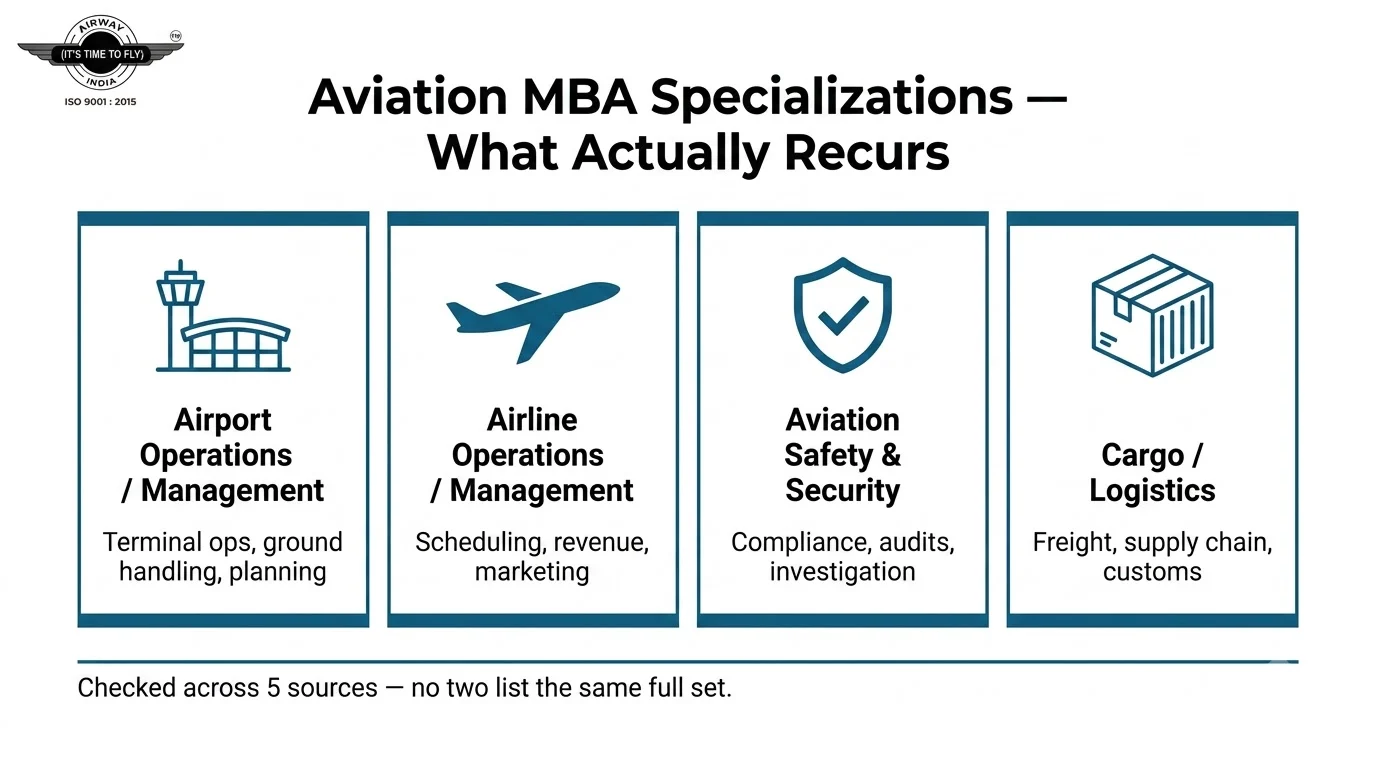
What five different sources say about aviation MBA specializations — and where they disagree
A Real Example of Why "Just Trust the Directory" Doesn't Work
We wanted a concrete example before telling you to "verify independently," so we checked one directly. UniversityKart runs a "MBA (Airport Management) Course at [University]" page for individual institutions. We compared its pages for IIM Ahmedabad, IIM Calcutta, and IIM Bangalore word for word.
All three use the identical sentence: "This specialized program is designed to provide you with the comprehensive knowledge and skills necessary to excel in managing airports and related aviation infrastructure." Only the institution name and city change. All three pages carry the same February 2024 metadata date, with nothing refreshed since.
We're not claiming the IIMs don't offer this — we haven't checked their own admissions pages directly, and this brief doesn't extend that far. What we can say directly, because we checked it ourselves: this specific directory is generating pages from a template, not from a verified course catalogue. If a directory lists a specialization at an institute, that's a starting point for research, not confirmation. Go to the institute's own page next.
What Airway India Actually Teaches
Here's where we should be equally honest about our own program. Unlike UPES, which runs separate named tracks (Airline Service Operations and Aviation Enterprise Management are two we verified directly, each with its own dedicated page), Airway India's MBA in Aviation Management doesn't split students into chosen specialization tracks. It's one integrated syllabus that covers all four recurring areas above within the same curriculum.
Core subjects include Airline & Airport Management, Airline Operations & Scheduling, and Airline Finance. Specialized subjects add Aviation Law and Aviation Safety Management & Accident Investigation. If you want airport, airline, and safety exposure in one program rather than picking a single track upfront, that's the honest way to describe what we offer — not a claim to specializations we don't structure as separate choosable tracks.
One more honest note: Mangalayatan University, our affiliating university, also affiliates a separate distance-education MBA run through IMTS Institute, which does list four named specializations (Airport Operations, Airline Management, Aviation Safety, and Customer Relationship Management). That's a different implementing institute and delivery mode from our own campus-based program — shared university affiliation doesn't mean identical curriculum, and we'd rather flag that distinction than let it look like an inconsistency.
Skills You'll Build, by Specialization
Airport Operations: regulatory knowledge, capacity planning, ground-handling coordination, passenger-experience management.
Airline Operations: scheduling and revenue management, route planning, airline marketing, fleet-utilization analysis.
Aviation Safety: compliance auditing, incident investigation, risk assessment, regulatory documentation.
Cargo/Logistics: supply-chain coordination, customs and documentation, freight pricing, warehouse and handling operations.
Career Paths and Recruiters, by Specialization
UPES's own disclosed data is the most specific, genuinely verified recruiter information across every source we checked this pass: GMR Group, Adani Group, Vistara Airlines, Spice Express, Accenture, Kuehne Nagel, Tata Airlines, and IndiGo Airlines all recruit from its aviation-MBA program, across roles spanning airline revenue analyst, airport operations manager, aviation sales and marketing, air cargo operations, and business analyst positions. We're citing this as UPES's own data, not a universal industry figure — no other source we checked names recruiters this specifically.
Roughly by specialization: Airport Operations leads to airport manager, ground operations supervisor, and airport business development roles — the largest single category by role count, tied to India's ongoing airport expansion. Airline Operations leads to airline operations manager, revenue analyst, and network planning roles, mostly with the airlines themselves rather than airport operators. Aviation Safety leads to safety officer, compliance manager, and quality assurance roles — fewer openings overall, but consistently senior ones. Cargo/Logistics leads to cargo manager, supply chain coordinator, and freight operations roles, increasingly with express logistics firms and e-commerce-linked freight operators rather than airlines directly.
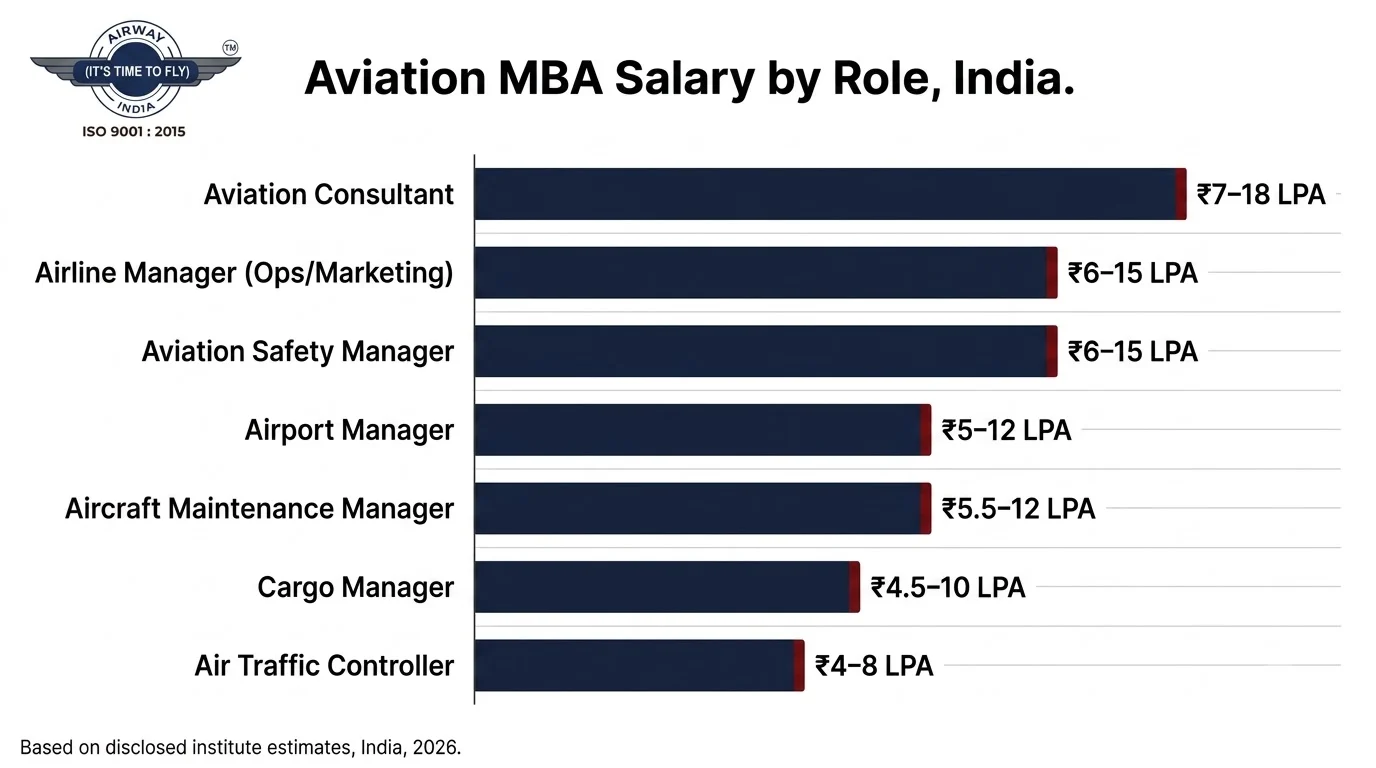
Real role-wise salary ranges by aviation MBA specialization area
Which Specialization Pays the Most in India?
Directories tend to give one blended number across every specialization, which hides more than it shows. UniversityKart's own Airport Management hub cites ₹4.5–6 LPA; its separate Aviation Management hub cites a different figure, ₹4–7 LPA — two pages on the same site, two different blended numbers, neither split by track.
Here's a role-level breakdown instead, based on our own disclosed estimates at Airway India:
| Role (by specialization area) | Typical salary range (India) |
|---|---|
| Aviation Consultant (cross-specialization) | ₹7–18 LPA |
| Airline Manager — Operations/Marketing | ₹6–15 LPA |
| Aviation Safety Manager | ₹6–15 LPA |
| Airport Manager | ₹5–12 LPA |
| Aircraft Maintenance Manager | ₹5.5–12 LPA |
| Cargo Manager | ₹4.5–10 LPA |
| Air Traffic Controller | ₹4–8 LPA |
Honest read: Aviation Safety and senior consulting roles top out highest, but Airport and Airline Operations roles are far more numerous and easier to break into as a fresher. Cargo/Logistics currently has the fastest-growing role count — India's air cargo market sat around 3.6 million tonnes in 2025 and is projected to grow at roughly 11% a year through 2034, driven largely by e-commerce — even though its individual salary ceiling sits lower than Safety. Worth weighing job availability against ceiling, not just the top number.
The IATA Certificate Angle
One genuinely useful pattern we found, currently underused by most Indian institutes: pairing an MBA specialization with a stackable IATA certificate — Airport Operations, Safety Management Systems, Supply Chain Management, or Airline Revenue Management are the common ones. A certificate doesn't replace the degree, but it's a fast, recognized way to prove specific specialization knowledge to a recruiter without waiting for placement season to make the case for you. Only EduProspect, among the five sources we checked, actively pairs its specialization list with named IATA certificates — worth asking any institute you're considering whether they support this kind of stacking, since it's a real differentiator most don't mention upfront.
How to Verify Any Institute's Specialization Claims Yourself
- Go to the institute's own program page, not a directory or a course-comparison hub.
- Look for a named specialization with its own syllabus — not just a keyword mentioned in passing.
- Check whether the page reads like it was written for this specific institute, or whether the phrasing feels reusable across any college in the country. Repeated, generic-sounding sentences across multiple institute pages on the same directory are a real warning sign, not a coincidence.
- Ask directly whether the specialization is a separate track you choose, or a topic folded into one integrated curriculum — both are legitimate, but they're different products, and marketing language often blurs the two.
- Cross-check recruiter names, if any are listed, against the institute's actual placement reports rather than taking a directory's word for it.
- Note the page's last-updated date where visible. A specialization list that hasn't been refreshed in a couple of years is worth a direct call to confirm it's still current.
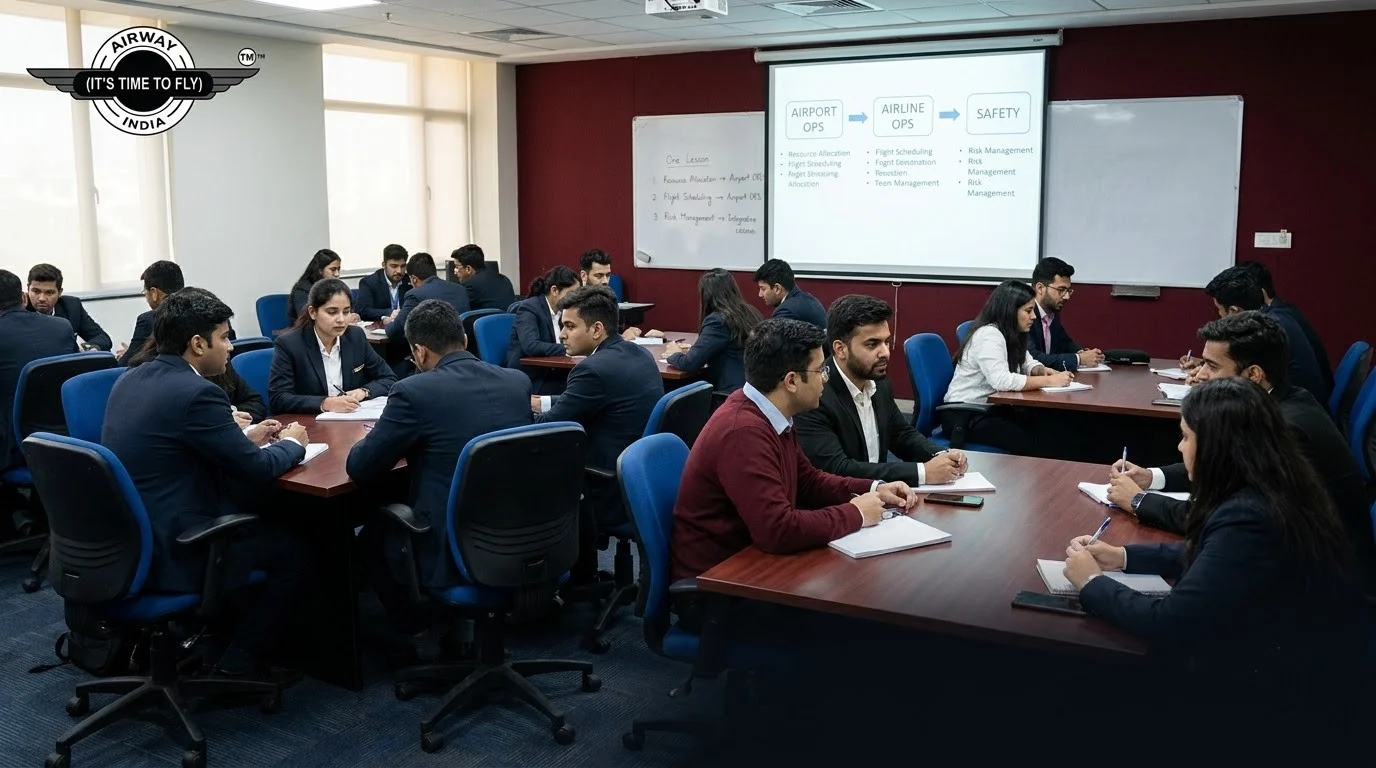
Airport, Airline, and Safety subjects taught together at Airway India
Why Students Choose Airway India
We'd rather undersell this than oversell it. Our MBA in Aviation Management is a single, integrated program — not a multi-track system — built on ISO 9001:2015 certification, IAF accreditation, and Mangalayatan University affiliation. It covers Airport, Airline, and Safety subject areas within one syllabus — Airline & Airport Management, Airline Operations & Scheduling, Aviation Law, and Aviation Safety Management & Accident Investigation among the named subjects — taught from a campus in Barasat, close to NSCBI airport. If you want a dedicated single-track specialization instead, UPES's named-track model (which we've credited fairly throughout this page) may fit that specific need better — we'd rather point that out than pretend we offer something we don't.
Related Reading
Frequently Asked Questions
Airport Management focuses on terminal operations, ground handling, and airport planning. Airline Management focuses on flight scheduling, revenue management, and airline marketing. Some institutes teach them as separate tracks; others fold both into one aviation-MBA curriculum — check the syllabus, not just the title.
No. We checked five sources and found five different specialization lists. Airport Operations, Airline Operations, and Aviation Safety recur most consistently; Cargo/Logistics, Customer Relationship Management, and Aviation Marketing appear inconsistently. Always verify directly on the institute's own page.
By role, Aviation Safety Manager and Aviation Consultant positions top out highest (₹15–18 LPA), per Airway India's own disclosed estimates. Airport and Airline Operations roles are more numerous and easier to enter as a fresher, even with a slightly lower ceiling.
It's real but underrepresented — only 2 of the 5 sources we checked list it as a named track rather than an elective. Given India's e-commerce-driven air freight growth, it's likely to become more prominent, but verify directly whether an institute treats it as a full specialization or a single elective.
India's air cargo market sat around 3.6 million tonnes in 2025, with projections of roughly 11% annual growth through 2034, driven mainly by e-commerce and express logistics demand. That growth is a big part of why Cargo/Logistics is becoming a more common aviation-MBA specialization, even though it's still less standardized than Airport or Airline tracks.
Not as separate chosen tracks. Our MBA in Aviation Management is one integrated program covering Airport, Airline, and Safety subject areas together in a single curriculum, rather than a multi-track system like UPES's.
Not without checking further. We directly confirmed one large directory reusing identical template text across IIM Ahmedabad, IIM Calcutta, and IIM Bangalore pages, with only the institution name changed. Treat directory listings as a starting point, then verify on the institute's own page.
Compliance auditing, incident investigation, risk assessment, and regulatory documentation — aimed at safety officer, compliance manager, and quality assurance roles.
Airport manager, ground operations supervisor, and airport business development roles are the most common outcomes, per the sources we checked this pass.
Often, yes. Stackable IATA certificates — Airport Operations, Safety Management Systems, Supply Chain Management, Airline Revenue Management — are a fast, recognized way to prove specific specialization knowledge, without replacing the degree itself.
UPES's own disclosed data names GMR Group, Adani Group, Vistara, Spice Express, Accenture, Kuehne Nagel, Tata Airlines, and IndiGo as real recruiters from its program — the most specific, verified recruiter data found across every source checked this pass.
Fees vary widely by delivery mode and institute — distance-education programs like IMTS run roughly ₹22,000–42,500 per year, while full-time campus programs at institutes like UPES or Dr DY Patil run into several lakh rupees total. Specialization choice itself doesn't change the fee; the institute and mode do.
Neither is inherently better — it depends on whether you already know which specific area you want, or prefer broad exposure across airport, airline, and safety topics before specializing on the job. Multi-track programs suit a settled career direction; integrated programs suit students still exploring.
Yes. It's affiliated with Mangalayatan University, and Airway India holds ISO 9001:2015 certification and IAF accreditation.
Ready to Pick Your Track?
If an integrated program covering Airport, Airline, and Safety subject areas fits what you're looking for, check eligibility directly, or reach out on WhatsApp with any question this page didn't answer.
Explore Airway India's MBA ProgramOr WhatsApp us at: +91 87777 06299