Introduction
The aviation industry offers exciting career opportunities beyond becoming a commercial pilot or cabin crew member. Every day, thousands of flights operate across domestic and international airports, supported by professionals who ensure that airport facilities, aircraft movements and airline operations run smoothly.
Two important career options within this industry are Airport Operations and Flight Operations.
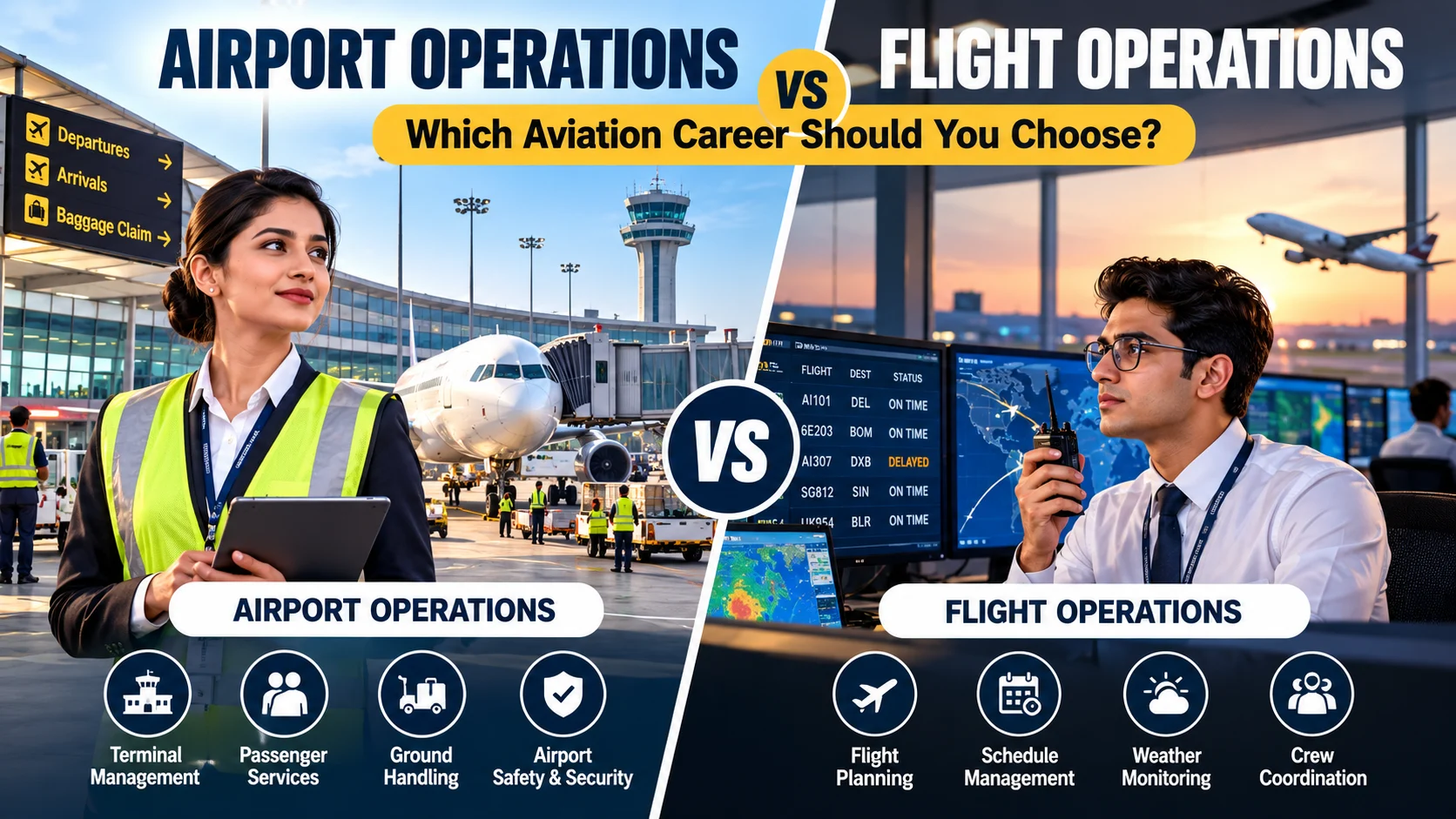
Although these terms sound similar, they represent two different areas of aviation management. Airport Operations focuses on managing airport activities, passenger facilities, ground services and airside operations. Flight Operations focuses on planning, coordinating and managing airline flight activities.
Both career paths offer opportunities to work with airlines, airports, ground handling companies and aviation service providers.
But which career is better? Which offers a higher salary? What qualifications are required? And what opportunities are available after completing Class 12?
In this guide, we will compare Airport Operations vs Flight Operations in India, covering job responsibilities, eligibility, training, salary expectations, career growth and future opportunities.
1. What Is Airport Operations?
Airport Operations refers to the management and coordination of activities that take place within an airport to ensure its safe and efficient functioning.
Airport Operations professionals work behind the scenes to ensure that passengers, aircraft, airport staff and ground service providers operate in a coordinated environment.
Their responsibilities include managing airport facilities, coordinating ground handling activities, monitoring terminal operations and ensuring compliance with aviation safety regulations.
Key Responsibilities of Airport Operations Professionals
- Managing daily airport activities and operational procedures.
- Coordinating passenger movement and terminal operations.
- Monitoring aircraft arrival and departure activities.
- Coordinating with ground handling agencies and airline staff.
- Managing airport safety and security procedures.
- Handling operational disruptions and passenger-related issues.
- Monitoring airport facilities and infrastructure.
- Ensuring compliance with applicable aviation regulations.
- Coordinating emergency response and contingency procedures.
Airport Operations professionals may work at domestic airports, international airports, private airports and aviation infrastructure companies.
Their primary objective is to ensure that the airport functions efficiently while maintaining passenger safety and service quality.
2. What Is Flight Operations?
Flight Operations refers to the planning, coordination, monitoring and management of an airline’s flight activities.
Unlike Airport Operations, which focuses on the airport environment, Flight Operations primarily deals with the operational requirements of individual flights and the airline’s overall flight schedule.
Flight Operations professionals work closely with pilots, cabin crew, flight dispatchers, air traffic services and other airline departments.
Their responsibilities help ensure that flights operate safely, efficiently and according to schedule.
Key Responsibilities of Flight Operations Professionals
- Preparing and coordinating flight schedules.
- Monitoring flight departures and arrivals.
- Coordinating flight planning and operational documentation.
- Monitoring weather conditions and operational restrictions.
- Coordinating with pilots and flight crew.
- Managing flight delays, diversions and cancellations.
- Monitoring aircraft utilisation and operational efficiency.
- Coordinating crew scheduling and flight duty requirements.
- Supporting compliance with aviation safety regulations.
Flight Operations professionals generally work with commercial airlines, cargo airlines, charter operators and aviation service organisations.
Their primary objective is to ensure that airline flight activities are properly planned, coordinated and executed.
3. Airport Operations vs Flight Operations: Key Differences
Although both departments contribute to the smooth functioning of the aviation industry, their responsibilities are quite different.
| Comparison | Airport Operations | Flight Operations |
|---|---|---|
| Primary focus | Managing airport activities | Managing airline flight activities |
| Workplace | Airports and terminals | Airline offices and operations centres |
| Main objective | Smooth airport functioning | Safe and efficient flight operations |
| Passenger interaction | Generally high | Usually limited |
| Aircraft coordination | Airport-side coordination | Airline-side flight coordination |
| Key responsibilities | Terminal, ground and airside operations | Flight planning, monitoring and coordination |
| Employers | Airport operators and ground handlers | Airlines and flight operators |
| Working environment | Airport terminals and operational areas | Operations control centres |
| Technical knowledge | Airport management and safety | Flight planning and airline operations |
| Career progression | Airport Executive to Operations Manager | Operations Executive to Operations Manager |
The simplest way to understand the difference is:
Airport Operations manages the airport environment, while Flight Operations manages the operational activities associated with airline flights.
4. Eligibility Criteria: Who Can Apply?
Students interested in either career can explore aviation-related courses after completing their higher secondary education.
However, eligibility requirements differ depending on the job position, employer and course.
Airport Operations Eligibility in India
Candidates interested in Airport Operations can generally consider the following qualifications:
- Completion of Class 12 from a recognised board for entry-level opportunities.
- Graduation in Aviation Management, Airport Management, Business Administration or a related discipline for certain executive and management positions.
- Good communication and interpersonal skills.
- Basic knowledge of airport operations and aviation regulations.
- Problem-solving and coordination abilities.
- Computer literacy and administrative skills.
Some employers may prefer candidates with an aviation-related diploma or degree, particularly for specialised operational roles.
Flight Operations Eligibility in India
Eligibility for Flight Operations depends on the specific job profile.
For entry-level operational support and coordination positions, candidates may be considered with qualifications such as:
- Class 12 or graduation, depending on the employer.
- A degree in Aviation Management or a related discipline.
- Knowledge of airline operations and aviation fundamentals.
- Good analytical and communication skills.
- Computer proficiency and attention to detail.
Certain specialised roles have additional regulatory requirements.
For example, flight dispatchers and operational control personnel may need specific training, qualifications or approvals under applicable DGCA regulations and airline procedures.
Important: Flight Operations is not the same as becoming a commercial pilot. A student interested in airline operations management does not automatically need a Commercial Pilot Licence. However, pilot and other licensed positions have separate eligibility and training requirements.
5. Training and Course Duration: Airport Operations vs Flight Operations
Choosing the right aviation course can help students understand the industry and prepare for entry-level opportunities.
However, training requirements depend on the job role and employer.
Airport Operations Training
Airport Operations training generally focuses on airport management, passenger handling, ground services and airport safety.
The course curriculum may include:
- Introduction to Aviation: Understanding the aviation industry, airport infrastructure and airline operations.
- Airport Management: Learning about airport administration and operational management.
- Ground Handling: Understanding baggage handling, aircraft turnaround and ground service coordination.
- Passenger Handling: Learning check-in procedures, boarding and passenger assistance.
- Airport Safety and Security: Understanding airport safety standards and security procedures.
- Terminal Management: Learning about passenger movement and terminal facilities.
- Aviation Customer Service: Developing passenger communication and complaint-handling skills.
- Emergency Management: Understanding airport emergency response and contingency planning.
Estimated course duration: 3 months to 3 years, depending on whether you choose a certificate, diploma or degree programme.
Flight Operations Training
Flight Operations training focuses on airline operational management, flight planning, scheduling and coordination.
The curriculum may include:
- Introduction to Flight Operations: Understanding airline operational structures.
- Flight Planning: Learning the fundamentals of flight routes, fuel planning and operational requirements.
- Airline Scheduling: Understanding flight schedules and aircraft utilisation.
- Meteorology: Learning how weather conditions affect flight operations.
- Aviation Regulations: Understanding relevant DGCA regulations and operational procedures.
- Flight Monitoring: Learning how airlines monitor flights and manage operational disruptions.
- Crew Coordination: Understanding pilot and cabin crew scheduling requirements.
- Airline Operations Control: Learning how airline operations teams coordinate daily flight activities.
Estimated course duration: 3 months to 3 years, depending on the programme and specialised training requirements.
Aviation Management courses can provide a foundation for both career paths, but specialised operational positions may require additional employer-specific or regulatory training.
6. Airport Operations vs Flight Operations Salary in India
Salary is an important consideration when choosing an aviation career.
Both Airport Operations and Flight Operations offer different salary structures depending on the employer, job designation, experience and responsibilities.
The following figures are broad illustrative estimates for relevant entry-level and experienced management positions in India. They are not official industry pay scales.
Airport Operations Salary in India
| Position | Estimated Monthly Salary |
|---|---|
| Airport Operations Trainee | ₹15,000–25,000 |
| Airport Operations Executive | ₹20,000–35,000 |
| Senior Operations Executive | ₹30,000–50,000 |
| Airport Operations Supervisor | ₹40,000–65,000 |
| Airport Operations Manager | ₹60,000–1.2 lakh |
| Senior Airport Operations Manager | ₹1 lakh–1.8 lakh+ |
Salary levels may vary considerably between airport operators, ground handling companies and other aviation service providers.
Flight Operations Salary in India
| Position | Estimated Monthly Salary |
|---|---|
| Flight Operations Trainee | ₹18,000–30,000 |
| Flight Operations Executive | ₹25,000–40,000 |
| Flight Operations Coordinator | ₹30,000–50,000 |
| Flight Operations Supervisor | ₹45,000–70,000 |
| Flight Operations Manager | ₹70,000–1.3 lakh |
| Senior Flight Operations Manager | ₹1.2 lakh–2 lakh+ |
Specialised positions involving flight dispatch, operational control and regulatory responsibilities may have different compensation structures.
Which Career Offers a Higher Salary?
Neither career guarantees a higher salary at every level.
Airport Operations can offer attractive opportunities in airport management, terminal operations and airport administration.
Flight Operations can offer competitive compensation in airline operational control, flight planning and specialised operational management.
In both cases, professional experience, technical knowledge, employer reputation and job responsibilities play an important role in determining salary growth.
7. Training Fees and Financial Investment
Before enrolling in an aviation course, students should understand the financial investment involved.
Unlike pilot training, Airport Operations and Flight Operations management courses generally do not require expensive flying hours or aircraft training.
Airport Operations Course Fees
The cost of Airport Operations courses depends on the institution, programme duration and qualification.
Students may choose from:
- Certificate courses in Airport Operations.
- Diploma programmes in Airport Management.
- Undergraduate degrees in Aviation Management.
- Postgraduate programmes in Aviation Management.
Private aviation institutes may charge anywhere from a few thousand rupees to several lakhs, depending on the course.
Flight Operations Course Fees
Flight Operations training fees also depend on the programme and its specialisation.
Available options may include:
- Certificate programmes in Airline Operations.
- Diploma courses in Aviation Management.
- Airline Operations Management programmes.
- Specialised flight dispatch training.
The cost of specialised training may be different from that of a general aviation management programme.
Important: Before enrolling, check whether the course provides practical exposure, industry-oriented training, internship opportunities and placement assistance. A course certificate alone does not guarantee employment.
8. Career Opportunities and Growth
Both career paths offer opportunities to grow into supervisory and managerial positions.
However, their career progression depends on different areas of expertise.
Airport Operations Career Growth
Airport Operations professionals can progress through various positions as they gain industry experience.
Typical Airport Operations Career Path:
- Airport Operations Trainee: Learns airport procedures and operational fundamentals.
- Airport Operations Executive: Coordinates daily airport activities and operational tasks.
- Senior Operations Executive: Handles more complex operational responsibilities.
- Airport Operations Supervisor: Supervises teams and coordinates airport activities.
- Airport Operations Manager: Manages operational performance and airport processes.
- Senior Airport Operations Manager: Oversees larger operational functions and strategic initiatives.
Other career opportunities include:
- Terminal Operations Manager.
- Ground Handling Manager.
- Airport Duty Manager.
- Passenger Service Manager.
- Airport Safety Officer.
- Airside Operations Executive.
- Airport Administration Manager.
Flight Operations Career Growth
Flight Operations professionals can build careers within airline operational departments.
Typical Flight Operations Career Path:
- Flight Operations Trainee: Learns airline operations and coordination procedures.
- Flight Operations Executive: Supports daily flight activities and operational coordination.
- Flight Operations Coordinator: Coordinates flight schedules and operational requirements.
- Flight Operations Supervisor: Oversees operational teams and flight-related coordination.
- Flight Operations Manager: Manages airline operational activities and performance.
- Senior Flight Operations Manager: Handles broader operational planning and management responsibilities.
Additional career opportunities include:
- Airline Operations Control Centre Executive.
- Flight Dispatcher, subject to applicable qualifications and approvals.
- Crew Scheduling Executive.
- Flight Planning Coordinator.
- Airline Operations Analyst.
- Operations Control Manager.
- Airline Operations Training Specialist.
9. Work Environment and Lifestyle
The working environment is another important factor to consider when selecting between Airport Operations and Flight Operations.
Although both professions belong to the aviation industry, their daily activities can be very different.
| Factor | Airport Operations | Flight Operations |
|---|---|---|
| Workplace | Airport terminals and operational areas | Airline offices and operations control centres |
| Passenger interaction | Frequent in many roles | Generally limited |
| Working hours | Shift-based | Shift-based |
| Main responsibility | Airport activities | Flight coordination |
| Work pressure | Passenger issues and airport disruptions | Flight delays and operational disruptions |
| Team coordination | Ground staff, airport authorities and airlines | Pilots, crew and airline departments |
| Work environment | Primarily airport-based | Primarily operations-centre or office-based |
Lifestyle in Airport Operations
Airport Operations professionals may work in terminals, operational offices and airside areas, depending on their designation.
Their work often involves interacting with passengers, airport authorities, ground handling agencies and airline representatives.
They may need to handle operational disruptions, passenger complaints and unexpected airport situations.
Shift work, including weekends and public holidays, is common in many airport operational roles.
Lifestyle in Flight Operations
Flight Operations professionals often work in airline operational control centres or offices.
Their work involves coordinating flight schedules, monitoring flight movements and responding to operational challenges.
For example, adverse weather conditions, aircraft technical issues or airspace restrictions may require immediate coordination between different airline departments.
The role requires analytical thinking, attention to detail and the ability to work under time pressure.
10. Skills Required: Airport Operations vs Flight Operations
The skills required for both careers overlap in areas such as communication, teamwork and problem-solving.
However, each profession requires a different set of specialised abilities.
| Airport Operations Skills | Flight Operations Skills |
|---|---|
| Communication skills | Analytical thinking |
| Passenger management | Flight coordination |
| Team management | Operational planning |
| Problem-solving | Decision-making |
| Customer service | Technical understanding |
| Conflict management | Time management |
| Airport safety awareness | Weather awareness |
| Leadership | Operational risk management |
Skills Required for Airport Operations
Students interested in Airport Operations should focus on:
- Communication and interpersonal skills.
- Customer service and passenger handling.
- Team coordination.
- Leadership and supervision.
- Problem-solving.
- Understanding airport safety procedures.
- Managing operational disruptions.
Skills Required for Flight Operations
Students interested in Flight Operations should develop:
- Analytical and logical thinking.
- Planning and coordination.
- Attention to detail.
- Understanding of aviation terminology.
- Knowledge of flight operations.
- Decision-making abilities.
- Technical and computer skills.
Students who enjoy interacting with people and managing airport activities may find Airport Operations more suitable.
Those who prefer planning, coordination, analysis and airline operational management may find Flight Operations more interesting.
11. Which Career Is Better After 12th?
This is one of the most common questions among students interested in aviation.
Both Airport Operations and Flight Operations can be explored after completing Class 12, although specific job positions may require graduation or additional qualifications.
The right choice depends on your interests, strengths and long-term career goals.
Choose Airport Operations If:
- You enjoy interacting with people.
- You are interested in airport management.
- You like coordinating teams and daily activities.
- You have good communication skills.
- You are interested in passenger services and ground operations.
- You want to develop a career in airport administration and management.
Choose Flight Operations If:
- You are interested in airline operations.
- You enjoy planning and coordination.
- You have strong analytical abilities.
- You are interested in flight schedules and operational management.
- You enjoy solving complex operational problems.
- You want to build a career within an airline’s operations department.
Neither career is universally better. Your decision should depend on the type of work you want to perform throughout your professional life.
12. Can You Switch Careers Between Airport Operations and Flight Operations?
Yes, professionals can transition between these two areas of aviation, depending on their experience, qualifications and the requirements of the position.
Both career paths involve aviation knowledge, operational coordination and safety awareness.
However, certain specialised responsibilities require additional training.
Airport Operations to Flight Operations
An Airport Operations professional interested in moving into Flight Operations may need to develop knowledge of:
- Flight planning.
- Airline scheduling.
- Flight monitoring.
- Aviation meteorology.
- Airline operational procedures.
- Flight dispatch requirements, where applicable.
Previous airport experience can provide useful industry exposure, but it does not automatically qualify someone for specialised flight operations positions.
Flight Operations to Airport Operations
A Flight Operations professional can explore Airport Operations roles by developing knowledge of:
- Airport management.
- Terminal operations.
- Ground handling.
- Passenger services.
- Airport safety procedures.
- Airside coordination.
Previous experience in airline operations can be valuable when applying for airport management and coordination positions.
13. Future Career Opportunities in the Indian Aviation Industry
India’s aviation sector continues to develop through airport infrastructure expansion, airline growth, increasing passenger traffic and investments in aviation services.
The expansion of aviation infrastructure creates demand for professionals across multiple operational departments.
Some important career areas include:
1. Airport Management
Airport operators require professionals to manage terminal facilities, operational activities, passenger movement and airport services.
2. Airline Operations
Airlines need operational teams to coordinate flight schedules, crew requirements, aircraft utilisation and daily flight activities.
3. Ground Handling Services
Ground handling companies provide services related to baggage, aircraft turnaround, passenger assistance and ramp operations.
4. Airport Infrastructure Management
The development and modernisation of airports create opportunities in infrastructure management, facilities coordination and operational planning.
5. Aviation Safety and Compliance
Airports and airlines require professionals who understand safety procedures, operational standards and regulatory compliance.
6. Cargo and Logistics Operations
The expansion of air cargo services creates opportunities in cargo handling, logistics coordination and airline cargo operations.
7. Aviation Training and Education
Experienced aviation professionals can explore opportunities in training, academic instruction and aviation education.
Students should remember that industry expansion creates potential opportunities, but employment depends on individual qualifications, recruitment requirements and market demand.
Conclusion: Airport Operations vs Flight Operations – Which Should You Choose?
Airport Operations and Flight Operations are two important career paths within the aviation industry. Although both contribute to smooth airline and airport functioning, their responsibilities, work environments and professional requirements are different.
If you enjoy managing airport activities, coordinating ground services, interacting with passengers and supervising operational teams, Airport Operations may be a suitable career choice.
On the other hand, if you are interested in airline management, flight planning, operational coordination and analysing flight-related activities, Flight Operations may be a better fit.
Both career paths offer opportunities to develop specialised skills and progress into managerial positions.
The best aviation career is the one that matches your interests, strengths and long-term professional ambitions.
Before enrolling in an aviation course, understand the job responsibilities, eligibility criteria and career progression associated with your chosen field.
With the right training, industry knowledge and practical exposure, you can build a rewarding career in India’s growing aviation sector.
Frequently Asked Questions (FAQs)
1. What is the main difference between Airport Operations and Flight Operations?
Airport Operations focuses on managing airport activities, including terminal management, passenger handling, ground services and airport safety. Flight Operations focuses on airline activities such as flight planning, scheduling, monitoring and operational coordination.
2. Which is better, Airport Operations or Flight Operations?
Both careers offer different opportunities. Airport Operations is suitable for individuals interested in airport management and passenger services, whereas Flight Operations is suitable for those interested in airline planning, coordination and operational management.
3. Can I pursue Airport Operations after Class 12?
Yes. Students can explore certificate, diploma and degree programmes related to Airport Management and Aviation Management after completing Class 12. Specific job requirements vary between employers.
4. What is the salary of Airport Operations professionals in India?
Entry-level Airport Operations professionals may earn approximately ₹15,000–35,000 per month, while experienced supervisors and managers may earn ₹40,000 to ₹1.2 lakh or more, depending on their employer, experience and responsibilities.
5. Do I need a pilot licence to work in Flight Operations?
No. A pilot licence is not required for every Flight Operations position. However, specialised roles such as certain flight dispatch and operational control positions may have specific training, licensing or approval requirements under applicable regulations.
SEO Details
| SEO Element | Recommendation |
|---|---|
| Primary Focus Keyword | Airport Operations vs Flight Operations |
| SEO Title | Airport Operations vs Flight Operations: Career Comparison |
| URL Slug | airport-operations-vs-flight-operations |
| Meta Description | Compare Airport Operations vs Flight Operations in India. Explore salary, eligibility, training, job roles and career opportunities after 12th. |
| Search Intent | Informational |
| Secondary Keywords | Airport operations salary in India, flight operations salary in India, airport management careers, airline operations jobs, aviation courses after 12th, airport operations course, flight operations course |
Suggested Internal Linking Opportunities
- Commercial Pilot vs Cabin Crew: Comparing Salary, Training and Career Opportunities.
- Airport Management vs Airline Management: Which Career Offers Better Opportunities?
- Ground Staff vs Cabin Crew: Which Aviation Career Should You Choose?
- Aviation Management After 12th: Courses, Eligibility, Salary and Career Scope.
- Airport Management Course Fees in India: Duration, Eligibility and Career Scope.
SEO Recommendation: Link this article to your Airport Management and Aviation Management course pages using natural anchor text such as Airport Management Course, Aviation Management Career Opportunities and Aviation Courses After 12th. This will help build topical relevance across your aviation content cluster.