Introduction
The aviation industry offers several exciting career opportunities for students who enjoy interacting with people, working in a professional environment and being part of a fast-moving industry. Among the most popular entry-level career choices are cabin crew and ground staff positions.
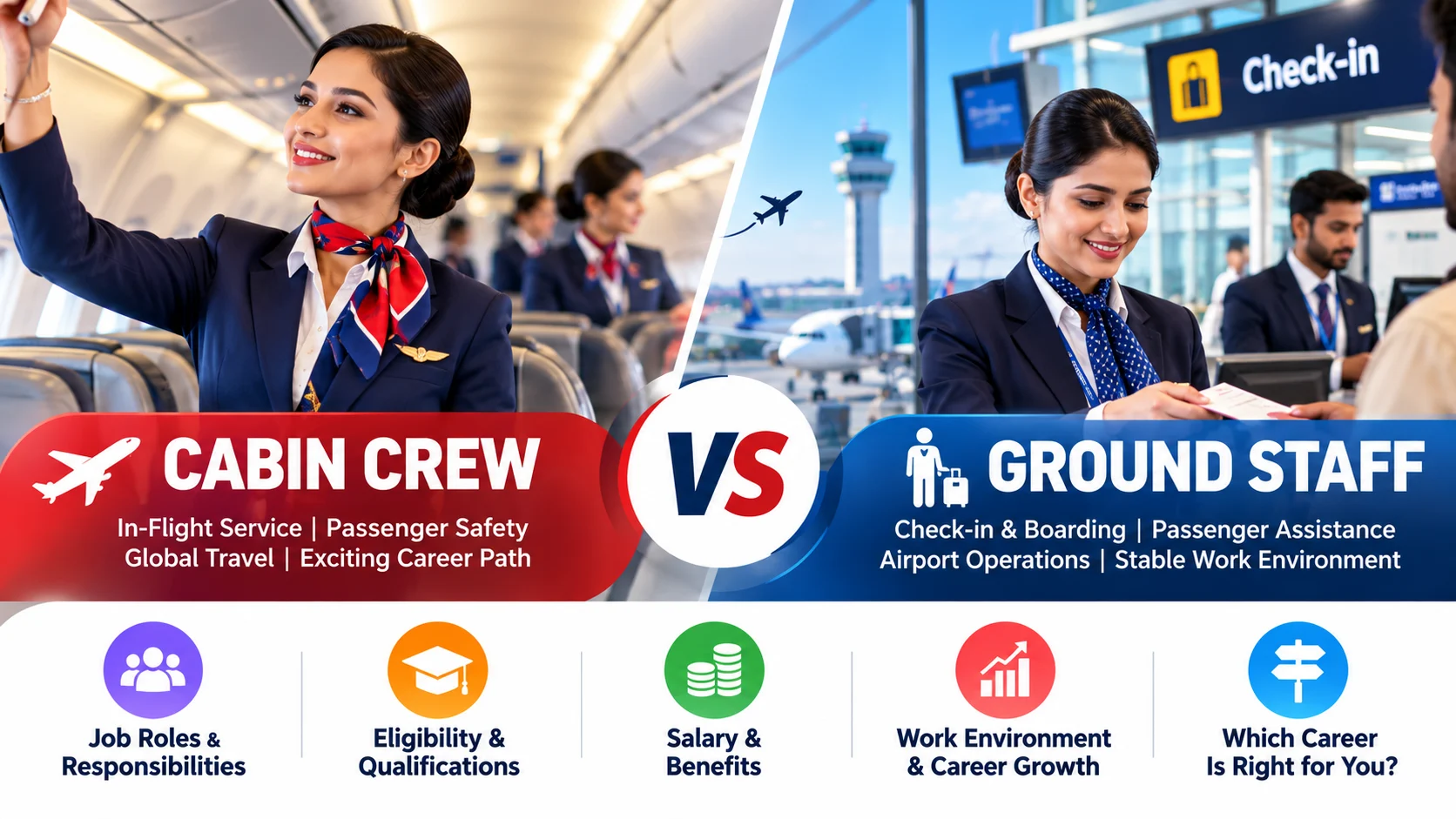
Both roles are essential to airline operations, but their responsibilities, working environments and career paths are quite different. Cabin crew members work inside aircraft and are responsible for passenger safety, comfort and in-flight services. Ground staff professionals work at airports, supporting passengers before departure and after arrival through check-in, boarding, baggage services, reservations and other airport-related activities.
For students exploring aviation careers after 12th, choosing between these two options can be confusing. Both involve customer service, communication and teamwork, but they demand different skills and personal preferences.
So, which career should you choose? This guide compares Cabin Crew vs Ground Staff in terms of job responsibilities, eligibility, working conditions, salary expectations and career growth to help you make an informed decision.
1. What Does a Cabin Crew Member Do?
Cabin crew members, commonly known as flight attendants, are airline professionals responsible for passenger safety and comfort throughout a flight. They work inside the aircraft and coordinate with the pilot and other crew members to ensure that passengers receive appropriate assistance during their journey.
Although cabin crew members are often associated with serving meals and assisting passengers, their most important responsibility is safety. They receive training to handle emergency situations, conduct safety demonstrations, operate emergency equipment and guide passengers during an evacuation when required.
Their duties begin before passengers board the aircraft and continue until the flight is completed.
Key responsibilities of cabin crew include:
- Pre-flight preparation: Checking cabin readiness, safety equipment and passenger-related requirements.
- Passenger boarding: Welcoming passengers, helping them find their seats and assisting with cabin baggage.
- Safety demonstrations: Explaining safety procedures, emergency exits and the use of safety equipment.
- In-flight services: Serving meals and beverages and assisting passengers with their requirements.
- Emergency response: Following safety procedures and assisting passengers during medical or other emergencies.
- Post-flight duties: Completing required reports and supporting cabin-related procedures after landing.
A cabin crew member must remain alert, professional and approachable throughout the flight. The job requires the ability to communicate with passengers from different backgrounds while maintaining composure in challenging situations.
The role also involves irregular working hours, overnight duties, weekends and public holidays. Crew members may travel frequently and spend time away from their home base depending on airline schedules.
For people who enjoy travelling, interacting with different people and working in an international environment, cabin crew jobs in India can offer an interesting career path.
2. What Does Ground Staff Do at an Airport?
Ground staff professionals play an important role in ensuring that airport and airline services operate smoothly before and after a flight. Unlike cabin crew members, they generally work on the ground at airport terminals, airline counters, boarding gates, baggage areas and operational offices.
Ground staff is a broad term. It can include airline employees, airport operator employees and professionals working for third-party ground-handling companies. Their exact responsibilities depend on their employer and department.
For example, a passenger service executive may assist travellers at the check-in counter, while a ramp operations employee may coordinate activities around an aircraft on the apron.
Key responsibilities of airport ground staff include:
- Check-in services: Verifying passenger documents, issuing boarding passes and assisting with baggage acceptance.
- Boarding assistance: Checking boarding passes, guiding passengers and coordinating boarding procedures.
- Baggage services: Supporting baggage handling, tracking delayed luggage and assisting with baggage-related complaints.
- Passenger assistance: Helping senior citizens, passengers with disabilities, families and travellers requiring special assistance.
- Reservations and ticketing: Assisting with bookings, cancellations, flight changes and travel enquiries, depending on the role.
- Ramp coordination: Supporting aircraft turnaround activities, baggage movement and coordination with relevant operational teams.
Ground staff professionals need to work accurately because even small errors in passenger documentation, baggage handling or boarding coordination can affect flight operations.
They must also communicate effectively with passengers, airline teams, security personnel and other airport departments.
Unlike cabin crew, ground staff members generally remain based at a particular airport or location, although shift patterns and job locations depend on the employer.
For students interested in customer service, airport operations and passenger handling without working onboard an aircraft, ground staff jobs in India can be a suitable option.
3. Cabin Crew vs Ground Staff: Key Differences in Job Roles and Working Environment
The most important difference between these two careers is the workplace. Cabin crew members work onboard aircraft, whereas ground staff professionals work at airports and support airline or airport operations.
However, the difference extends beyond the workplace. Their responsibilities, daily schedules, passenger interactions and training requirements also vary.
| Comparison | Cabin Crew | Ground Staff |
|---|---|---|
| Workplace | Inside aircraft | Airport terminals, counters and operational areas |
| Main responsibility | Passenger safety and in-flight service | Passenger handling and ground operations |
| Employer | Airlines | Airlines, airport operators and ground-handling companies |
| Work schedule | Flight-based, irregular rosters | Airport shifts, including nights and weekends |
| Travel | Frequent travel depending on routes and roster | Usually based at a particular airport |
| Passenger interaction | During the flight | Before departure and after arrival |
| Key skills | Safety awareness, communication and service | Customer service, coordination and accuracy |
| Work environment | Aircraft cabin | Airport terminal and operational areas |
Which role offers a better work environment?
There is no universal answer because the work environment depends on individual preferences.
Cabin crew members may enjoy travelling, visiting different destinations and meeting passengers from diverse backgrounds. However, they must adapt to changing schedules, time-zone differences, long duty periods and time away from family.
Ground staff professionals generally have a more location-based work routine. However, airport operations continue throughout the day and night, so shift work is common. They may also experience busy periods during flight departures, arrivals, delays and holiday seasons.
Both careers require patience, teamwork and the ability to handle difficult passenger situations professionally.
Students should also understand that working at an airport does not always mean working directly for an airline. Some airport services are provided by specialised companies, and recruitment conditions may differ.
4. Eligibility, Qualifications and Skills: What Do You Need to Apply?
One of the reasons these careers attract students is that many entry-level opportunities are accessible after completing Class 12. However, eligibility requirements vary between airlines, airport operators and ground-handling companies.
Aviation management or hospitality qualifications can help students understand the industry, but completing a particular course does not guarantee employment. Employers conduct their own recruitment and selection processes.
Cabin crew eligibility
For cabin crew positions, airlines generally assess educational qualifications, communication skills, medical fitness, grooming standards and other role-specific criteria.
For example, Air India’s published cabin crew recruitment criteria include Indian nationality with a valid passport, Class 12 with at least 50% marks, and specified age, height, vision and other requirements. These criteria are specific to its recruitment programme and may change. Other airlines can have different eligibility conditions.
You can check the current requirements on the Air India Cabin Crew Careers website.
Important skills for cabin crew candidates include:
- Excellent spoken English and effective communication.
- Confidence and professional passenger interaction.
- Teamwork and conflict-resolution abilities.
- Safety awareness and the ability to remain calm under pressure.
- Physical fitness and medical suitability for the role.
Ground staff eligibility
Ground staff recruitment requirements depend on the department and employer. Many entry-level passenger service roles consider candidates who have completed Class 12, while some employers prefer graduates or candidates with relevant experience.
A diploma or degree in aviation, airport management, hospitality or customer service may help candidates develop industry knowledge. However, the employer’s published vacancy criteria should always be treated as the final eligibility standard.
Important skills for ground staff candidates include:
- Communication and customer service.
- Computer literacy and familiarity with booking or airport systems.
- Problem-solving and passenger assistance.
- Attention to detail and document verification.
- Coordination and time management.
The National Qualification Register also lists a cabin crew occupational qualification covering pre-flight tasks, passenger handling, post-flight duties and safety procedures. This illustrates why cabin crew training involves much more than hospitality alone.
5. Salary, Career Growth and Future Opportunities: Which Career Should You Choose?
Salary is an important consideration when comparing Cabin Crew vs Ground Staff, but there is no single fixed salary for either profession. Earnings depend on the airline or service provider, experience, location, job grade, allowances, roster and employment terms.
Cabin crew compensation may include a fixed salary and additional components such as flying-related allowances, layover benefits or other employer-specific benefits. Ground staff compensation depends on the role, employer and location. Customer service executives, ticketing professionals, ramp employees and supervisory staff can have different pay structures.
Rather than relying on a single salary figure advertised by a training institute, candidates should compare actual recruitment offers and understand the difference between fixed pay, allowances and variable benefits.
Career growth in cabin crew
Cabin crew members can progress through seniority and experience into leadership positions. Depending on the airline’s structure, the career path may include:
- Junior or entry-level Cabin Crew
- Senior Cabin Crew
- Cabin Supervisor or Cabin In-charge
- Cabin Crew Trainer
- Base or In-flight Management roles
Experienced cabin crew members may also explore opportunities in training, recruitment, customer experience and other ground-based airline departments.
Career growth in ground staff
Ground staff professionals can develop specialised experience in passenger services, reservations, baggage operations, ramp handling and airport operations.
Possible progression routes include:
- Passenger Service Executive
- Senior Customer Service Executive
- Team Leader or Supervisor
- Duty Officer
- Airport Operations Manager
- Station or Department Manager
The actual progression depends on the organisation, performance, qualifications and available vacancies.
How is India’s aviation growth creating opportunities?
India’s aviation sector continues to expand, supporting demand for airport and airline services. According to the Ministry of Civil Aviation, scheduled domestic airlines carried 165.5 million passengers in FY 2024–25, compared with 153.7 million in FY 2023–24, representing growth of 7.7%.
The country’s airport network also increased from 74 airports in 2014 to 164 in 2025. These developments indicate the scale of India’s aviation ecosystem and the importance of trained professionals across passenger services and airline operations.
Source: Ministry of Civil Aviation – Our Performance.
Which career is right for you?
Choose cabin crew if you:
- Enjoy travelling and working onboard aircraft.
- Like interacting with passengers from different cultures.
- Can adapt to irregular schedules and frequent travel.
- Are comfortable taking responsibility for passenger safety.
Choose ground staff if you:
- Prefer working at an airport rather than travelling frequently.
- Enjoy customer service and operational coordination.
- Are interested in check-in, boarding, baggage or airport services.
- Prefer building experience at a particular airport or operational location.
Both professions can offer rewarding opportunities. Your choice should depend on your personality, career goals, preferred working environment and the requirements of the jobs you intend to pursue.
Conclusion
Choosing between cabin crew and ground staff is an important decision for students planning a career in aviation. Both roles are essential to the passenger journey, but they involve different responsibilities and working environments.
Cabin crew professionals focus on passenger safety, comfort and in-flight services, while ground staff professionals support check-in, boarding, baggage handling and other airport operations. Cabin crew may appeal to individuals who enjoy travelling and working onboard aircraft, whereas ground staff may suit those who prefer airport-based roles and operational coordination.
Before enrolling in an aviation training programme, research the eligibility criteria of airlines and ground-handling companies, compare course content and look for practical training opportunities. A recognised qualification, strong communication skills, professional behaviour and a clear understanding of the job can help you prepare for the recruitment process.
Ultimately, the right choice in the Cabin Crew vs Ground Staff comparison is the career that matches your interests and allows you to build the skills needed for long-term growth in the aviation industry.
Frequently Asked Questions (FAQs)
1. Which is better, cabin crew or ground staff?
Neither career is universally better. Cabin crew is suitable for candidates who enjoy travelling and working onboard aircraft, while ground staff is suitable for those interested in airport-based passenger services and operations. The right choice depends on your preferences and career goals.
2. Can I become cabin crew after Class 12?
Yes. Some airlines recruit candidates who have completed Class 12, subject to their age, communication, medical fitness and other eligibility requirements. For example, Air India publishes Class 12 as its minimum educational qualification for its cabin crew programme. Always check the latest airline recruitment notification.
3. What qualifications are required for ground staff jobs in India?
Requirements vary by employer and job profile. Many entry-level passenger service positions consider Class 12 candidates, while some roles prefer graduates or candidates with relevant aviation, hospitality or customer-service qualifications.
4. Do cabin crew members earn more than ground staff?
Not necessarily in every case. Cabin crew and ground staff salaries vary according to the employer, experience, role, allowances and employment terms. Compare actual job offers rather than relying on general salary estimates.
5. Can ground staff become cabin crew later?
Yes, it may be possible. Ground staff professionals can apply for cabin crew vacancies if they meet the airline’s eligibility criteria and successfully complete its selection and training process. Previous customer-service experience may be useful, but it does not guarantee selection.