Introduction
The aviation industry offers exciting career opportunities for students who want to work in a dynamic, professional and globally connected environment. From cabin crew and ground staff to flight operations, customer service, sales and airline management, there are several career paths available in this sector.
However, students exploring aviation careers after 12th or graduation often have one important question: should they start their career with a domestic airline or aim for an international airline?
Both options offer opportunities, but they can differ in route networks, work environments, recruitment requirements, salary structures, employee benefits and career exposure. Domestic airlines generally focus on routes within a particular country, while international airlines operate services connecting different countries. Some airlines operate both domestic and international flights, so the distinction is not always based on the airline’s name or ownership.
For aspiring aviation professionals in India, understanding these differences can help them choose suitable job opportunities and prepare for recruitment.
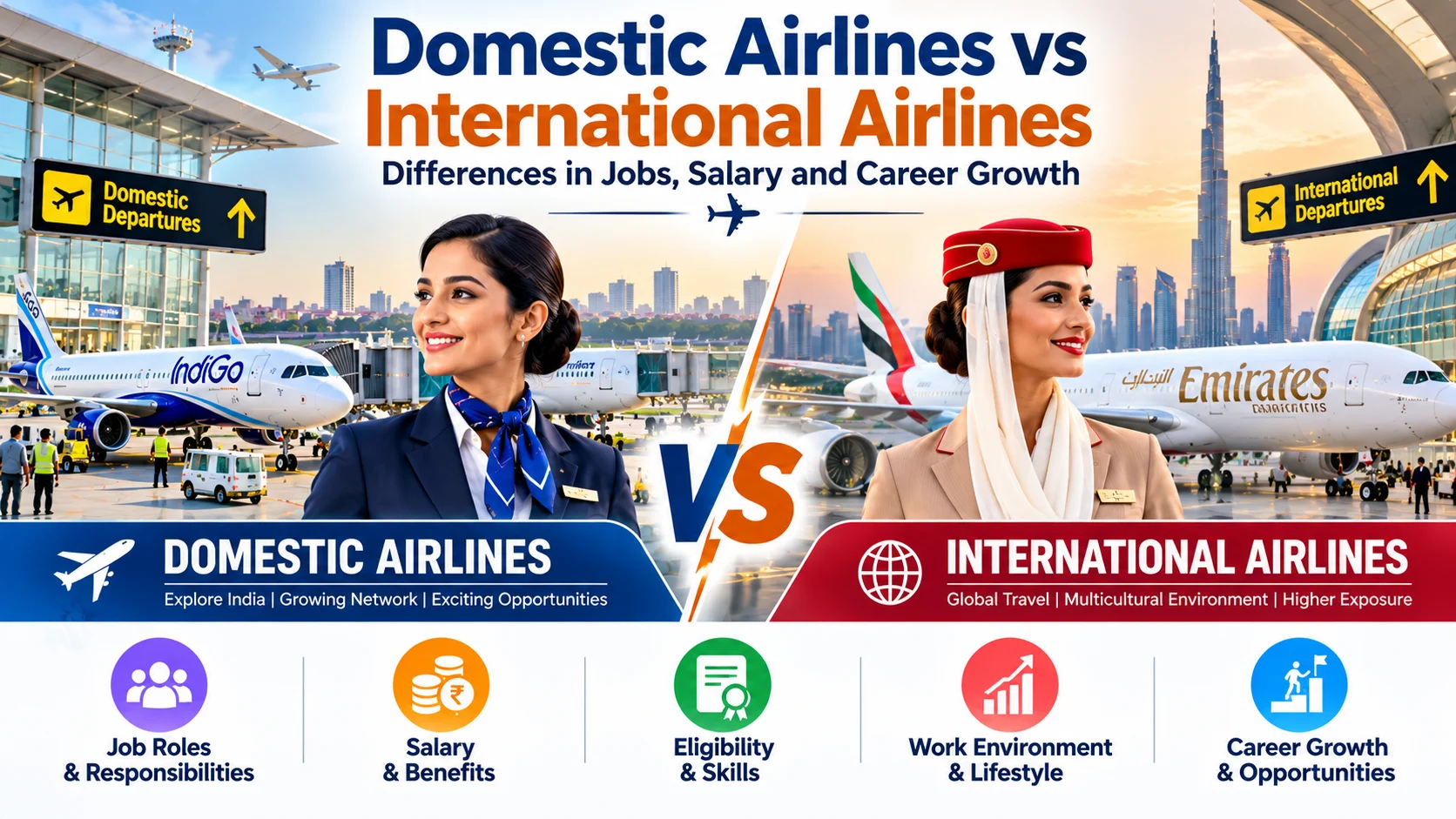
In this guide, we will compare Domestic Airlines vs International Airlines in terms of job roles, salary expectations, eligibility, working conditions and career growth to help you decide which path is right for you.
1. What Is the Difference Between Domestic and International Airlines?
The primary difference between domestic and international airlines is the geographical coverage of their flight operations.
A domestic flight operates between two destinations within the same country. For example, a flight from Kolkata to Delhi or Mumbai to Bengaluru is a domestic service. An international flight connects destinations in different countries, such as Delhi to Dubai, Mumbai to London or Bengaluru to Singapore.
Domestic airlines primarily serve routes within their home country, while international airlines operate cross-border services. However, many airlines operate in both markets. Air India, for example, connects Indian cities with destinations across the world. Therefore, a candidate should distinguish between an airline’s overall network and the specific route or department associated with a job.
Domestic airlines
Domestic airline operations focus on connecting cities within a country. In India, airlines such as IndiGo, Air India Express, Akasa Air and Alliance Air operate domestic services, although their networks and international operations differ.
Some common characteristics of domestic airline operations include:
- Shorter average flight durations on many routes.
- Frequent flights between major cities and regional destinations.
- High passenger movement during business hours, weekends and holiday periods.
- Strong emphasis on quick aircraft turnaround and schedule coordination.
- Opportunities in passenger services, cabin crew, ground handling and airline operations.
International airlines
International airlines connect passengers across national borders. They may operate short-haul regional flights as well as long-haul services between continents.
Examples include Emirates, Qatar Airways, Singapore Airlines and British Airways. Indian airlines such as Air India also operate international services.
Some characteristics of international airline operations include:
- Flights connecting multiple countries and international hubs.
- Greater exposure to different cultures, languages and passenger expectations.
- Additional documentation and border-related travel procedures.
- Longer flight durations on certain routes.
- Opportunities to work in international bases and multicultural teams, depending on the employer.
The important point is that domestic and international operations are not completely separate career industries. Many skills developed in one environment can be useful in the other.
2. What Job Opportunities Are Available in Domestic and International Airlines?
Both domestic and international airlines recruit professionals across operational, customer-facing, technical and commercial departments. The main difference lies in the airline’s network, location, scale of operations and specific recruitment requirements.
Cabin crew jobs
Cabin crew members are responsible for passenger safety, comfort and onboard services. In domestic operations, crew members may work on shorter routes with multiple flight sectors during a duty period. International operations can involve longer flights, different time zones and extended layovers, depending on the airline’s schedule.
For candidates interested in cabin crew jobs in India, domestic airlines can provide an opportunity to gain experience in passenger handling, safety procedures and in-flight service. International carriers may offer exposure to global routes and multicultural working environments.
Ground staff and airport services
Ground staff professionals support airline operations at airports. Their responsibilities may include check-in, boarding, baggage coordination, passenger assistance and flight-related customer service.
Domestic airline ground staff usually work with passengers travelling within the country. International airline services can involve additional coordination related to international travel documentation, immigration processes and destination-specific requirements.
Other airline career opportunities
Apart from cabin crew and ground staff, both domestic and international airlines recruit for several other departments:
- Flight operations: Supporting flight planning, operational coordination and dispatch-related activities.
- Reservations and ticketing: Managing bookings, cancellations, changes and passenger enquiries.
- Sales and marketing: Promoting airline services and managing corporate or travel-agent relationships.
- Revenue management: Analysing demand, pricing and seat availability.
- Cargo operations: Coordinating freight bookings, documentation and shipment handling.
- Engineering and maintenance: Supporting aircraft maintenance through appropriately qualified technical professionals.
- Human resources and administration: Managing recruitment, employee relations and organisational activities.
The range of opportunities is not limited to flying roles. Air India’s careers portal, for example, lists recruitment areas including cabin crew, flight operations, engineering, ground services, security, sales and marketing, finance and technology.
3. Domestic Airlines vs International Airlines: Salary, Benefits and Working Conditions
Salary is one of the most common considerations when comparing domestic airline jobs in India with international airline opportunities. However, it is not accurate to assume that every international airline pays more than every domestic airline.
Compensation depends on the employer, job role, experience, base location, employment contract, allowances and working hours. A senior professional at a domestic airline may earn more than an entry-level employee at an international carrier.
Salary expectations
Domestic airline employees are generally paid according to Indian employment structures and the specific terms of their employer. Entry-level cabin crew, ground staff and customer-service employees may receive fixed compensation along with applicable allowances or incentives.
International airline employees may receive compensation based on the country in which they are employed. Some overseas carriers provide additional benefits such as accommodation, transport, medical insurance or travel privileges, depending on the contract.
For example, Emirates and Qatar Airways advertise specific employee benefits for their cabin crew programmes, including accommodation or transport arrangements in applicable roles. These benefits should be evaluated alongside the salary, cost of living, tax rules and employment conditions.
Rather than comparing only the advertised monthly salary, candidates should examine the complete compensation package.
Working conditions
Domestic airline employees may work from an Indian airport base and operate on routes within the country or across a combination of domestic and international sectors. Their schedules can include early mornings, late nights, weekends and public holidays.
International airline employees may be based overseas or in another country, depending on the employer and role. Cabin crew may experience longer flights, time-zone changes and layovers. Ground staff and office-based employees generally follow schedules determined by their station and department.
Benefits and lifestyle
The benefits offered by airlines can vary considerably. Some may include:
- Medical insurance and employee wellness programmes.
- Travel concessions for employees and eligible family members.
- Accommodation or transport support for selected overseas roles.
- Performance-linked incentives.
- Training and professional development.
- Leave and retirement benefits according to employment terms.
Candidates should always check whether advertised benefits are guaranteed, conditional or available only to particular employee categories.
4. Eligibility, Qualifications and Skills: How Do Recruitment Requirements Differ?
The eligibility requirements for domestic and international airline jobs vary according to the employer and the specific position. A Class 12 qualification may be sufficient for some entry-level cabin crew or passenger-service roles, while technical, managerial and specialist positions may require a degree, professional certification or relevant work experience.
Domestic airline eligibility
For domestic airline recruitment in India, employers may assess:
- Educational qualifications, often Class 12 for certain entry-level positions.
- Communication skills in English and Hindi, depending on the role.
- Medical fitness and other role-specific requirements.
- Customer-service ability and professional presentation.
- Passport and other documents where required for the position.
As one example, Air India’s published cabin crew criteria include Indian nationality, a valid passport, Class 12 with at least 50% marks and specified age, height, vision and medical requirements. These are Air India-specific conditions and should not be treated as universal requirements for every domestic airline.
International airline eligibility
International airlines may have additional recruitment requirements because employees can be based overseas and serve passengers from different countries.
Depending on the airline, candidates may need:
- Strong spoken and written English.
- A valid passport and eligibility to meet the employer’s visa requirements.
- Medical fitness and role-specific physical criteria.
- Previous hospitality or customer-service experience for selected positions.
- Willingness to relocate or work from an overseas base.
For example, Emirates requires cabin crew applicants to be at least 21 years old, have completed high school, meet its reach requirement and demonstrate English proficiency. Qatar Airways also specifies English fluency, physical fitness and the ability to relocate to Doha.
Skills that help in both career paths
Whether you apply to a domestic or international airline, employers value communication, teamwork, problem-solving and professional behaviour.
Other useful skills include:
- Customer relationship management.
- Conflict resolution and passenger assistance.
- Time management and operational discipline.
- Cultural awareness and adaptability.
- Computer literacy and familiarity with relevant airline systems.
An aviation management course or hospitality qualification may help candidates understand airline operations, but it does not guarantee recruitment. Always compare the course curriculum with the actual requirements listed by employers.
5. Career Growth and Future Opportunities: Which Airline Should You Choose?
Both domestic and international airlines offer career growth, but the opportunities depend on the employee’s performance, experience, qualifications and the organisation’s internal structure.
A candidate who begins with a domestic airline may develop practical experience in passenger services, ground operations, cabin safety or airline administration. With relevant experience and by meeting the required selection criteria, that professional may later apply for an international airline position.
Similarly, someone who begins with an international carrier can develop global customer-service experience, operational knowledge and exposure to different markets. These skills may support future opportunities in airline management, training, customer experience or operational leadership.
Career growth in domestic airlines
Depending on the department and employer, possible progression routes include:
- Junior Cabin Crew to Senior Cabin Crew and Cabin Supervisor.
- Customer Service Executive to Team Leader and Airport Duty Manager.
- Ground Operations Executive to Supervisor and Station Manager.
- Sales Executive to Regional Sales or Commercial Manager.
- Operations Coordinator to Senior Operations and Management roles.
Career growth in international airlines
International carriers may offer opportunities in cabin crew leadership, station management, flight operations, customer experience, training, commercial functions and corporate departments.
Some employees may also explore internal transfers or opportunities across different international stations, subject to company policy and vacancies.
How is India’s aviation growth creating opportunities?
India’s aviation industry provides a strong foundation for both domestic and international airline careers. According to the Ministry of Civil Aviation, scheduled domestic airlines carried 165.5 million passengers in FY 2024–25, compared with 153.7 million in FY 2023–24, representing growth of 7.7%. International routes served by scheduled Indian and foreign carriers carried 74.14 million passengers in FY 2024–25.
These figures highlight the scale of passenger movement and the demand for professionals across airlines, airports and aviation support services.
Which option should you choose?
Choose a domestic airline career if you:
- Want to begin your aviation career in India.
- Prefer working from an Indian base.
- Want to gain experience in domestic passenger services or airline operations.
- Prefer to develop your career before considering overseas opportunities.
Choose an international airline career if you:
- Want exposure to international routes and multicultural teams.
- Are comfortable relocating or working from an overseas base.
- Meet the specific eligibility and language requirements.
- Are interested in global aviation operations and international work environments.
There is no single correct route. Starting with a domestic airline can be a practical way to build experience, while applying directly to an international airline may be suitable for candidates who already meet its recruitment requirements.
Conclusion
Choosing between domestic and international airlines depends on your career goals, preferred working environment, qualifications and willingness to travel or relocate. Domestic airlines can provide opportunities to build aviation experience within India, while international carriers may offer exposure to overseas bases, global routes and multicultural teams.
However, international airline jobs are not automatically better, and domestic airline careers should not be considered less rewarding. Salary, benefits and career progression depend on the employer, job role and individual performance.
Before applying, research the airline’s official recruitment criteria, compare the complete compensation package and understand the responsibilities of the position. Developing communication, customer-service, teamwork and operational skills can improve your readiness for both domestic and international opportunities.
Ultimately, the best choice in the Domestic Airlines vs International Airlines comparison is the one that aligns with your professional ambitions and gives you the opportunity to grow in the aviation industry.
Frequently Asked Questions (FAQs)
1. What is the main difference between domestic and international airlines?
Domestic airline services connect destinations within the same country, while international airline services connect destinations in different countries. Some airlines operate both domestic and international routes.
2. Do international airlines pay more than domestic airlines?
Not always. Some international airlines offer higher compensation or additional benefits, but salaries vary by employer, role, experience, location and employment contract. Candidates should compare total compensation rather than basic salary alone.
3. Can I join an international airline after working for a domestic airline?
Yes. Relevant experience in cabin crew, ground services, customer support or airline operations may help when applying to international carriers. However, candidates must still meet the international airline’s eligibility and recruitment requirements.
4. Can I apply for domestic or international airline jobs after Class 12?
Yes. Some entry-level cabin crew and passenger-service positions accept candidates who have completed Class 12. Requirements differ between employers, and technical or managerial positions may require additional qualifications.
5. Which is better for a fresher: domestic or international airline jobs?
A domestic airline may be a practical starting point for freshers who want to build experience in India. However, freshers can also apply directly to international airlines if they meet the advertised requirements. The best option depends on eligibility, career goals and personal circumstances.