Introduction
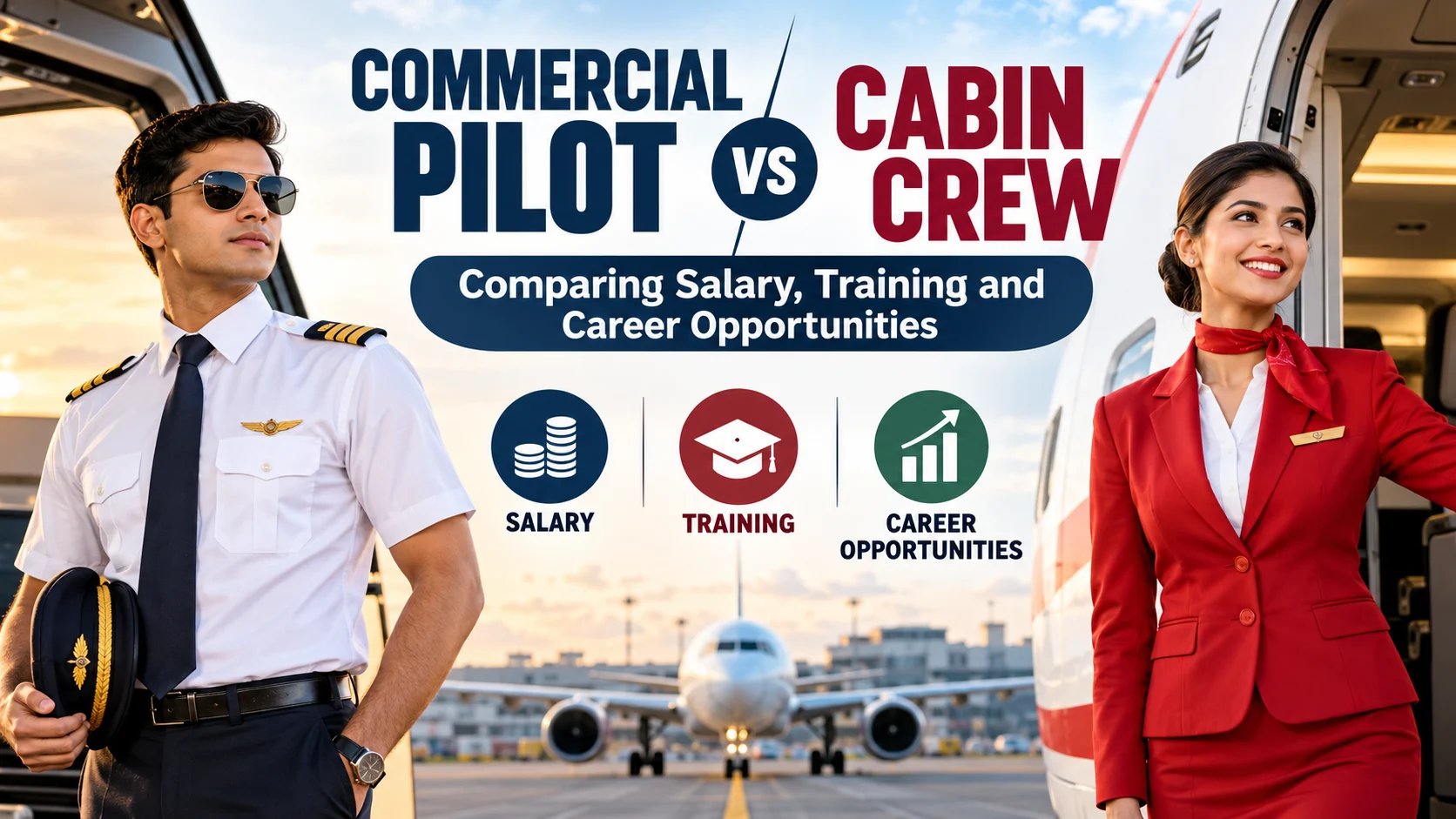
Choosing a career in aviation can be exciting, especially for students who dream of working in the airline industry. However, not every aviation career follows the same path. Two popular career options are becoming a Commercial Pilot and working as a Cabin Crew Member.
Both professions offer opportunities to travel, work with international airlines, meet people from different cultures and build a rewarding career. However, they differ significantly in terms of eligibility, training requirements, investment, salary, responsibilities and long-term career growth.
If you are confused between becoming a commercial pilot and joining an airline as cabin crew, understanding these differences can help you make a better career decision.
In this guide, we will compare commercial pilot vs cabin crew careers in India, covering salary expectations, training duration, qualifications, job responsibilities and future opportunities.
1. What Is a Commercial Pilot?
A commercial pilot is a trained aviation professional responsible for operating aircraft and ensuring the safe transportation of passengers and cargo.
Commercial pilots work with domestic and international airlines, cargo operators, charter companies and other aviation organisations.
Their primary responsibility is to operate an aircraft safely while following aviation regulations, flight plans and instructions from air traffic control.
Key responsibilities of a commercial pilot:
- Operating and controlling aircraft during different phases of flight.
- Reviewing flight plans, weather conditions and technical reports.
- Conducting pre-flight and post-flight inspections.
- Communicating with air traffic control.
- Monitoring aircraft systems and fuel levels.
- Ensuring passenger and crew safety during flights.
- Following aviation regulations and standard operating procedures.
Becoming a commercial pilot requires specialised technical knowledge, extensive flight training and the necessary aviation licences.
2. What Is a Cabin Crew Member?
A cabin crew member, commonly known as a flight attendant, is responsible for passenger safety, comfort and service during a flight.
Cabin crew professionals work inside the aircraft cabin and ensure passengers have a safe and comfortable flying experience.
Although passenger service is an important part of the role, safety remains their primary responsibility.
Key responsibilities of cabin crew:
- Conducting pre-flight safety checks.
- Demonstrating emergency procedures and safety equipment.
- Assisting passengers during boarding and deboarding.
- Providing food, beverages and other in-flight services.
- Handling passenger queries and special requests.
- Managing emergency situations and medical incidents.
- Ensuring compliance with airline safety procedures.
Cabin crew members require strong communication skills, confidence, customer service abilities and the ability to handle challenging situations professionally.
3. Commercial Pilot vs Cabin Crew: Key Differences
Although both professions operate within the same aviation industry, their responsibilities and career requirements are quite different.
| Comparison | Commercial Pilot | Cabin Crew |
|---|---|---|
| Primary role | Flying and operating aircraft | Passenger safety and service |
| Education | 10+2 with Physics and Mathematics for the standard Indian CPL route | Usually 10+2 |
| Training | Ground school and flight training | Airline or aviation-specific training |
| Licence | Commercial Pilot Licence (CPL) | No DGCA pilot licence required |
| Training duration | Often 18–36 months or longer | Often a few months, depending on the airline |
| Initial investment | Very high | Generally lower |
| Salary potential | Higher at senior levels | Moderate to high with experience |
| Work environment | Cockpit | Aircraft cabin |
| Key skills | Technical knowledge and decision-making | Communication and passenger management |
| Career progression | First Officer to Captain | Junior Cabin Crew to Senior Cabin Crew and management roles |
The most important distinction is that pilots operate the aircraft, whereas cabin crew members are responsible for passenger safety and service inside the cabin.
4. Eligibility Criteria: Who Can Apply?
The eligibility requirements for commercial pilots and cabin crew members are different.
Commercial Pilot Eligibility in India
To become a commercial pilot in India, candidates generally need to meet the following requirements:
- Complete Class 12 with Physics and Mathematics from a recognised board or equivalent.
- Meet the minimum age requirement of 18 years for a CPL.
- Obtain the required DGCA medical clearance.
- Pass the applicable DGCA examinations.
- Complete the prescribed flying hours and training.
- Pass the required skill tests and meet licensing conditions.
Students who studied Commerce or Arts can also explore the pilot career path by completing Physics and Mathematics at the required 10+2 level through an accepted board or equivalent route.
For example, Air India’s Cadet Pilot Programme accepts eligible candidates who meet its academic requirements and medical standards, including those who complete the missing subjects through NIOS. Pariksha DGCA+1
Cabin Crew Eligibility in India
Cabin crew eligibility varies from one airline to another. However, the general requirements include:
- Completion of Class 12 from a recognised board.
- Good communication skills in English and, preferably, other languages.
- Good interpersonal and customer service skills.
- Medical fitness and the ability to meet airline-specific physical requirements.
- Professional grooming and a positive attitude.
- Ability to work flexible schedules, including weekends and holidays.
Aviation or hospitality qualifications can be helpful, but a specialised cabin crew diploma is not universally compulsory.
Important: Airlines may have their own age, height, vision, language and other recruitment requirements. Always check the latest official recruitment notification before applying.
5. Training and Course Duration: Pilot vs Cabin Crew
Training is one of the biggest differences between these two aviation careers.
Commercial Pilot Training
Commercial pilot training is a technical and practical programme that prepares candidates to operate aircraft.
The training generally includes:
- Ground School: Learning aviation meteorology, air navigation, air regulations and aircraft technical subjects.
- DGCA Examinations: Clearing the applicable theoretical examinations.
- Flying Training: Completing the required flying hours at a DGCA-approved Flying Training Organisation (FTO).
- Medical Assessment: Meeting the prescribed aviation medical standards.
- Skill Tests: Demonstrating the ability to operate an aircraft safely.
- Additional Qualifications: Obtaining the necessary instrument and multi-engine ratings and aircraft-specific qualifications as required for airline employment.
The standard CPL route requires a minimum of 200 hours of flying experience under the applicable licensing requirements. Ministry of Civil Aviation+1
Estimated duration: 18–36 months or longer, depending on training progress, weather, aircraft availability and examinations.
Cabin Crew Training
Cabin crew training is comparatively shorter and focuses on passenger safety, emergency response and in-flight service.
The training generally covers:
- Aviation fundamentals and airline operations.
- Aircraft familiarisation.
- Passenger handling and customer service.
- Emergency evacuation procedures.
- Firefighting and safety equipment.
- First aid and medical emergencies.
- Grooming and professional communication.
- Security procedures and teamwork.
Most airlines conduct their own induction and training programmes after selecting candidates.
Candidates can also pursue aviation, hospitality or cabin crew courses to improve their industry knowledge and interview preparation.
Estimated duration: A few weeks to several months, depending on the airline and training programme.
6. Commercial Pilot vs Cabin Crew Salary in India
Salary is one of the most important factors students consider when choosing an aviation career.
Commercial pilots generally have a higher earning potential, particularly after gaining experience and progressing to the position of Captain.
Cabin crew members can also earn attractive salaries, especially with established domestic and international airlines.
Commercial Pilot Salary in India
The salary of a commercial pilot depends on the airline, aircraft type, experience, flying hours and designation.
The following figures are indicative monthly compensation ranges, not guaranteed salaries.
| Position | Estimated monthly earnings |
|---|---|
| Junior First Officer | ₹1.5–2 lakh |
| First Officer | ₹2–3.5 lakh |
| Senior First Officer | ₹3.5–5 lakh |
| Captain | ₹5–10 lakh |
| Senior / International Captain | ₹8–15 lakh+ |
Source: Indicative industry salary estimates. Actual compensation varies by airline and employment terms. ThePilot.in+1
Cabin Crew Salary in India
Cabin crew salaries depend on the airline, experience, flight hours, domestic or international routes and additional allowances.
An indicative salary progression may look like this:
| Position | Estimated monthly earnings |
|---|---|
| Trainee Cabin Crew | ₹20,000–35,000 |
| Junior Cabin Crew | ₹30,000–50,000 |
| Experienced Cabin Crew | ₹45,000–75,000 |
| Senior Cabin Crew | ₹60,000–1 lakh |
| Cabin Crew Supervisor / In-charge | ₹75,000–1.2 lakh+ |
These are broad illustrative estimates, not official airline pay scales. Actual take-home salary can vary considerably.
Which Career Offers a Higher Salary?
Higher earning potential
Commercial Pilot
Commercial pilots generally earn more than cabin crew members, especially after becoming First Officers and Captains.
However, it is important to consider the initial investment involved in pilot training. A high salary does not necessarily mean a better financial return for every student.
Cabin crew careers generally have a lower entry barrier in terms of training investment, allowing candidates to start earning earlier.
7. Training Fees and Financial Investment
Another major difference between commercial pilot and cabin crew careers is the cost of training.
Commercial Pilot Training Fees
Becoming a commercial pilot requires a substantial financial investment.
In India, CPL training can cost approximately ₹35 lakh to ₹60 lakh or more, depending on the flying school, training location, aircraft availability and additional requirements.
Additional expenses may include:
- DGCA examination fees.
- Medical examination costs.
- Accommodation and living expenses.
- Study materials and equipment.
- Type rating and additional qualifications.
- Travel and other training-related expenses.
Candidates should obtain a detailed fee structure from DGCA-approved flying schools before enrolling.
Cabin Crew Training Fees
Cabin crew training generally requires a much smaller investment.
Candidates may choose between:
- Airline-sponsored training after selection.
- Private aviation training institutes.
- Diploma or certificate programmes in aviation and hospitality.
- Short-term personality development and communication courses.
Private institute fees can vary significantly depending on the course, duration and facilities.
It is worth remembering that completing a private cabin crew course does not guarantee an airline job. Many airlines recruit candidates directly and provide their own mandatory training.
8. Career Opportunities and Growth
Both professions offer opportunities for career advancement, but their progression paths are different.
Commercial Pilot Career Growth
A commercial pilot can progress through several positions based on experience, flight hours, performance and licensing requirements.
Commercial Pilot Career Path
- Commercial Pilot Licence (CPL)Completes the licensing and training requirements.
- Junior First OfficerBegins airline flying under the required supervision.
- First OfficerGains operational experience as a co-pilot.
- Senior First OfficerBuilds experience and prepares for command responsibilities.
- CaptainTakes command of the aircraft after meeting all requirements.
- Training Captain / ExaminerMay move into specialised training and assessment roles.
Other opportunities include:
- Cargo aviation.
- Charter and private aviation.
- Corporate aviation.
- Flight instruction.
- Aviation training and examination roles.
- Helicopter operations, with the relevant qualifications.
Cabin Crew Career Growth
Cabin crew members can also develop long-term careers within the airline industry.
Cabin Crew Career Path
- Trainee Cabin CrewCompletes airline induction and safety training.
- Junior Cabin CrewStarts working on scheduled flights.
- Senior Cabin CrewTakes on greater operational and passenger management responsibilities.
- Cabin Supervisor / In-chargeCoordinates cabin operations and manages the cabin team.
- Cabin Crew ManagerHandles team management, training and operational responsibilities.
Additional career opportunities include:
- Cabin crew trainer.
- In-flight service manager.
- Airline customer experience manager.
- Ground operations executive.
- Airport operations management.
- Airline training and recruitment.
9. Work Environment and Lifestyle
The lifestyle of a commercial pilot and a cabin crew member can be quite different, even though both spend considerable time travelling.
| Factor | Commercial Pilot | Cabin Crew |
|---|---|---|
| Workplace | Aircraft cockpit | Aircraft cabin |
| Working hours | Based on flight schedules and duty limitations | Based on flight schedules and duty limitations |
| Passenger interaction | Limited | Frequent |
| Physical demands | Concentration and decision-making | Standing, walking and passenger assistance |
| Travel opportunities | Domestic and international | Domestic and international |
| Time away from home | Depends on roster and routes | Depends on roster and routes |
| Work pressure | Flight safety and operational decisions | Passenger safety and service management |
Lifestyle of a Commercial Pilot
Pilots must maintain high levels of concentration and discipline. Their schedules may include early morning departures, overnight duties and long-haul flights.
They are responsible for making critical operational decisions and maintaining compliance with aviation safety standards.
Lifestyle of Cabin Crew
Cabin crew members spend considerable time interacting with passengers and managing in-flight responsibilities.
Their work can involve long periods of standing, irregular schedules, jet lag and handling difficult passenger situations.
Both professions require flexibility, discipline and the ability to maintain a professional attitude under pressure.
10. Skills Required: Pilot vs Cabin Crew
The skills required for these two professions are different because their job responsibilities are different.
| Commercial Pilot Skills | Cabin Crew Skills |
|---|---|
| Technical knowledge | Communication skills |
| Decision-making | Customer service |
| Analytical thinking | Problem-solving |
| Situational awareness | Teamwork |
| Leadership | Conflict management |
| Concentration | Adaptability |
| Risk management | Emotional intelligence |
| Technical proficiency | Professional grooming |
Students interested in becoming pilots should have an aptitude for mathematics, physics, technical learning and analytical decision-making.
Students interested in cabin crew careers should focus on communication, confidence, interpersonal skills and passenger management.
11. Which Career Is Better After 12th?
There is no universal answer because the right career depends on your academic background, financial situation, personality and professional goals.
Here is a simple comparison to help you decide.
Choose Commercial Pilot if:
- You are passionate about flying aircraft.
- You have an interest in science, mathematics and technology.
- You can meet the required medical standards.
- You are financially prepared for extensive flight training.
- You want to build a career in aircraft operations.
- You aspire to become an airline Captain.
Choose Cabin Crew if:
- You enjoy interacting with people.
- You have good communication skills.
- You are interested in travelling and hospitality.
- You enjoy working in a team.
- You can handle challenging customer situations.
- You want to enter the aviation industry without the high investment required for pilot training.
For students who are unsure about their career direction, speaking with aviation professionals and understanding actual job responsibilities can be helpful before enrolling in any course.
12. Can You Switch Careers Between Pilot and Cabin Crew?
Yes, it is possible to move from one aviation career to another, but the transition requires meeting the relevant qualifications.
Cabin Crew to Commercial Pilot
A cabin crew member who wants to become a commercial pilot must complete the required academic qualifications, medical assessments, DGCA examinations and flying training.
Previous cabin crew experience may provide valuable exposure to airline operations, but it does not replace the requirements for a CPL.
Commercial Pilot to Cabin Crew
A commercial pilot can apply for cabin crew positions if they meet the airline’s recruitment criteria.
However, pilot licences and flight experience do not automatically qualify someone for cabin crew employment. They must complete the airline’s selection and training requirements.
13. Future Career Opportunities in the Indian Aviation Industry
India’s aviation industry continues to offer career opportunities across airlines, airports, cargo operations, aviation training and other related sectors.
The Ministry of Civil Aviation reports that India has 41 DGCA-approved Flying Training Organisations with 63 bases and issued 1,652 CPLs during 2025. This reflects the scale of India’s pilot-training ecosystem. Ministry of Civil Aviation
The industry’s growth creates opportunities not only for pilots and cabin crew but also for professionals in:
- Airport management.
- Airline management.
- Ground handling.
- Aviation safety and security.
- Cargo and logistics.
- Aircraft maintenance.
- Passenger service management.
- Aviation training and education.
Students should understand that industry growth does not guarantee immediate employment. Career opportunities depend on qualifications, recruitment demand, experience and individual performance.
Conclusion: Commercial Pilot vs Cabin Crew – Which Should You Choose?
Both commercial pilot and cabin crew careers offer exciting opportunities in the aviation industry. However, they are designed for individuals with different interests, skills and career aspirations.
If your ambition is to fly aircraft, take operational responsibility and earn a higher income over the long term, becoming a commercial pilot may be the right choice. However, you must be prepared for extensive training, licensing requirements and significant financial investment.
On the other hand, if you enjoy travelling, interacting with people and delivering excellent passenger experiences, a cabin crew career can be an excellent starting point in aviation.
Ultimately, the best career is not necessarily the one with the highest salary. It is the one that matches your abilities, interests and long-term professional goals.
Make an informed decision, understand the eligibility requirements and choose a career path that allows you to grow in the aviation industry.
Frequently Asked Questions (FAQs)
1. Which career is better, commercial pilot or cabin crew?
Both careers offer different opportunities. Commercial pilots generally have higher earning potential and technical responsibilities, while cabin crew members focus on passenger safety, service and in-flight operations. The better choice depends on your interests, qualifications and financial resources.
2. Can I become a commercial pilot after completing Class 12?
Yes. You can pursue commercial pilot training after Class 12 if you meet the required academic, medical and licensing criteria. Physics and Mathematics at the 10+2 level are generally required for the standard Indian CPL route.
3. What is the salary of a commercial pilot in India?
Commercial pilot salaries vary by airline, experience and designation. An indicative monthly range can start around ₹1.5–2 lakh for a junior First Officer and increase to ₹5–10 lakh or more for experienced Captains.
4. Is cabin crew training compulsory to get an airline job?
A private cabin crew diploma is not compulsory for every airline. Many airlines recruit candidates directly and provide their own mandatory safety and service training after selection.
5. Can Arts or Commerce students become cabin crew or commercial pilots?
Yes. Arts and Commerce students can apply for cabin crew positions if they meet airline-specific requirements. They can also pursue commercial pilot training by completing the required Physics and Mathematics qualifications at the 10+2 level through an accepted route.
SEO Details
| SEO Element | Recommendation |
|---|---|
| Primary Focus Keyword | Commercial Pilot vs Cabin Crew |
| SEO Title | Commercial Pilot vs Cabin Crew: Salary, Training & Career |
| URL Slug | commercial-pilot-vs-cabin-crew |
| Meta Description | Compare commercial pilot vs cabin crew careers in India. Explore salary, training fees, eligibility, job roles and career opportunities after 12th. |
| Search Intent | Informational |
| Secondary Keywords | Commercial pilot salary in India, cabin crew salary in India, pilot vs air hostess, aviation careers after 12th, pilot training fees in India, cabin crew eligibility |