Introduction
The aviation industry in India offers exciting career opportunities for students and professionals interested in airport management, airline operations, cabin crew, aircraft engineering, customer service and aviation administration.
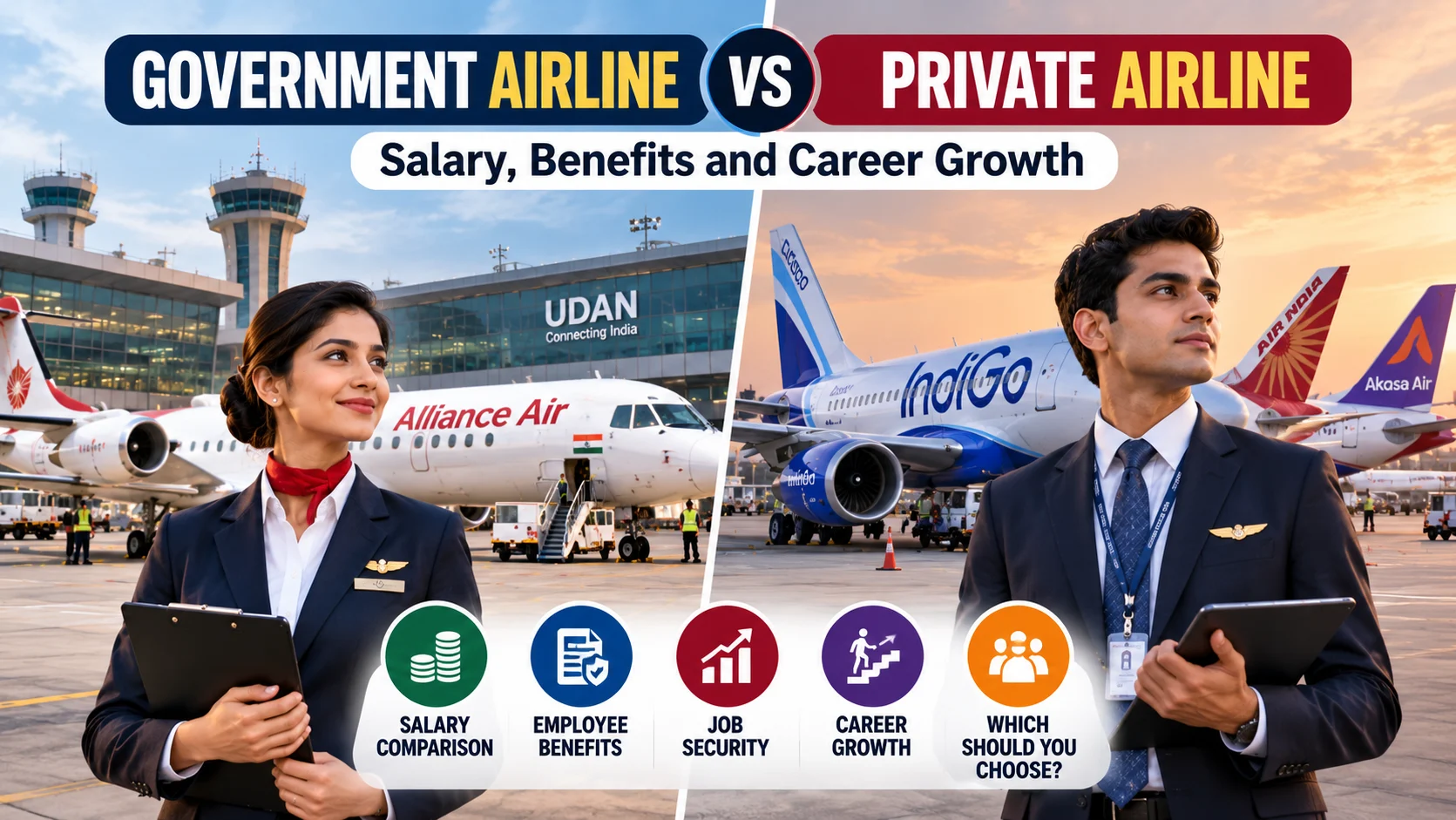
However, one important decision students often face is whether to build their career with a government-owned airline or a private airline.
Both offer opportunities to work in a dynamic aviation environment, travel, develop professional skills and grow into managerial positions. However, they can differ in terms of salary structures, employee benefits, recruitment procedures, job contracts, work culture and career progression.
For example, government-owned aviation organisations may offer structured compensation and certain employment benefits, while private airlines may offer different compensation models, performance-linked incentives and opportunities across expanding business operations.
But is working for a government airline always more secure? Do private airlines pay higher salaries? Which offers better career growth?
In this article, we will compare government-owned and private airlines in India using publicly available information, official recruitment notifications and aviation industry data.
Important clarification: Air India is no longer a government-owned airline. Its strategic disinvestment was completed on 27 January 2022, when the Tata Group took over its management and control. Alliance Air, meanwhile, is a government-owned airline through AI Assets Holding Limited (AIAHL). Press Information Bureau+1
1. What Is a Government Airline?
A government airline is an airline owned or controlled by the government, either directly or through a government-owned company.
In India, Alliance Air is an important example. It operates as a wholly owned subsidiary of AI Assets Holding Limited (AIAHL), a Government of India undertaking under the administrative control of the Ministry of Civil Aviation.
Its primary role includes providing regional air connectivity, particularly to smaller cities and underserved destinations. It also participates in the government’s Regional Connectivity Scheme (UDAN). Ministry of Civil Aviation+1
Examples of Government-Owned Aviation Organisations
- Alliance Air: Operates regional passenger services.
- AI Assets Holding Limited: A government-owned holding company responsible for managing aviation-related subsidiaries and assets.
- Airports Authority of India (AAI): A government organisation responsible for developing, managing and operating designated airports and air navigation infrastructure.
It is important to distinguish between a government-owned airline and a government aviation organisation. Working at AAI, for example, is not the same as working for an airline.
What Is It Like to Work for a Government-Owned Airline?
Employees may work in departments such as:
- Airport and ground operations.
- Flight operations.
- Aircraft engineering and maintenance.
- Cabin crew and passenger services.
- Finance and administration.
- Human resources.
- Aviation safety and security.
- Commercial and regional operations.
Depending on the position, employment may be permanent, contractual or fixed-term.
A government ownership structure does not automatically mean that every employee receives government employee status or civil-service benefits.
2. What Is a Private Airline?
A private airline is an airline owned and operated by private companies or corporate groups rather than being directly owned by the government.
Private airlines operate through commercial business models and compete for passengers, routes, market share and operational efficiency.
India has several major private airline operators, including:
- IndiGo
- Air India
- Air India Express
- SpiceJet
- Akasa Air
Air India and Air India Express are part of the Tata Group following their privatisation in January 2022. Air India Newsroom & Press Releases+2
What Is It Like to Work for a Private Airline?
Private airlines recruit professionals across various operational and corporate departments.
Common career areas include:
- Cabin crew and passenger services.
- Airport services and ground operations.
- Flight operations.
- Aircraft maintenance and engineering.
- Sales and marketing.
- Revenue management.
- Customer experience.
- Finance and administration.
- Human resources.
- Aviation safety and compliance.
Private airlines may offer opportunities to work across multiple locations, operational departments and specialised business functions.
Their recruitment and compensation policies are generally determined by company requirements, employment contracts and applicable labour laws.
3. Government Airline vs Private Airline: Key Differences
Understanding the differences between these two employment environments can help students make an informed career decision.
| Comparison | Government-Owned Airline | Private Airline |
|---|---|---|
| Ownership | Government-owned company or holding structure | Private company or corporate group |
| Recruitment | Official recruitment notifications and selection procedures | Company recruitment and selection processes |
| Salary structure | Organisation-specific pay and compensation policies | Company-specific compensation policies |
| Employment | Permanent or contractual, depending on position | Permanent or contractual, depending on position |
| Benefits | As specified in employment terms and company policies | As specified in employment terms and company policies |
| Job security | Depends on contract and organisational circumstances | Depends on contract and organisational circumstances |
| Performance incentives | Depends on company policy | May include performance-linked incentives |
| Career growth | Based on vacancies, experience and internal policies | Based on performance, vacancies and organisational structure |
| Work culture | Organisation-specific | Organisation-specific |
| Transfers | May be required depending on operational needs | May be required depending on operational needs |
The important point: Government ownership does not automatically guarantee permanent employment, while private employment does not automatically mean less job security. The actual employment contract matters more than the ownership label alone.
4. Salary Comparison: Government Airline vs Private Airline in India
Salary is one of the most important factors when choosing between a government-owned and private airline.
However, there is no single salary structure applicable to all government or private airline employees. Compensation depends on the job role, experience, qualifications, aircraft type, flying hours, employment category and company policies.
To make this comparison meaningful, let’s examine actual publicly available compensation information.
Government Airline Salary: Alliance Air
Alliance Air publishes employee remuneration information under its Right to Information (RTI) disclosures.
Its RTI document dated 29 October 2025 provides the following monthly remuneration figures for selected positions:
| Job Designation | Published Monthly Remuneration |
|---|---|
| Supervisor | ₹23,121 |
| Senior Supervisor | ₹27,005 |
| Assistant Officer / Assistant Crew Controller | ₹29,516 |
| Officer / Crew Controller | ₹36,100 |
| Flight Dispatcher | ₹47,475 |
| Assistant Manager | ₹39,220 |
| Manager | ₹42,300 |
| Senior Manager | ₹65,000 |
| Cabin Crew (up to 65 flying hours) | ₹36,175 |
| Commander | ₹6,83,000 |
Source: Alliance Air, RTI disclosure dated 29 October 2025, Manual 10. These are published remuneration figures for listed positions, not a universal salary scale or guaranteed offers for new recruits. plone.allianceair.in+1
An additional example comes from Alliance Air’s recruitment notification dated 12 December 2025.
The company advertised a Business Analyst position at Officer-to-Manager level with monthly emoluments ranging from ₹36,100 to ₹42,000, along with medical, travel, provident fund, gratuity and bonus benefits as applicable. plone.allianceair.in
These figures demonstrate that government-owned airline employment can include a range of compensation structures depending on the position.
Private Airline Salary in India
Private airlines generally do not publish a consolidated salary chart covering every employee designation.
Compensation is usually communicated through recruitment offers, employment contracts and company-specific policies.
Salary packages can include:
- Fixed monthly salary.
- Flying-hour or duty-related allowances.
- Performance-linked incentives.
- Sales or productivity incentives.
- Medical insurance.
- Travel concessions.
- Provident fund and other applicable statutory benefits.
For example, Air India’s published remuneration policy describes employee compensation in terms of fixed salary, allowances, perquisites, medical coverage and retirement benefits, subject to applicable limits and policies. Air India
For pilots, compensation can vary substantially depending on aircraft type, rank, experience and flying responsibilities. Cabin crew and ground operations employees have different compensation structures.
Why are exact salary comparisons difficult?
Unlike Alliance Air’s RTI disclosure, private airlines do not necessarily publish employee-wise or designation-wise salary information. Therefore, presenting an unsupported figure as the official salary of an entire private airline would be misleading.
For an accurate comparison, students should examine the actual job offer, including fixed pay, variable components, allowances and deductions.
5. Employee Benefits: Government Airline vs Private Airline
Salary is only one component of total compensation. Employee benefits can also influence the overall value of a job.
Let’s understand what employees may receive in both types of organisations.
Benefits in Government-Owned Airlines
Government-owned airline employees may receive benefits such as:
- Provident Fund: Retirement savings benefits according to applicable rules and employment conditions.
- Gratuity: Benefits subject to eligibility and applicable legislation.
- Medical Benefits: Medical insurance or healthcare benefits according to company policy.
- Travel Concessions: Discounted or free air travel for employees and eligible family members, where applicable.
- Leave Benefits: Paid leave and other leave entitlements according to employment terms.
- Bonus: Bonus or other incentives where applicable under company policy.
- Employment Structure: Some positions may offer longer-term employment arrangements, while others are contractual.
An actual example is Alliance Air’s recruitment notification, which specifies free or concessional air passages for employees and declared family members on its network, along with provident fund and gratuity benefits as per company policy. plone.allianceair.in+1
Benefits in Private Airlines
Private airlines may provide several employee benefits, depending on designation and employment category.
These may include:
- Medical Insurance: Health coverage for employees and, in some cases, eligible dependants.
- Travel Benefits: Concessional or discounted tickets.
- Performance Incentives: Variable pay or performance-related rewards for eligible positions.
- Retirement Benefits: Provident fund, gratuity and other applicable benefits.
- Professional Training: Role-specific technical, operational and customer service training.
- Employee Assistance: Wellness and employee support programmes.
- Career Development: Internal job opportunities and specialised training.
For example, Air India’s official pilot careers programme lists travel privileges, medical insurance, loss-of-licence protection, group life insurance, personal accident cover and certain parental leave benefits. These are programme-specific benefits and should not be assumed to apply identically to every Air India employee. Air India Pilot Careers+1
Which Offers Better Employee Benefits?
There is no universal answer.
A government-owned airline may offer structured benefits under its employment policies, while a private airline may provide a different combination of insurance, travel privileges, allowances and performance incentives.
The best way to compare two offers is to calculate their total annual value rather than comparing only the monthly salary.
6. Job Security: Is a Government Airline Job More Secure?
Job security is one of the common reasons candidates consider government-owned organisations.
However, it is important to understand the difference between government ownership and government employment.
A government-owned airline is still a commercial organisation. Its employees are not automatically government servants.
For example, Alliance Air’s recruitment notifications specify fixed-term employment agreements for certain positions, with extension subject to satisfactory performance. plone.allianceair.in+1
Private airlines also recruit through different employment arrangements, including permanent and fixed-term contracts.
Job security can depend on:
- Nature of the employment contract.
- Financial performance of the organisation.
- Employee performance.
- Business restructuring.
- Operational requirements.
- Applicable labour laws.
- Availability of permanent vacancies.
What should candidates check before accepting an offer?
- Is the position permanent or contractual?
- What is the contract duration?
- Are there provisions for contract renewal?
- What is the notice period?
- Are there performance-based termination conditions?
- Are medical and retirement benefits included?
These details are more useful than assuming that every government airline position is permanent.
7. Career Growth: Government Airline vs Private Airline
Career progression is another major factor when choosing an airline.
Both government-owned and private airlines offer opportunities to move into senior operational, technical and managerial positions.
However, promotion structures, internal vacancies and organisational requirements can differ.
Career Growth in Government-Owned Airlines
Employees may progress through positions based on experience, qualifications, performance and organisational policies.
A typical operations career pathway could look like this:
Government Airline Career Path
- Junior Executive / TraineeStarts with operational and administrative responsibilities.
- Executive / OfficerHandles specific operational activities and departmental responsibilities.
- Assistant ManagerCoordinates teams and manages assigned functions.
- ManagerSupervises departmental activities and operational performance.
- Senior Manager / Department HeadOversees larger teams, budgets and strategic activities.
Other career opportunities may include:
- Flight Operations Management.
- Airport Operations Management.
- Aviation Safety.
- Aircraft Engineering.
- Finance and Administration.
- Human Resource Management.
- Commercial Operations.
Actual designations and promotion structures vary by organisation.
Career Growth in Private Airlines
Private airlines may provide opportunities for career advancement through experience, performance, specialised skills and internal vacancies.
A typical airline operations career pathway could look like this:
Private Airline Career Path
- Trainee / Junior ExecutiveLearns airline operations and departmental procedures.
- Executive / Senior ExecutiveTakes responsibility for daily operational activities.
- Assistant ManagerCoordinates teams and manages specific operational functions.
- ManagerHandles departmental performance and operational targets.
- Senior Manager / Head of DepartmentOversees strategic planning and larger business functions.
Private airlines may also offer opportunities to move between departments such as airport services, customer experience, commercial operations, revenue management and corporate functions, subject to qualifications and internal requirements.
Which Offers Better Career Growth?
Career growth depends on the individual organisation and the position.
Candidates should examine:
- Internal promotion policies.
- Training and development opportunities.
- Availability of senior positions.
- Performance appraisal systems.
- Opportunities for departmental transfers.
- Scope for specialised professional qualifications.
A private airline may offer opportunities in rapidly changing business functions, while a government-owned organisation may have more formalised recruitment and promotion procedures. Neither arrangement guarantees faster advancement.
8. Recruitment Process: Government Airline vs Private Airline
The recruitment process is another important difference between the two employment environments.
Government-Owned Airline Recruitment
Government-owned airlines generally publish vacancies through official recruitment portals and notifications.
For example, Alliance Air publishes recruitment advertisements through its official careers section.
The recruitment process may include:
- Checking the official recruitment notification.
- Verifying educational qualifications and experience.
- Submitting an application.
- Appearing for written examinations, interviews or skill assessments, where applicable.
- Completing document verification.
- Completing medical assessments, where required.
- Receiving an employment offer.
Some positions may have age limits, reservation provisions and specific experience requirements.
Candidates should regularly check official recruitment announcements rather than relying on third-party job advertisements.
Private Airline Recruitment
Private airlines generally conduct recruitment through their official career websites and authorised recruitment channels.
The process may include:
- Searching for relevant job openings.
- Submitting an online application.
- Resume screening.
- Aptitude tests or technical assessments, where applicable.
- Personal or technical interviews.
- Group discussions or assessment activities for selected positions.
- Background verification and medical assessments, where required.
- Final employment offer.
Private airlines may recruit throughout the year depending on operational requirements and business expansion.
Official recruitment websites:
9. Work Culture: Government Airline vs Private Airline
Work culture can influence employee satisfaction, professional development and long-term career decisions.
However, it is important not to assume that all government-owned airlines or private airlines follow the same working culture.
Work Culture in Government-Owned Airlines
Government-owned airline employees may experience:
- Formal organisational structures.
- Defined departmental responsibilities.
- Established administrative procedures.
- Structured reporting systems.
- Organisation-specific performance evaluation.
- Fixed-term or permanent employment arrangements.
The actual work environment depends on the organisation, department and job designation.
Work Culture in Private Airlines
Private airlines may emphasise:
- Operational efficiency.
- Customer experience.
- Productivity and performance.
- Commercial targets.
- Technology adoption.
- Team coordination.
- Operational flexibility.
Employees may work in a fast-paced environment, particularly in customer-facing and airline operations departments.
However, work pressure and flexibility differ between employers and positions.
10. Which Airline Offers Better Opportunities for Freshers?
Fresh graduates and students completing aviation-related courses often want to know where they should apply first.
Both government-owned and private airlines can offer opportunities, but the availability of entry-level vacancies varies.
Opportunities in Government-Owned Airlines
Freshers can monitor recruitment for positions such as:
- Junior Operations Executive.
- Customer Service Executive.
- Ground Operations Staff.
- Administrative Assistant.
- Technical Assistant.
- Trainee positions, where advertised.
However, some government-owned airline vacancies may require relevant experience or specialised qualifications.
Opportunities in Private Airlines
Private airlines recruit across several departments, including:
- Airport Services.
- Cabin Crew.
- Ground Operations.
- Customer Support.
- Flight Operations Support.
- Sales and Commercial Operations.
- Engineering and Maintenance.
For example, Air India’s official careers portal lists recruitment categories including cabin crew, pilots, flight operations, engineering, ground services and security. Current Vacancies+1
Students should remember that an aviation management diploma or degree does not guarantee selection. Employers may have specific educational, communication, medical and experience requirements.
11. Growth of the Indian Aviation Industry: What Does the Data Tell Us?
The future of aviation employment is closely connected to passenger demand, airport infrastructure, airline expansion and regional connectivity.
India’s aviation industry has witnessed significant growth, creating opportunities across airlines, airports, cargo operations and aviation services.
Consider these figures from the Ministry of Civil Aviation’s published performance information.
Indian Aviation Industry: Key Statistics
164
Airports in 2025Up from 74 in 2014
165.5M
Domestic passengersFY 2024–25
7.7%
Passenger growthCompared with FY 2023–24
3.72M
Metric tonnes of air cargoHandled during FY 2024–25
Source: Ministry of Civil Aviation, Our Performance. Figures relate to the stated reporting periods, not current monthly traffic. Ministry of Civil Aviation
These figures demonstrate the expansion of India’s aviation ecosystem.
As airport infrastructure and passenger traffic grow, potential employment opportunities can emerge in areas such as:
1. Airport Operations: Managing passenger movement, airport facilities and daily operational activities.
2. Airline Operations: Coordinating flight schedules, aircraft utilisation and operational requirements.
3. Ground Handling: Managing baggage, aircraft turnaround and passenger assistance.
4. Aviation Engineering: Supporting aircraft maintenance, inspection and technical services.
5. Customer Experience: Improving passenger satisfaction and service delivery.
6. Aviation Management: Managing business operations, human resources, finance and commercial activities.
However, industry growth should not be interpreted as a guarantee of recruitment. Actual job opportunities depend on airline expansion, workforce requirements and economic conditions.
12. Government Airline vs Private Airline: Which Should You Choose?
There is no universally correct answer. Your decision should depend on your career expectations, preferred working environment, financial goals and employment preferences.
Choose a Government-Owned Airline If:
- You prefer organisations with formal employment policies.
- You are interested in regional aviation and government-owned aviation operations.
- You value clearly defined employment benefits.
- You are comfortable with formal recruitment procedures.
- You find a suitable vacancy matching your qualifications.
- You are interested in the specific career opportunities offered by government-owned aviation organisations.
Choose a Private Airline If:
- You want to explore opportunities across different airline business functions.
- You are interested in commercial aviation operations.
- You prefer applying through company recruitment portals.
- You want to explore performance-linked compensation structures.
- You are interested in technology-driven airline operations.
- You want to build experience across different departments and business functions.
Final Comparison
| Career Factor | Government-Owned Airline | Private Airline |
|---|---|---|
| Salary | Organisation-specific | Company-specific |
| Employee benefits | Policy and contract dependent | Policy and contract dependent |
| Job security | Depends on employment terms | Depends on employment terms |
| Recruitment | Official notifications | Company recruitment portals |
| Work culture | Organisation-specific | Organisation-specific |
| Career progression | Internal policies and vacancies | Performance, policies and vacancies |
| Training | Role-specific | Role-specific |
| International exposure | Depends on airline operations | Depends on airline operations |
Conclusion: Working for a Government Airline vs Private Airline
Choosing between a government-owned and private airline is an important career decision for students and professionals entering the aviation industry.
Government-owned airlines such as Alliance Air offer opportunities in regional aviation, airline operations and technical departments. Their recruitment procedures, compensation structures and employment benefits are determined by organisational policies and individual employment agreements.
Private airlines such as IndiGo, Air India, Air India Express and Akasa Air offer opportunities across various commercial, operational and technical departments.
Rather than choosing an airline based only on its ownership, candidates should evaluate the actual salary package, employment contract, benefits, work environment and career progression opportunities.
Remember, a successful aviation career is not determined by whether you work for a government-owned or private airline. It depends on your skills, professional development, industry knowledge and ability to grow within the organisation.
Start by understanding the aviation industry, choosing the right specialisation and preparing for the recruitment requirements of your preferred employers.
Frequently Asked Questions (FAQs)
1. Is Air India a government airline or a private airline?
Air India is a privately owned airline under the Tata Group. The Government of India completed its strategic disinvestment on 27 January 2022, transferring 100% of its shares to the strategic buyer. Press Information Bureau+1
2. Which government-owned airline operates in India?
Alliance Air is an important example of a government-owned airline in India. It is a wholly owned subsidiary of AI Assets Holding Limited (AIAHL), a Government of India undertaking. Ministry of Civil Aviation+1
3. Do government airline employees receive pensions?
Not necessarily. Government-owned airline employees are not automatically government servants. Retirement benefits depend on the employment agreement, applicable rules and company policies. Candidates should verify the specific retirement benefits mentioned in their offer.
4. Do private airlines pay higher salaries than government-owned airlines?
There is no universal rule. Salaries depend on job designation, experience, qualifications, allowances and employer policies. Private airlines may offer different incentive structures, while government-owned airlines may publish specific remuneration information for certain positions.
5. Can freshers apply for government and private airline jobs?
Yes. Both government-owned and private airlines may recruit freshers for eligible positions. However, recruitment requirements vary according to the department, designation, educational qualifications and experience.
6. Which airline is better for an aviation management graduate?
Both types of airlines can offer relevant career opportunities. Graduates can explore airport operations, ground services, customer experience, airline administration and other management-related positions depending on employer requirements.
SEO Details
| SEO Element | Recommendation |
|---|---|
| Primary Focus Keyword | Government Airline vs Private Airline |
| SEO Title | Government Airline vs Private Airline: Salary, Benefits & Career |
| URL Slug | government-airline-vs-private-airline |
| Meta Description | Compare government airline vs private airline jobs in India. Explore salary, employee benefits, job security, recruitment and career growth. |
| Search Intent | Informational |
| Secondary Keywords | Government airline jobs in India, private airline jobs, airline salary in India, Alliance Air salary, Air India careers, aviation career opportunities, airline jobs after graduation |
Authentic Sources and References
These are useful primary sources to retain as external references in your published article.
- Ministry of Finance – Completion of Air India Disinvestment — Official confirmation of Air India’s privatisation.
- Ministry of Civil Aviation – Organisations — Government aviation organisations and Alliance Air ownership.
- AI Assets Holding Limited – Official Overview — Government ownership and organisational structure.
- Alliance Air – RTI Employee Remuneration Disclosure — Published salary information.
- Alliance Air – Official Recruitment Portal — Recruitment notifications and employment details.
- Ministry of Civil Aviation – Industry Performance — Airport, passenger and cargo statistics.
- Air India – Official Careers Portal — Private airline recruitment.
- IndiGo – Official Careers Portal — Private airline recruitment.