BBA vs MBA Aviation Management 2026 — Which Is Better for Your Career in India?
Every year, hundreds of students walk into our Airway India campus in Barasat, Kolkata, and ask us the same thing — "Should I do BBA or MBA in Aviation Management?" It's a fair question, and honestly, it doesn't have a single right answer. But it does have a right answer for you, depending on where you are right now and where you want to go.
In our experience advising students since we started here in Kolkata, we've found that most people who struggle with this choice are actually confused about two different things: the degree itself, and what it does to your career five years down the line.
So let's sort that out properly. This is a real, detailed comparison — fees, salary data, job roles, ROI, and everything else you need to make a clear decision. No fluff.
BBA vs MBA Aviation — Quick Side-by-Side Comparison Table
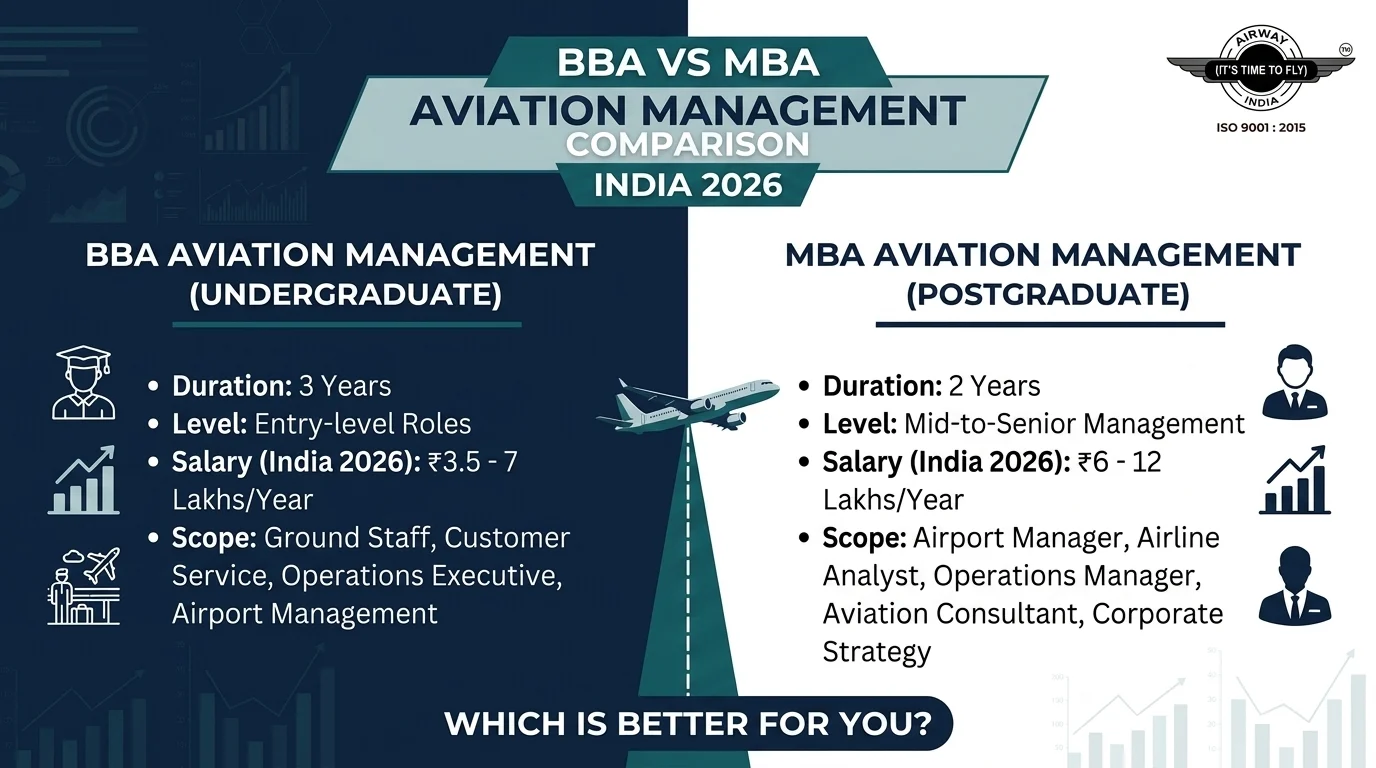
Before we go deeper, here's the most important table you need. Bookmark it.
| Feature | BBA in Aviation Management | MBA in Aviation Management |
|---|---|---|
| Level | Undergraduate (UG) | Postgraduate (PG) |
| Duration | 3 Years (6 Semesters) | 2 Years (4 Semesters) |
| Eligibility | 12th Pass (any stream, min 50%) | Any Bachelor's Degree |
| Focus Area | Airline & Airport Operations | Strategic Management & Leadership |
| Starting Salary (India) | ₹3.5L – ₹7L per annum | ₹6L – ₹12L per annum |
| Career Level | Entry to Mid-Level | Mid to Senior Management |
| Ideal For | Fresh 12th graduates | Working professionals or BBA graduates |
| Total Fees at Airway India | ₹3.93L – ₹3.99L (3 years) | ₹2L – ₹6L (2 years) |
| University Affiliation | Mangalayatan University | Mangalayatan University |
| Placement Assistance | 100% | 100% |
| Available at Airway India? | Yes | Yes |
Both programs are available right here at Airway India, Barasat, Kolkata. You don't need to look elsewhere.
What Is BBA in Aviation Management? — Course Structure & Career Path
BBA stands for Bachelor of Business Administration. The Aviation Management specialisation adds a completely different layer on top of standard business education — you're learning how airlines work, how airports are managed, how cargo moves, and how customer service functions in a high-pressure aviation environment.
At Airway India, our BBA in Aviation Management is a 3-year full-time undergraduate programme. It runs over 6 semesters, with classes 5 days a week. Students enter right after 12th grade, from any stream — Arts, Commerce, or Science.
What does the BBA syllabus cover?
The curriculum moves from foundational business concepts in Year 1 toward hands-on aviation knowledge in Years 2 and 3. Core subjects include:
- Fundamentals of Management and Business Communication
- Airline and Airport Operations
- Aviation Safety Regulations (DGCA-aligned)
- Airport Ground Handling and Cargo Management
- Customer Service in Aviation
- Aviation Logistics and Supply Chain
- Revenue Management for Airlines
- Aviation Law and ICAO Regulations
- Internship with airline or airport partners
In Year 3, students complete an industry internship — our partnerships with IndiGo, Air India, SpiceJet, and other airlines give Airway India students real access to actual airline environments. That experience is what sets a BBA graduate apart from someone who just studied theory.
Eligibility for BBA at Airway India:
• 12th pass from a recognised board
• Minimum 50% aggregate marks
• Age between 17–22 years
• No science background required
What Is MBA in Aviation Management? — Course Structure & Career Path
MBA in Aviation Management is a postgraduate degree. It's built for people who already hold a bachelor's degree and want to move into leadership and strategic roles within the aviation sector.
Our MBA in Aviation Management at Airway India runs for 24 months (4 semesters). It combines core MBA subjects — finance, strategy, marketing, HR — with aviation-specific modules that are directly relevant to how India's aviation sector works today.
What does the MBA syllabus cover?
- Strategic Management in Aviation
- Airline Finance and Revenue Optimisation
- Airport Business Development
- Aviation Policy, Safety and DGCA Compliance
- Human Resource Management in Airlines
- Aviation Risk Management
- International Aviation Law (ICAO & IATA frameworks)
- Leadership and Organisational Behaviour
- Capstone project with real industry data
The MBA programme at Airway India is led by DGCA-authorised professors and visiting faculty with actual airline and airport management backgrounds. Furthermore, every student gets access to our industry network — which is how most of our MBA graduates land management roles within 60–90 days of graduation.
Eligibility for MBA at Airway India:
• Any bachelor's degree (any stream)
• Graduates from BBA Aviation, BBA General, B.Com, B.Sc — all eligible
• Working professionals are welcome too
BBA vs MBA Aviation — Fee Comparison India 2026
Let's talk money, because that's what most families want to know first.
| Programme | Duration | Total Fees at Airway India | Per Year Cost |
|---|---|---|---|
| BBA Aviation Management | 3 Years | ₹3.93L – ₹3.99L | ₹1.23L – ₹1.31L |
| MBA Aviation Management | 2 Years | ₹2L – ₹6L | ₹1L – ₹3L |
These fees include tuition, lab access, aviation simulation training, and placement assistance. For exact fee breakdowns, visit our Aviation Course Fees Kolkata 2026 page or call us at +91 86970 38522.
Scholarship Options: We do have scholarship schemes available for eligible students. Check the Aviation Scholarship India 2026 page for current openings.
One important point — the MBA is shorter in duration (2 years vs 3 years), which means the total out-of-pocket cost difference is not as large as it appears. However, BBA students also have 3 years of earning potential from the day they graduate, which changes the ROI calculation significantly. We'll cover that below.
Salary After BBA in Aviation Management in India 2026
Here's what BBA Aviation Management graduates are earning right now in India.
| Job Role | Starting Salary (Fresher) | With 3–5 Years Experience |
|---|---|---|
| Airport Operations Executive | ₹3.5L – ₹5L p.a. | ₹7L – ₹10L p.a. |
| Airline Customer Service Manager | ₹4L – ₹6L p.a. | ₹8L – ₹12L p.a. |
| Ground Handling Supervisor | ₹3.5L – ₹5.5L p.a. | ₹7L – ₹10L p.a. |
| Cargo Executive | ₹3.5L – ₹5L p.a. | ₹6L – ₹9L p.a. |
| Ticketing and Revenue Manager | ₹4L – ₹6.5L p.a. | ₹8L – ₹13L p.a. |
These figures are based on current market data and placement records from our Kolkata campus. Roles at private airlines — IndiGo, Air India, Akasa Air — tend to offer the higher end of this range. Public sector roles at AAI (Airports Authority of India) typically come with additional benefits and job security.
The average starting salary for a BBA Aviation Management graduate in India ranges between ₹3.5 LPA and ₹7 LPA. With 3–5 years of experience, that figure climbs to ₹8L–₹13L, especially for those who move into supervisory and managerial positions.
What we've seen at Airway India is that students who complete their BBA internship at a real airline and get placed in an operational role often hit ₹6L+ within 12–18 months of graduation — because they come in with actual airport experience, not just a degree.
Salary After MBA in Aviation Management in India 2026
MBA graduates command a noticeably higher starting salary. But the salary progression also differs in a fundamental way — MBA graduates climb faster on the management track rather than the operational track.
| Job Role | Entry Salary (MBA Fresher) | Mid-Career (5–7 Years) |
|---|---|---|
| Airport Director (Asst.) | ₹7L – ₹10L p.a. | ₹18L – ₹28L p.a. |
| Airline General Manager | ₹8L – ₹12L p.a. | ₹20L – ₹35L p.a. |
| Aviation Strategy Consultant | ₹7L – ₹11L p.a. | ₹16L – ₹30L p.a. |
| Airline CFO / Finance Head | ₹10L – ₹14L p.a. | ₹25L+ p.a. |
| Civil Aviation Policy Manager | ₹7L – ₹9L p.a. | ₹15L – ₹22L p.a. |
The entry salary range for MBA Aviation Management graduates in India is ₹6L – ₹12L per annum at the fresher level. For professionals with an MBA plus 2–3 years of BBA-level work experience before the MBA, the entry point is often even higher — because they bring operational know-how into a management role.
India's aviation sector is creating between 2.5 to 5 lakh new aviation jobs annually, according to industry data. With three new airlines — Al Hind Air, FlyExpress, and Shankh Air — set to begin operations in 2026, and 18 greenfield airports planned with a ₹30,000 crore investment, the demand for senior aviation managers is sharper than ever. MBA graduates are the ones who fill those director-level and GM-level vacancies.
Career Scope: BBA vs MBA Aviation — Which Opens More Doors?
This is where the real comparison happens — not salaries, but career trajectories.
BBA opens more doors, faster. After completing BBA at 21–22 years of age, you're job-ready on Day 1. Airlines want young, trained operations staff. They want people who understand ground handling, cargo, customer service, and airport compliance. A BBA graduate with an Airway India placement walks into that role directly. That's a huge advantage if you want to start earning early and build experience.
Moreover, a BBA isn't just a starting point — it's also the best foundation for an MBA later. In our experience, students who complete BBA + 2 years of work + MBA end up in the top tier of aviation management in India. They have both theoretical depth and practical grounding, which is the combination that airlines and airport authorities actively recruit for.
MBA opens higher doors. If your goal is to lead an airline department, manage an airport, or get into aviation consulting or finance, the MBA is non-negotiable. You won't get considered for Airport Director or Airline GM positions without a postgraduate degree. The salary ceiling for BBA graduates, without an MBA, typically plateaus around ₹15L–₹18L even with 10 years of experience. MBA graduates can break through to ₹25L–₹35L+ in the same timeframe.
So, to put it simply: BBA gets you in the industry fast, and MBA gets you to the top of that same industry.
Top Job Roles After BBA Aviation Management in India
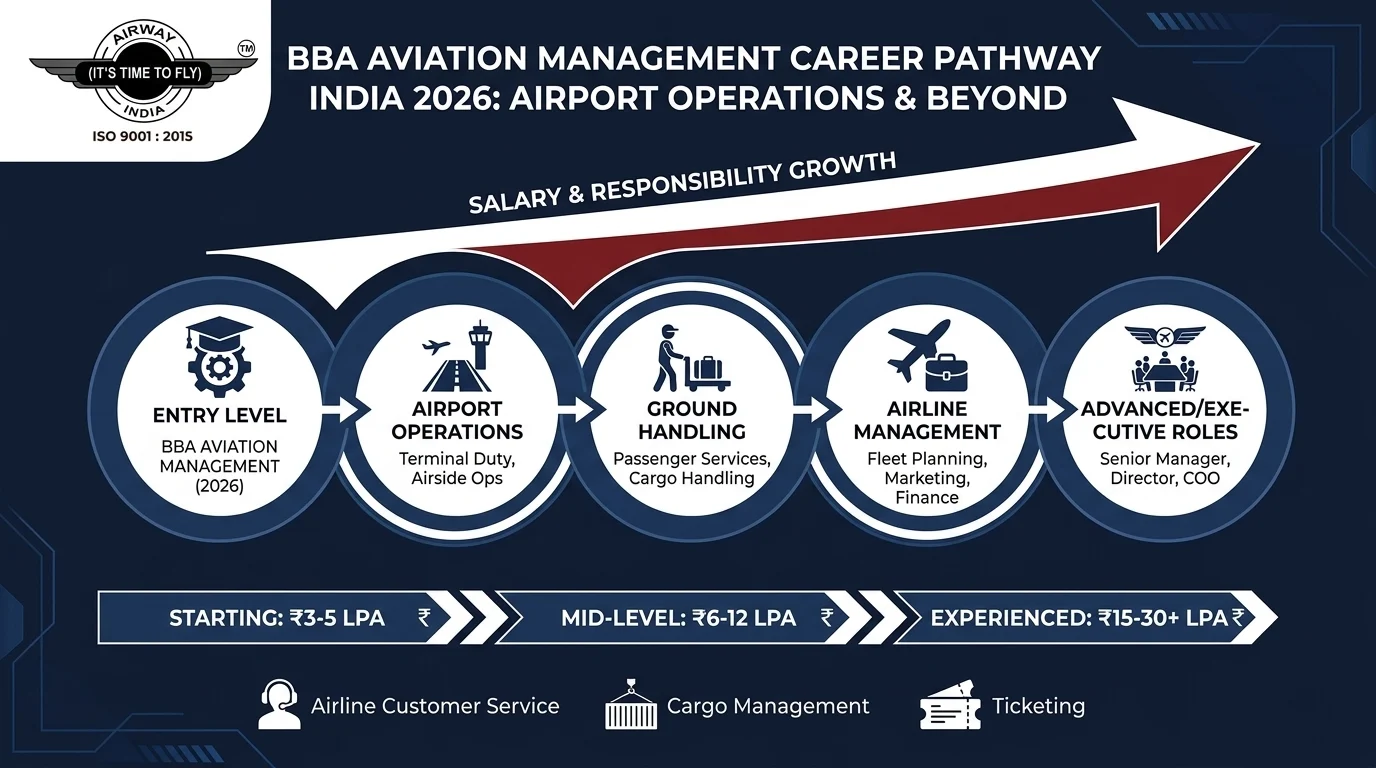
After completing BBA in Aviation Management, graduates typically move into the following operational and supervisory roles:
- Airport Operations Executive Manages daily airport operations — gate assignments, passenger flow, delay management, and coordination between airlines and ground teams. One of the most in-demand roles at NSCBI and other major Indian airports.
- Airline Customer Service Manager Handles passenger experience across check-in, boarding, and complaints. IndiGo, Air India, and Akasa Air actively recruit for this role from Airway India's placement pool.
- Ground Handling Supervisor Oversees ramp operations, baggage handling, and turnaround coordination. A critical role with clear promotion tracks into senior airport management.
- Cargo Executive Works with freight operations, customs coordination, and logistics for airline cargo divisions. Demand is particularly strong with international carriers operating out of Kolkata.
- Ticketing and Revenue Manager Manages fare structures, booking systems, and revenue optimisation for airline sales teams. Strong analytical roles with good growth potential.
- Aviation Safety Officer (Entry-Level) Ensures DGCA compliance on the ground, monitors safety protocols, and reports to airport safety managers.
For a detailed list of aviation job opportunities, visit our Aviation Jobs After BBA India 2026 page.
Top Job Roles After MBA Aviation Management in India
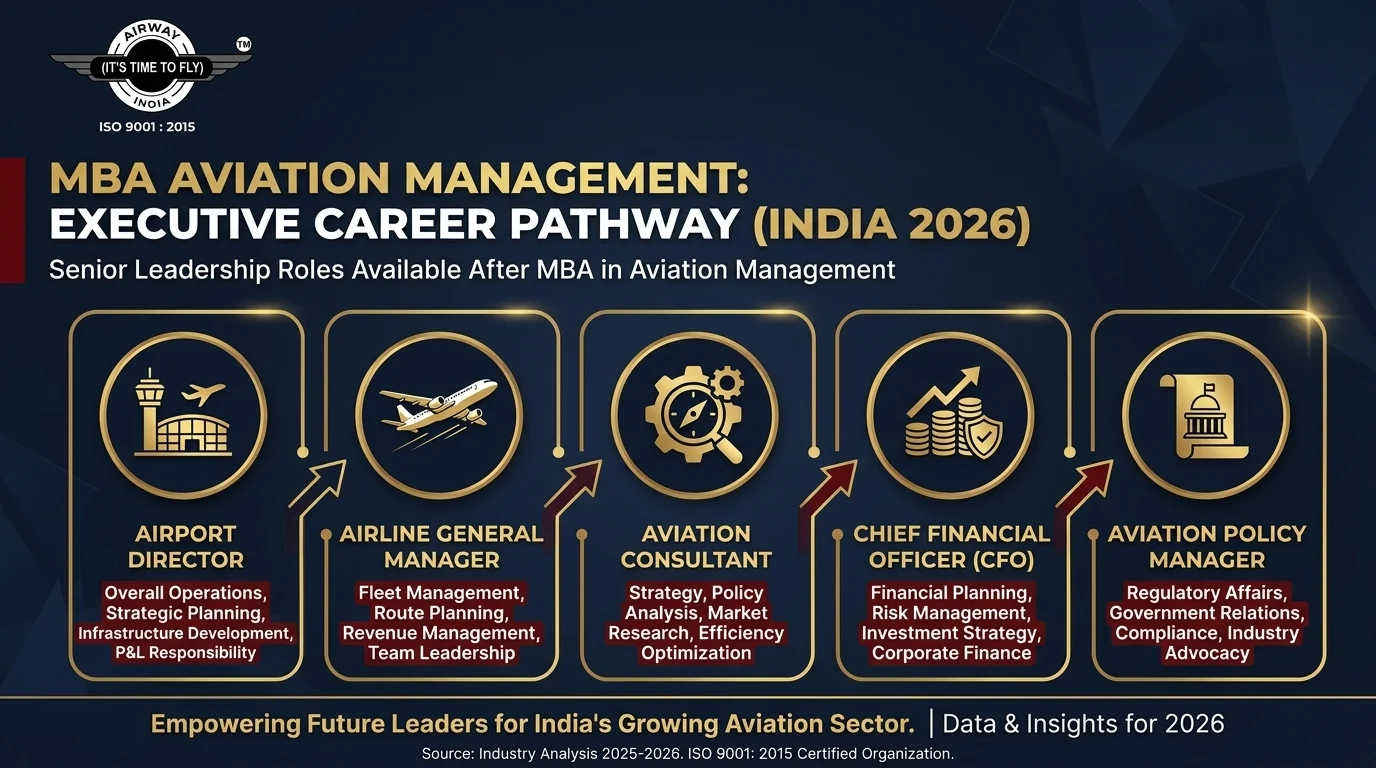
MBA graduates in Aviation Management target leadership positions that simply aren't accessible at the BBA level:
- Airport Director / Deputy Director The person who runs an airport's entire operations, commercial activity, and regulatory compliance. AAI and private concessionaires (like GMR, GVK) both hire MBA aviation managers for this track.
- Airline Vice President — Operations VP-level roles in airlines manage fleets, schedules, crew, and operational efficiency across hundreds of flights daily. These are ₹20L+ roles.
- Aviation Strategy Consultant Consulting firms like Booz Allen, KPMG, and aviation-specific boutiques hire MBA aviation graduates to advise airline boards and government authorities on expansion, policy, and efficiency.
- Airline Chief Financial Officer (CFO) Airlines are complex financial organisations. MBA graduates who combine aviation knowledge with finance skills are rare — and very well compensated.
- Civil Aviation Policy Manager Roles in DGCA, AAI, AICTE aviation committees, and the Ministry of Civil Aviation are available to MBA aviation graduates with strong academics and communication skills.
- IATA Training & Standards Manager IATA (International Air Transport Association) certifies and trains aviation professionals worldwide. MBA graduates from AICTE-approved programmes are eligible for these global roles.
ROI Analysis — Which Has Better Return on Investment in India?
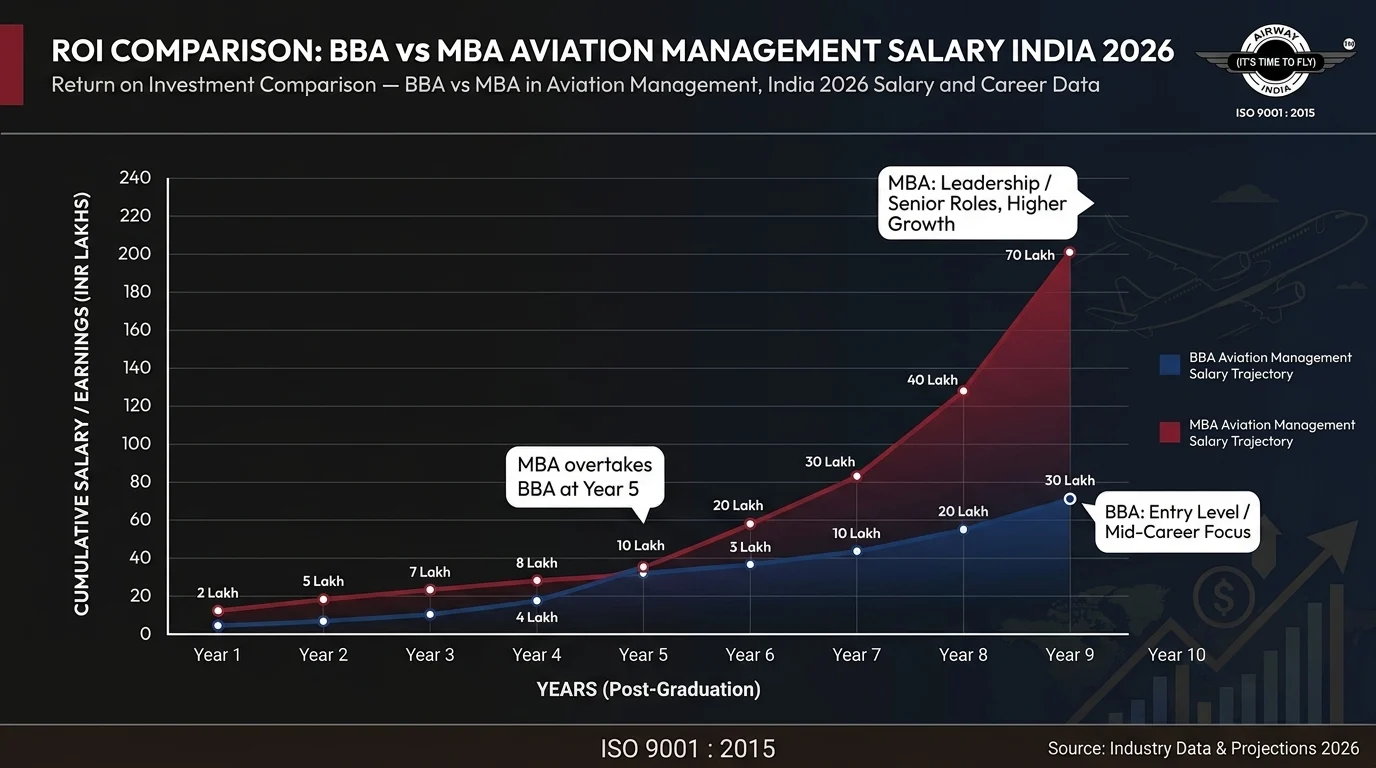
Let's run through a real break-even analysis. We do this regularly with students at Airway India when they're deciding between BBA and MBA.
BBA Path:
- 3 years of education (age 18–21)
- Starting salary: ₹5L per annum
- By Year 5 (age 26): earning ~₹7L–₹9L p.a.
- Total earnings by Year 5 from work: ~₹22L–₹28L
- Total invested in education: ₹3.93L – ₹3.99L
MBA Path (after a different degree):
- 2 years of education after graduation (age 22–24)
- Starting salary: ₹8L–₹10L p.a.
- By Year 5 from graduation (age 29): earning ~₹14L–₹18L p.a.
- Total invested in education: ₹2L–₹6L
BBA → Work → MBA Path (Airway India's recommended route):
- 3 years BBA (age 18–21) → 2 years work experience → 2 years MBA (age 23–25)
- Start MBA salary: ₹10L–₹14L p.a. (work experience adds a premium)
- By Year 5 from MBA graduation (age 30): ₹20L–₹28L p.a.
- This is the highest-earning trajectory by age 35.
The break-even point, if you go straight to MBA, is around Year 5 — because your higher salary compensates for the extra education cost. However, the BBA-to-MBA route consistently produces the highest earners in aviation management in the long term. The combination of operational experience and strategic education is simply the most valuable profile an airline or airport authority can hire.
Can You Do MBA After BBA in Aviation Management?
Yes. And honestly, in our opinion, it's the best career path in Indian aviation right now.
Here's exactly how it works:
- Complete BBA in Aviation Management at Airway India (3 years)
- Get placed through our 100% placement assistance — work 2–3 years in an operational role
- Return for MBA in Aviation Management (2 years)
- Graduate with a mix of management credentials + real industry experience
This combination is exactly what senior recruiters at IndiGo, Air India, and airport operators look for. When we place MBA graduates who came through our BBA programme first, they consistently get better offers than MBA-only candidates from comparable institutions.
Why? Because they can answer operational questions from personal experience. They've handled a flight delay. They've managed ground staff. They've coordinated with ATC during disruptions. That knowledge is worth more to an airline than any textbook.
Airway India, as one of the few institutions in Kolkata that offers both BBA and MBA in Aviation Management, is positioned to support your complete journey — from your 12th grade through to your senior management career.
Which Is Better — BBA or MBA Aviation for Kolkata Job Market?
Both, but in different ways. Let's be direct about what's happening in Kolkata's aviation sector right now.
NSCBI (Netaji Subhas Chandra Bose International) Airport is undergoing major capacity expansion — from 26 million to 45 million passengers. That expansion directly means more staff, more supervisory roles, and more management positions. AAI is already advertising for new positions.
Furthermore, IndiGo, Air India, and Akasa Air have expanded their Kolkata operations significantly. Ground handling companies like Air India SATS are scaling up. Cargo volumes through Kolkata are growing as the city becomes a transit hub for North-East India.
For BBA graduates from Airway India in Barasat — the college is just 20 minutes from NSCBI Airport. We've built specific placement partnerships for Kolkata airport roles, and our students regularly get placed in operational positions at the airport and at airlines operating out of Kolkata.
For MBA graduates, the Kolkata market offers airport management roles, airline regional headquarters positions, and consulting opportunities tied to the city's growing aviation infrastructure. Additionally, many of our MBA alumni have gone on to take leadership positions with AAI, BCAS, and private airport operators across India.
Visit us at 18, 1, Jessore Rd, Rathtala, Barasat, Kolkata — 700124. Call +91 86970 38522 or find us on Google Maps to arrange a campus visit and talk to our counsellors in person.
Shiksha.com also provides a good reference for aviation career scope and salary benchmarks in India if you want a third-party perspective.
BBA vs MBA Aviation — Our Verdict Based on Your Goal
We've advised hundreds of students through this exact decision. Here's how we frame it:
Choose BBA in Aviation Management if:
• You've just completed 12th and want to enter the aviation workforce quickly
• You want to build operational knowledge before moving to management
• Budget is a key factor and you want to start earning at 21
• You plan to do MBA later, after gaining work experience
Choose MBA in Aviation Management if:
• You already hold a bachelor's degree (any field)
• You're a working professional looking to move into management
• Your career goal is Airport Director, Airline GM, or Aviation Consultant
• You want to target senior roles in AAI, DGCA, or international organisations
Our recommendation, as a team? If you're choosing right after 12th — start with BBA. Don't skip the foundation. The industry respects operational experience. Then, after 2–3 years of work, come back for the MBA. That path consistently produces the strongest aviation management careers we've seen from Airway India graduates.
However, if you're already a graduate or a professional — go straight to MBA. Don't repeat what you've already done.
For personalised counselling, message us on WhatsApp at +91 91877770 6299 or email info@airwayindia.in. Our admissions team responds within the same working day.