Introduction
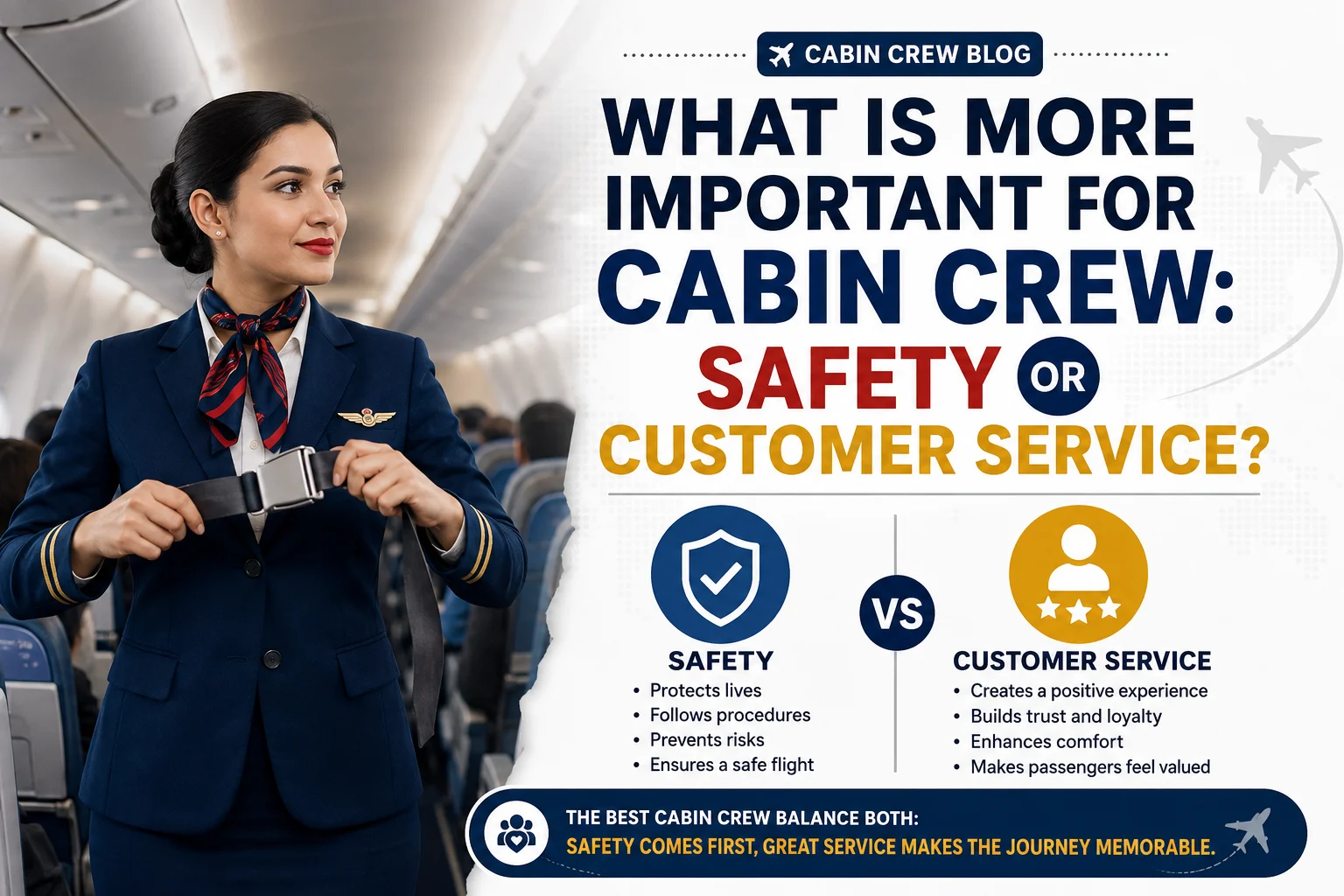
One of the most important questions asked during a cabin crew interview is: “What is more important—safety or customer service?” Although both are essential to the airline industry, the correct answer is clear: safety must always come first.
Cabin crew members are responsible for much more than serving food, helping passengers, or creating a pleasant travel experience. Their primary responsibility is to protect passengers and crew by following established safety procedures and responding appropriately during emergencies.
At the same time, putting safety first does not mean ignoring customer service. A professional cabin crew member should be able to maintain safety standards while delivering polite, empathetic, and efficient service.
The real challenge is therefore not simply choosing between safety or customer service. It is learning how to prioritize safety while using excellent customer service skills to handle safety-related situations professionally.
1. Why Safety Is More Important Than Customer Service in Aviation
When discussing safety or customer service, safety must always take priority because aviation involves situations where a small mistake can have serious consequences.
Customer service focuses on passenger satisfaction, comfort, and convenience. Safety, on the other hand, protects passengers from potential injury or danger. If the two ever come into conflict, safety procedures must take precedence.
Cabin crew members are trained to follow specific procedures rather than make decisions based solely on what a passenger wants.
Some examples include:
- Ensuring passengers follow seatbelt instructions.
- Conducting required safety checks.
- Ensuring emergency exits remain accessible.
- Following procedures during turbulence.
- Managing emergency evacuations.
- Preventing passengers from carrying or using prohibited items.
- Following instructions from the flight crew during abnormal situations.
Example 1: A Passenger Wants to Walk During Turbulence
Imagine a passenger wants to visit the washroom while the aircraft is experiencing significant turbulence. The passenger may become frustrated when the cabin crew asks them to remain seated.
From a customer-service perspective, allowing the passenger to move might appear helpful. However, from a safety perspective, allowing them to walk during severe turbulence could expose them to injury.
The cabin crew should therefore politely explain the situation and ask the passenger to remain seated until it is safe to move.
The solution is not to sacrifice customer service for safety. It is to communicate the safety requirement with empathy and professionalism.
2. How Safety and Customer Service Work Together
The debate about safety or customer service can sometimes create the impression that airlines have to choose one over the other. In reality, excellent cabin crew members combine both.
Safety establishes what must be done, while customer service determines how it should be communicated.
For example, a cabin crew member may need to tell a passenger that their oversized baggage cannot remain in the cabin. The safety requirement is non-negotiable, but the communication does not have to be unpleasant.
A professional response could involve:
- Listening to the passenger’s concern.
- Explaining the reason for the restriction.
- Remaining calm and respectful.
- Offering an appropriate alternative.
- Avoiding unnecessary confrontation.
- Following company procedures consistently.
This approach solves the passenger’s problem without compromising safety.
The key principle is simple:
Safety determines the decision; customer service determines the way you deliver that decision.
This is particularly important during difficult situations. Passengers may not always understand why a particular instruction is necessary. A calm explanation can turn a potentially negative interaction into a positive experience.
3. Safety or Customer Service: What Should Cabin Crew Do Under Pressure?
Cabin crew members frequently have to make decisions while dealing with pressure, time constraints, and demanding passengers. This is where understanding safety or customer service becomes especially important.
Suppose a passenger complains because the crew has stopped the meal service due to turbulence. The passenger may be hungry, impatient, or unhappy about the delay.
The cabin crew should not resume service simply to satisfy the passenger. Instead, they should explain that the service has been temporarily suspended because the conditions are unsafe.
A good problem-solving approach is:
- Assess the situation according to established procedures.
- Prioritize passenger safety.
- Communicate the reason clearly.
- Acknowledge the passenger’s inconvenience.
- Provide an alternative when possible.
- Resume normal service only when it is safe to do so.
Example 2: Hot Beverage During Turbulence
Consider a passenger asking for a cup of hot coffee while the aircraft is experiencing turbulence.
The passenger might consider the refusal poor customer service. However, serving a hot beverage in unstable conditions could create a burn risk.
Instead of simply saying “No,” the crew member can explain:
“I’d be happy to serve you the coffee once the turbulence settles and it is safe for us to move around the cabin.”
This response protects the passenger while maintaining a positive service experience.
The lesson is important for cabin crew candidates: saying no can still be excellent customer service when the reason is passenger safety and the communication is respectful.
4. How Excellent Customer Service Supports Aviation Safety
When considering safety or customer service, customer service should not be viewed as something separate from safety. Good communication can actually make safety procedures more effective.
Passengers are more likely to cooperate when instructions are delivered clearly and respectfully.
For example, during an emergency or safety-related situation, a calm cabin crew member can help passengers:
- Understand what they need to do.
- Remain calm.
- Follow instructions quickly.
- Avoid unnecessary panic.
- Ask questions when clarification is required.
- Cooperate with the crew.
Example 3: An Emergency Evacuation
During an emergency evacuation, cabin crew cannot focus on keeping every passenger happy. Their priority is to move passengers to safety as quickly and efficiently as possible.
A passenger might want to collect their handbag, mobile phone, or luggage before leaving the aircraft. The cabin crew must firmly instruct them to leave their belongings behind.
This may appear less customer-friendly in the moment, but it is the correct professional response.
The best approach combines firmness with respectful communication:
- Give clear instructions.
- Use a confident voice.
- Avoid unnecessary arguments.
- Keep passengers moving toward the appropriate exit.
- Follow emergency procedures.
- Prioritize life safety over personal belongings.
In such circumstances, good customer service means helping passengers understand and follow the safety requirement—not allowing them to do whatever makes them comfortable.
5. Safety or Customer Service: The Best Answer for a Cabin Crew Interview
If an interviewer asks, “What is more important—safety or customer service?”, a strong candidate should avoid saying that customer service is unimportant.
The best answer demonstrates that the candidate understands the relationship between the two.
You could answer:
“Safety is more important because the primary responsibility of cabin crew is to protect passengers and crew. However, I believe excellent customer service should always accompany safety. If I have to choose between a passenger’s preference and a safety procedure, I will always follow the safety procedure. At the same time, I will communicate the decision politely, explain the reason when appropriate, and try to provide an alternative solution.”
This answer demonstrates several qualities that airlines look for:
- Safety awareness
- Professionalism
- Communication skills
- Emotional control
- Problem-solving ability
- Passenger orientation
- Understanding of cabin crew responsibilities
The most important thing is not to memorize the answer word-for-word. Interviewers may ask follow-up questions to determine whether you genuinely understand the principle.
For instance, they may ask:
“What if a passenger becomes angry because you refused their request?”
A strong response would be:
“I would remain calm, listen to the passenger, explain the safety reason behind the decision, and offer an alternative if one is available. I would never compromise a safety procedure simply to satisfy a passenger.”
That demonstrates practical understanding rather than a rehearsed response.
Conclusion
So, what is more important—safety or customer service? The answer is safety, particularly in aviation where decisions can directly affect passenger and crew wellbeing.
However, choosing safety does not mean compromising professionalism or treating passengers poorly. The best cabin crew members understand how to combine both priorities.
Safety tells cabin crew what must be done, while customer service determines how they communicate and manage the situation.
A successful cabin crew professional should therefore:
- Put safety before passenger convenience.
- Follow established procedures consistently.
- Remain calm under pressure.
- Communicate safety requirements clearly.
- Treat passengers with patience and respect.
- Look for safe alternatives to solve passenger problems.
- Never compromise safety to avoid a complaint.
Ultimately, airlines do not need to choose between safe operations and excellent service. The strongest cabin crew members deliver excellent customer service within the boundaries of safety.
The simple rule to remember is: safety comes first, but safety should always be delivered with professionalism, empathy, and excellent customer service.