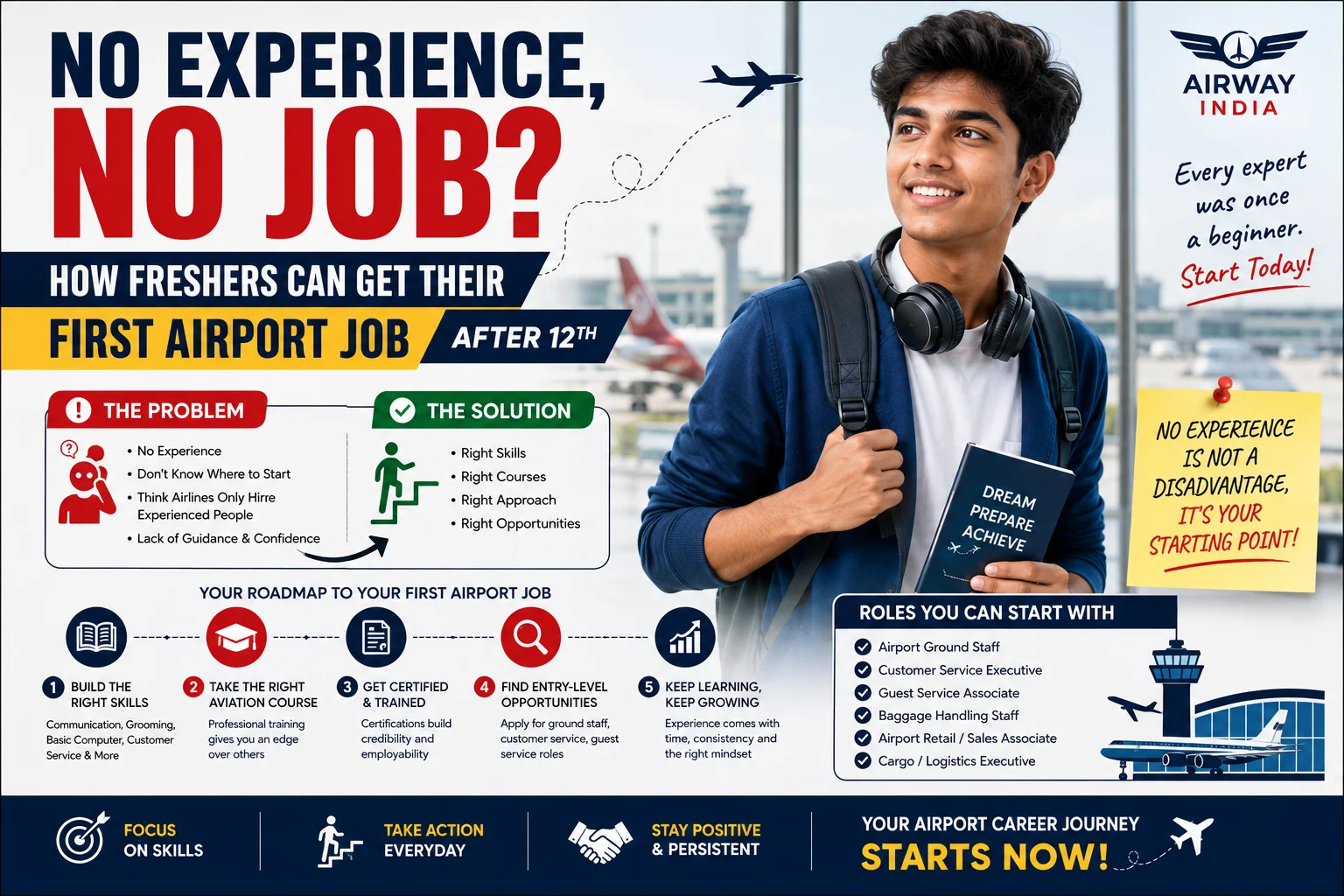
No Experience, No Job? The Real Problem Behind Your First Airport Job After 12th
You have completed 12th, you want to work at an airport, and you start searching for vacancies. Then you see the same problem again and again: experience required. It can feel like a trap. If employers want experience, how is a fresher supposed to get the first opportunity?
The good news is that entry-level airport jobs do exist, but getting your first role is not simply about sending hundreds of resumes. You need to understand which positions are realistic for freshers, build the skills employers value, present those skills properly and prepare for the selection process.
This guide takes a practical problem-solving approach. Instead of telling you to “work hard” or “apply everywhere,” it shows you what to do when you have no experience and want your first airport job after 12th.
1. Choose the Right Airport Job After 12th for a Fresher
One of the biggest mistakes freshers make is treating “airport job” as one single career. Airports have many departments and employers, and the eligibility requirements can differ from one position to another. If you apply randomly, you may spend weeks applying for jobs that do not match your profile.
Start by identifying entry-level aviation roles that fit your education, communication ability and interests. Depending on the employer and vacancy, freshers may find opportunities in areas such as ground operations, customer service, passenger assistance, ticketing support, baggage-related services and other airport support functions.
- Read the complete job description before applying.
- Check the stated education and experience requirements.
- Look for roles explicitly open to freshers or entry-level candidates.
- Understand whether the position is directly with an airline, airport operator, ground-handling company or another service provider.
- Apply only when your genuine profile matches the vacancy.
Example: Rahul has completed 12th and has no formal work experience. Instead of applying randomly for senior airport operations positions, he targets entry-level passenger-service opportunities where his communication, basic computer skills and customer-handling ability can be relevant. His applications become more focused and realistic.
2. Build Skills That Can Replace “Experience” on Your Airport Job After 12th Resume
Being a fresher does not mean your resume has to look empty. The key is to demonstrate job-ready skills instead of pretending that you have experience you do not have.
For many customer-facing and support roles, employers may value communication, teamwork, basic computer knowledge, problem-solving, professional behaviour and the ability to interact respectfully with passengers. You can build evidence of these abilities through education, volunteering, internships, projects, part-time activities and structured training.
- Communication: practise clear spoken English and professional conversation.
- Customer service: learn how to listen, respond politely and handle common complaints.
- Computer skills: become comfortable with email, documents, spreadsheets and basic digital tools.
- Teamwork: use examples from college, school activities, sports or volunteering.
- Professional presentation: improve grooming, punctuality and workplace etiquette.
- Airport knowledge: understand basic terminology, passenger processes and the responsibilities of your target role.
Do not simply write “excellent communication” under skills. Show where you used it. For example: “Coordinated registration and assisted participants during a college event.” That statement gives a recruiter evidence of communication and people-handling ability.
3. Fix Your Resume Before Applying for an Airport Job After 12th
A fresher resume does not need to be packed with information. It needs to make your suitability obvious quickly. If a recruiter cannot understand your target role and relevant strengths within a short scan, your application can lose attention.
Build the resume around the airport role you actually want. If you are applying for customer-facing work, place communication, customer service, language and computer skills where they are easy to find. If you have completed relevant training, mention it clearly rather than hiding it at the bottom.
- Use a clear professional headline.
- Write a short career objective related to the target airport role.
- Highlight relevant education and certifications.
- Use specific examples from projects, volunteering or internships.
- Keep formatting clean and consistent.
- Proofread your phone number, email address, spelling and grammar.
- Save the final version as a professional PDF unless the employer requests another format.
Example: Instead of an objective such as “I am looking for a challenging job in a reputed company,” a stronger version is: “12th-pass fresher seeking an entry-level airport customer-service role where I can use my communication, interpersonal and basic computer skills while building a long-term career in aviation.”
4. Get Practical Preparation Before Your First Airport Job After 12th Interview
Many freshers focus only on finding vacancies and forget that getting shortlisted is only the first step. If you reach the interview without understanding the role, your chances of selection may still be low.
You do not need to sound like an aviation expert. You do need to demonstrate that you understand what the job involves and that you are willing to learn. Spend time preparing answers for common questions and practise speaking naturally rather than memorising long scripts.
- Prepare a strong answer to “Tell me about yourself.”
- Know why you want to work in aviation.
- Understand the responsibilities of the specific airport role.
- Practise customer-service and difficult-passenger scenarios.
- Prepare examples that demonstrate teamwork and responsibility.
- Research the employer before attending the interview.
- Practise your posture, eye contact, speaking pace and confidence.
Example: If an interviewer asks, “What would you do if a passenger is angry about a delay?”, do not stop at “I would be polite.” Explain that you would listen calmly, acknowledge the concern, provide accurate information within your authority and follow the organisation’s procedure or escalate the matter when necessary.
5. Apply Strategically to Airport Jobs After 12th Instead of Applying Everywhere
When you are desperate for your first job, it is tempting to send the same resume to every vacancy you find. More applications do not automatically mean more opportunities. Poorly matched applications can waste time and make it harder to improve your approach.
Create a simple job-search system. Track the employer, position, eligibility requirements, application date and result. Tailor your resume when the role has different priorities, and use reliable recruitment channels rather than paying unknown people for guaranteed jobs.
- Create a list of target employers and relevant entry-level roles.
- Check official recruitment pages and verified vacancy information.
- Tailor your resume to the role.
- Keep a record of applications and interview outcomes.
- Follow up professionally where appropriate.
- Never pay someone simply because they promise a guaranteed airport job.
Think of your first airport job search as a process of improvement. If ten applications produce no interviews, do not simply send another fifty. Review your eligibility, resume, skills, job targeting and interview readiness first.
What to Do If You Keep Getting Rejected for an Airport Job After 12th
Repeated rejection can make you believe that aviation is not for you. But rejection is information. Your job is to find the part of the process that needs improvement.
- No interview calls? Review your resume and job targeting.
- Getting interviews but failing them? Improve answers, confidence and role knowledge.
- Struggling with communication? Practise speaking every day and record yourself.
- Missing required skills? Take relevant training and build practical evidence.
- Applying for unsuitable roles? Recheck eligibility before submitting applications.
For example, if you receive interview invitations but repeatedly fail at the interview stage, creating another resume is unlikely to solve the real problem. In that situation, focus on mock interviews, communication practice, customer-service scenarios and feedback on your presentation.
A Simple 30-Day Plan to Prepare for Your First Airport Job After 12th
If you are starting from zero, use the next 30 days to become more job-ready instead of waiting for the perfect vacancy.
- Days 1–5: Choose your target airport role and understand its eligibility requirements.
- Days 6–10: Build or rewrite your fresher resume.
- Days 11–17: Practise communication, customer service and basic computer skills.
- Days 18–22: Study common interview questions and airport-role scenarios.
- Days 23–26: Record mock interview answers and correct weak areas.
- Days 27–30: Start targeted applications and continue interview preparation.
The goal is not to become perfect in 30 days. The goal is to move from “I have no experience” to “I can demonstrate relevant skills, understand the role and explain why I am prepared for it.”
Conclusion: Your First Airport Job After 12th Starts With Preparation
Having no experience can make your first airport job after 12th seem out of reach, but lack of experience does not mean lack of potential. Your first objective is to identify realistic entry-level roles, understand their requirements and build skills that demonstrate your readiness.
Then turn those skills into a targeted resume, prepare properly for interviews and apply strategically. If you face rejection, diagnose the problem instead of blindly increasing the number of applications.
Your first aviation opportunity may not happen immediately. But with the right skills, preparation and a focused job-search strategy, you can give yourself a much stronger chance of getting that first step into the aviation industry.