Failed a Cabin Crew Interview? Start by Finding the Real Problem
You prepared your documents, dressed professionally, reached the venue on time and walked into the cabin crew interview believing you were ready. Then came the rejection. No clear explanation. No second chance. Just a message that says you were not selected.
It is easy to conclude that you are not good enough for a cabin crew career. But rejection does not always mean you lack potential. Sometimes, a few avoidable mistakes in your cabin crew interview preparation can prevent recruiters from seeing your strengths.
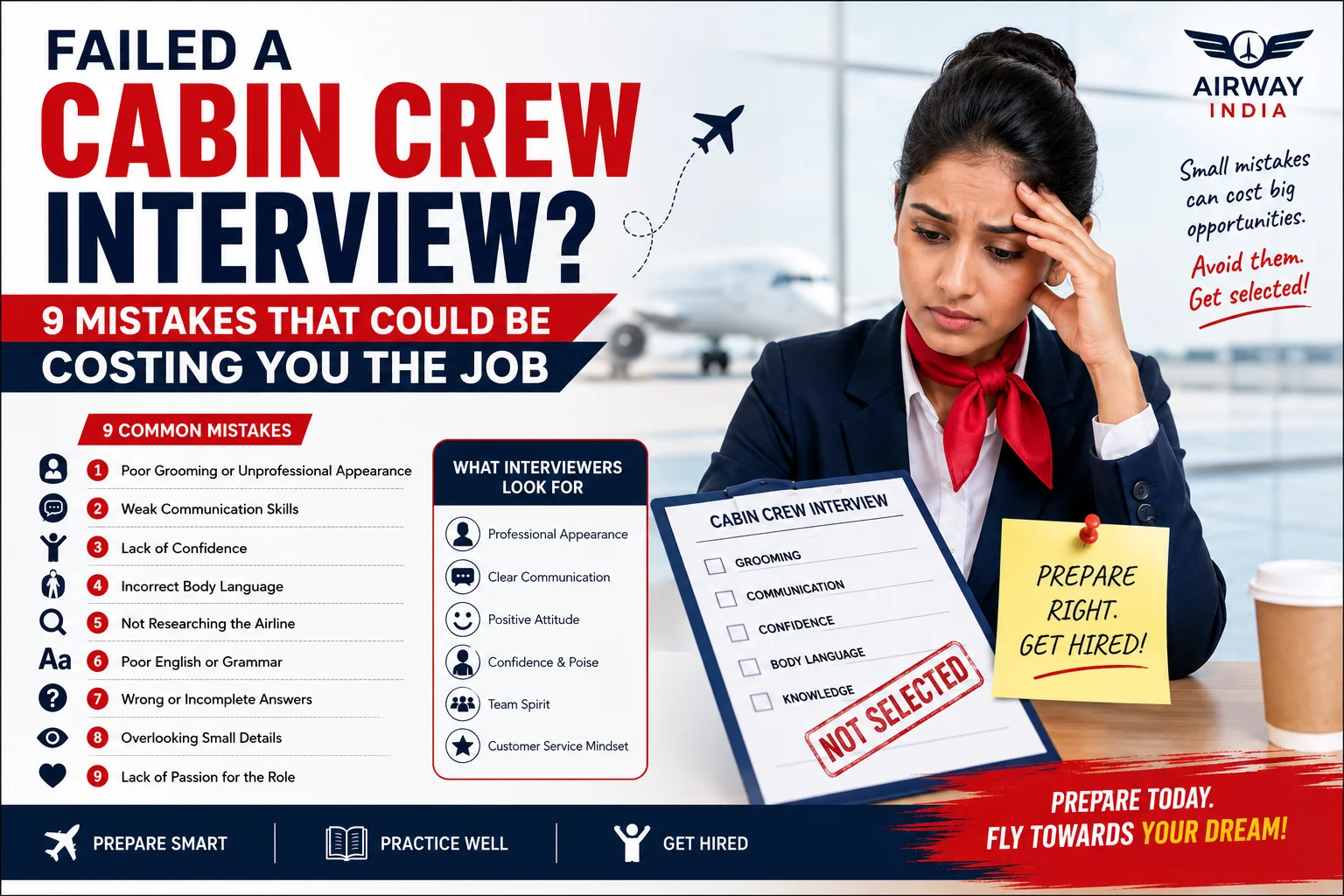
The good news is that interview performance can be improved. Instead of attending the next interview with the same approach, identify what went wrong, practise deliberately and turn each weakness into a strength. Here are nine common mistakes and, more importantly, what you can do about them.
Cabin Crew Interview Mistakes in Your Answers and Preparation
The first problem is often not what you say, but how prepared you are to answer basic questions naturally. Recruiters can quickly notice when a candidate has memorised lines without understanding the role.
1. Giving memorised answers
There is nothing wrong with practising common cabin crew interview questions. The problem begins when every answer sounds rehearsed. A memorised response can become difficult to adapt when the interviewer asks a follow-up question.
- Understand the point you want to communicate instead of memorising sentences.
- Prepare examples from your studies, work, volunteering or everyday experiences.
- Practise answering the same question in different ways.
2. Not knowing why you want to become cabin crew
If your answer is simply “I love travelling,” it may sound superficial. A strong candidate should understand that cabin crew work involves passenger safety, service, teamwork, communication and responsibility—not just visiting different destinations.
Example: Instead of saying, “I want this job because I love travelling,” explain that you enjoy interacting with people, staying calm in demanding situations and want a career where service and responsibility are important.
3. Giving vague answers to customer-service questions
Questions about difficult passengers are designed to understand your judgement and communication skills. Saying “I will handle the passenger politely” is too general. Explain what you would actually do.
- Listen without interrupting.
- Stay calm and acknowledge the passenger’s concern.
- Follow company procedures and seek assistance when necessary.
- Keep safety and professionalism as priorities.
Cabin Crew Interview Mistakes in Communication and Body Language
Even a strong answer can lose impact if your voice, posture and facial expressions communicate nervousness or disinterest. Cabin crew communication skills are assessed through the entire interaction, not only through your spoken answers.
4. Speaking too softly, too quickly or without confidence
Many candidates become nervous and rush through their answers. Others speak so softly that the interviewer has to ask them to repeat themselves. Neither means you are incapable, but both can weaken the impression you create.
- Pause for a second before answering.
- Speak at a comfortable pace.
- Use clear, simple English rather than complicated words.
- Practise speaking while maintaining natural eye contact.
5. Weak eye contact and nervous body language
Looking constantly at the floor, crossing your arms, fidgeting with your hands or avoiding eye contact can make you appear uncomfortable. You do not need to look perfectly confident; you need to appear composed and engaged.
Before your next cabin crew interview, record yourself answering five common questions. Watch the recording without judging your appearance. Check whether you sit upright, smile naturally, maintain reasonable eye contact and use controlled gestures.
Cabin Crew Interview Mistakes in Grooming and Professional Presentation
Professional presentation matters in cabin crew recruitment because the role involves representing an airline while interacting with passengers. The goal is not expensive clothing or heavy makeup. It is a neat, professional and role-appropriate appearance.
6. Treating grooming as an afterthought
Untidy hair, wrinkled clothing, dirty footwear, excessive accessories or an appearance that does not follow the interview instructions can distract from your strengths. Always check the employer’s specific recruitment guidelines because requirements can differ between airlines and hiring events.
- Wear clean, well-fitted professional clothing.
- Keep hair neat and presentation polished.
- Choose simple, professional accessories.
- Maintain clean shoes and nails.
- Follow any airline-specific grooming instructions provided for the assessment.
7. Ignoring your first impression
Your interview begins before the first formal question. How you enter the room, greet the panel, wait for instructions and interact with staff can influence the overall impression. Professionalism should be consistent from arrival to departure.
Example: Imagine two candidates with similar qualifications. Candidate A enters hurriedly, avoids greeting the panel and immediately sits down. Candidate B greets the panel politely, waits for instructions and maintains calm, respectful behaviour. The second candidate is already demonstrating interpersonal skills relevant to a customer-facing role.
Cabin Crew Interview Mistakes That Reveal Poor Role Awareness
Recruiters are not simply looking for someone who looks suitable for an airline. They want candidates who understand the responsibilities of the position and can work professionally with passengers and colleagues.
8. Focusing only on salary, travel and glamour
Salary, travel benefits and the opportunity to visit different places can be legitimate attractions, but making them the centre of your interview can create the wrong impression. A cabin crew career also requires discipline, teamwork, irregular working hours, customer service and a strong focus on safety.
Show that you understand both the attractive and demanding sides of the profession. A balanced answer demonstrates maturity.
9. Not researching the airline or the role
Walking into a cabin crew interview without researching the airline is an avoidable mistake. You should have a basic understanding of the airline, its service approach, route network and the role you are applying for. You do not need to memorise its entire history, but you should be able to explain why you are interested in that organisation.
- Read the official recruitment information.
- Understand the advertised role and eligibility requirements.
- Learn basic facts about the airline.
- Prepare a genuine answer for “Why do you want to join us?”
How to Fix Your Cabin Crew Interview Performance Before Your Next Attempt
Do not respond to rejection by simply applying again. Use the rejection as feedback and create a short improvement plan. Your objective is to make the next cabin crew interview noticeably better than the previous one.
- Step 1: Write down every question you remember from the previous interview.
- Step 2: Identify three answers where you felt particularly weak.
- Step 3: Rewrite those answers using real examples rather than memorised scripts.
- Step 4: Record yourself answering questions and review your communication and body language.
- Step 5: Practise a mock interview with someone who will give honest feedback.
- Step 6: Prepare your professional outfit and documents in advance.
- Step 7: Research the airline and review the job requirements before applying.
For example, if your previous interview went badly because you froze when asked about a difficult passenger, do not simply memorise a new answer. Practise several customer-service scenarios. That way, you learn how to think through the situation rather than depend on one script.
Likewise, if English communication is your biggest challenge, spend 15–20 minutes each day speaking answers aloud. Focus on clarity and confidence, not on using complicated vocabulary.
Conclusion: Turn Cabin Crew Interview Rejection Into Better Preparation
Failing a cabin crew interview can be discouraging, especially when you have invested time and hope into the opportunity. But rejection does not have to be the end of your aviation journey.
Start by identifying the actual problem. Maybe your answers were memorised, your communication lacked confidence, your body language showed nervousness, your grooming needed improvement or you simply had not researched the airline. These are practical issues that can be worked on.
The solution is not to become a completely different person. It is to present your genuine personality with better preparation, clearer communication and a stronger understanding of the cabin crew job. Prepare differently for your next interview, and give yourself a better chance to show what you can actually do.